
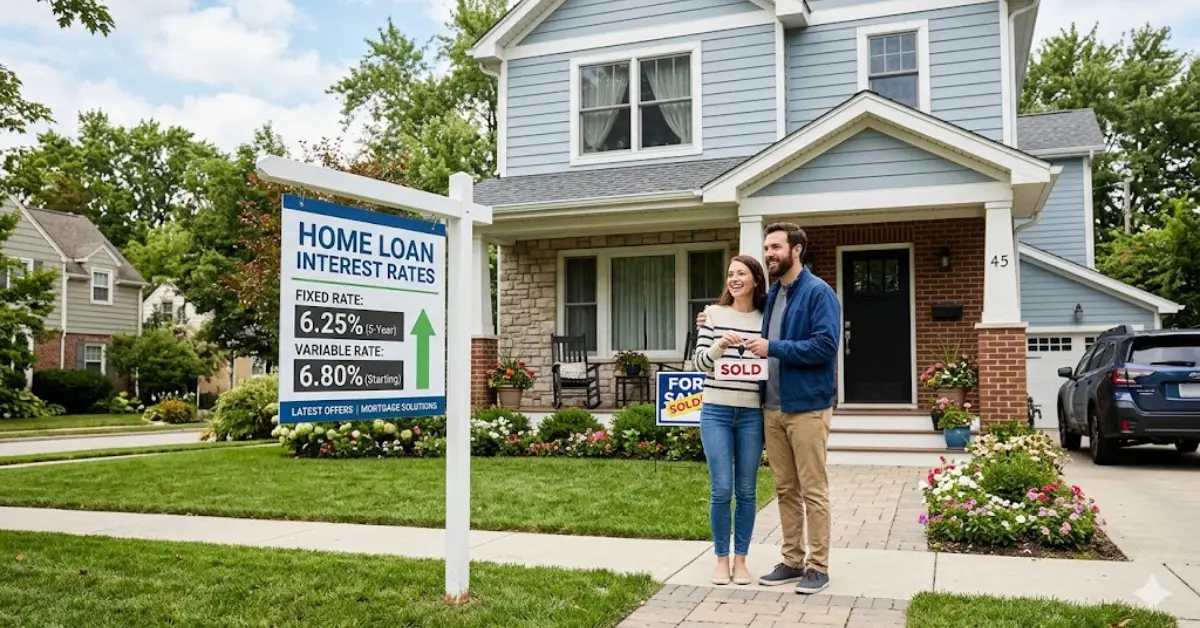
Buying a home usually marks the largest financial decision you will ever make. The interest rate attached to that loan directly shapes your monthly payment, your total cost over time, and your long-term financial flexibility. Even a quarter-percent shift changes how much money stays in your pocket versus how much flows to your lender.
You do not need a finance degree to navigate this landscape. You just need clear information, realistic expectations, and a strategy that matches your timeline. This guide breaks down how home loan interest rates work, what drives them, and how you position yourself to secure the best possible terms.
Table of Contents
ToggleWhat Are Home Loan Interest Rates, and Why Do They Matter?
A home loan interest rate represents the annual cost of borrowing money to purchase real estate.
Lenders charge this percentage to compensate for risk, inflation, and the opportunity cost of lending capital.
The rate you receive determines your principal-and-interest payment, which typically makes up the largest portion of your monthly housing expense.
Think of the interest rate as the price tag on borrowed money. Just like groceries or gas, that price changes based on market conditions, your financial profile, and the lender’s pricing strategy.
You pay that price every month until the loan matures or you refinance.
The Difference Between APR and Interest Rate Mortgage
Borrowers often confuse the interest rate with the Annual Percentage Rate (APR). The two numbers tell different stories. The interest rate reflects only the cost of borrowing the principal.
The APR includes the interest rate plus certain fees, points, and closing costs spread across the loan term.
The Consumer Financial Protection Bureau requires lenders to disclose the APR so you can compare true loan costs.
A loan with a lower interest rate might carry higher origination fees, which pushes the APR upward. Always compare APRs when evaluating offers from different lenders.
How Lenders Price Your Loan
Lenders use risk-based pricing models to set your rate. Underwriters review your credit history, debt-to-income ratio, employment stability, down payment size, and property appraisal. Stronger profiles receive better rates. Weaker profiles receive higher rates or require mortgage insurance.
Lenders also adjust pricing based on market demand, investor guidelines, and their own capital requirements. When mortgage-backed securities trade at a discount, lenders raise rates to maintain profit margins. When demand cools, they may lower rates or offer credits to attract qualified borrowers.
Current Home Loan Interest Rates and Housing Loan Rates Today
Rates fluctuate daily. They respond to economic data releases, central bank policy shifts, global bond market movements, and seasonal lending patterns. You will notice housing loan rates today differ from last month, last year, or even last week. That volatility reflects how mortgage pricing ties directly to broader financial markets.
To stay informed, track reliable benchmarks. Freddie Mac’s Primary Mortgage Market Survey publishes weekly national averages. Fannie Mae and the Federal Reserve also release lending data that shapes industry expectations. Use these sources to ground your rate shopping in reality rather than social media speculation.
Where Rates Stand Right Now
In recent years, mortgage rates moved from historic lows into a more normalized range. The 30-year fixed rate has generally hovered in the mid-to-high six percent band, while 15-year fixed rates typically sit one to one-and-a-half percentage points lower. These ranges shift with inflation reports, employment data, and Treasury yields.
You will not find a single “correct” rate for everyone. Your actual offer depends on your loan program, credit score, down payment, and lender pricing adjustments. Shop multiple quotes. Request Loan Estimates on the same day. Compare the numbers side by side before locking.
Mortgage Interest Rate History in Context
Understanding where rates stand today requires a quick look backward. In the early 1980s, the Federal Reserve raised the federal funds rate to combat runaway inflation. Mortgage rates peaked above 18 percent. Borrowers adapted with shorter terms, larger down payments, and strict budgeting.
The 2008 financial crisis triggered a different trajectory. The Fed cut rates and launched quantitative easing. By 2020 and 2021, 30-year fixed rates dipped below 3 percent for the first time in modern records. Those levels reflected emergency monetary policy, not a permanent baseline. Rates normalized as inflation surged and the Fed tightened policy in 2022 and 2023.
History shows that mortgage rates move in cycles. They rarely stay at extreme lows or extreme highs for long. Prepare for fluctuations. Build flexibility into your budget. Focus on securing a rate that aligns with your financial goals rather than chasing historical outliers.
Fixed vs Adjustable Rate Mortgage: Which Fits Your Budget?
Your loan structure shapes your risk exposure. Fixed-rate loans lock your interest rate for the entire term. Adjustable-rate mortgages start with a fixed period, then adjust periodically based on a published index plus a margin. Neither option wins universally. The right choice depends on your timeline, income stability, and comfort with uncertainty.
The Stability of Fixed-Rate Loans
A fixed-rate mortgage guarantees the same principal-and-interest payment from day one until payoff. You know exactly how much you pay in year five, year fifteen, and year twenty-nine. That predictability simplifies budgeting and protects you from future rate spikes.
Fixed loans work best when you plan to stay in the home for seven or more years. They also suit buyers who value peace of mind over short-term savings. You pay a premium for that stability, especially when the yield curve inverts or when lenders price in long-term inflation expectations. The trade-off buys you certainty.
How Floating Home Loan Interest Rates Work
Floating home loan interest rates tie your payment to a benchmark index, such as the Secured Overnight Financing Rate (SOFR) or the Constant Maturity Treasury (CMT). Lenders add a fixed margin to that index. Your rate adjusts after an initial fixed period, typically every six or twelve months.
Most adjustable mortgages include caps that limit how much your rate can change per adjustment and over the loan lifetime. These caps protect you from extreme swings. Still, your payment can rise significantly if the index climbs. Hybrid ARMs like 5/1, 7/1, or 10/1 offer a fixed period followed by annual adjustments. They make sense if you plan to sell or refinance before the adjustment phase begins.
Factors Affecting Home Loan Interest Rates
Your rate does not appear from thin air. Lenders calculate it using a blend of personal financial metrics and macroeconomic conditions. Understanding these variables helps you improve your offer before you apply.
Credit Score Impact on Mortgage Rates
Your credit score serves as a primary pricing lever. Lenders use FICO models to gauge repayment risk. Borrowers with scores above 760 typically receive the most favorable pricing. Scores between 700 and 759 still qualify for strong rates. Scores below 680 often trigger rate adjustments or require compensating factors like larger down payments.
Each tier shift can change your rate by 0.25 to 0.75 percent. That difference compounds over thirty years. Improve your score before applying.
Pay down revolving balances. Correct report errors. Avoid new credit inquiries in the months leading up to your application. Small improvements yield meaningful savings.
Down Payment, Loan Term, and Property Type
Your down payment directly influences pricing. Borrowers who put down 20 percent or more avoid private mortgage insurance and often receive better rate adjustments. Smaller down payments increase lender risk, which shows up in higher rates or required insurance premiums.
Loan term matters too. Fifteen-year mortgages carry lower rates than thirty-year loans because lenders collect principal faster and face less long-term uncertainty. Property type also plays a role. Primary residences receive the best pricing. Second homes and investment properties carry higher rates due to elevated default risk. Condominiums and manufactured homes may face additional pricing adjustments based on lender guidelines.
Macroeconomic Drivers: Inflation, Fed Policy, and Bond Yields
Mortgage rates track the 10-year U.S. Treasury yield more closely than the federal funds rate. Investors demand higher yields when inflation expectations rise. Higher yields push mortgage rates upward. When economic growth slows and inflation cools, yields drop, and rates follow.
Federal Reserve policy influences the broader environment. The Fed does not set mortgage rates directly. It sets the federal funds rate, which affects short-term borrowing costs. Mortgage lenders price long-term loans based on investor demand for mortgage-backed securities. When the Fed tightens policy, short-term rates rise, inflation expectations shift, and long-term mortgage pricing adjusts accordingly.
How to Find the Lowest Home Loan Interest Rates
Securing a competitive rate requires preparation, comparison, and timing. You cannot control the market, but you can control how you participate in it. A disciplined approach saves thousands over the life of your loan.
Using a Home Loan Interest Rates Calculator
A home loan interest rates calculator helps you estimate monthly payments, compare loan structures, and visualize the impact of rate changes. Input your home price, down payment, loan term, and estimated rate. The tool generates principal-and-interest figures, which you then add to taxes, insurance, and HOA fees.
Remember that calculators provide estimates, not guarantees. They do not account for lender fees, discount points, or borrower-specific adjustments. Use them to narrow your budget range and test scenarios. Then request official Loan Estimates from licensed lenders to see real numbers.
Shopping Smart: Lender Fees, Points, and Timing
Lenders compete for business. Some offer slightly higher rates but waive origination fees. Others advertise lower rates but charge discount points upfront. One point equals one percent of the loan amount. Points buy down your rate. Calculate your break-even horizon before paying them. If you plan to move or refinance within three years, points rarely make financial sense.
Request quotes from at least three lenders. Include a national bank, a credit union, and a reputable mortgage broker. Compare the APR, not just the interest rate. Review the fee breakdown line by line. Ask about rate lock periods, float-down options, and extension fees. Timing matters. Lock your rate when you feel comfortable with the number and market volatility increases. Do not wait for a perfect bottom. Markets rarely cooperate with wishful thinking.
Housing Finance Interest Rates Trends to Watch
The mortgage market evolves alongside technology, regulation, and economic cycles. Recognizing emerging patterns helps you anticipate shifts and adjust your strategy before rates move.
What Experts Predict for the Next 12–24 Months
Consensus forecasts suggest rates will stabilize as inflation continues moderating and labor markets normalize. The Federal Reserve’s policy path will guide short-term borrowing costs, while Treasury yields will steer long-term mortgage pricing. Most economists expect gradual declines from recent peaks, followed by a plateau in a mid-six percent range for 30-year fixed loans.
These projections assume no major economic shocks, geopolitical disruptions, or sudden inflation spikes. Rates remain sensitive to data. If employment growth slows and consumer spending cools, rates may dip faster. If supply chain constraints return or housing inventory tightens sharply, rates could hold steady or climb. Treat forecasts as directional guides, not guarantees.
How AI and Digital Lending Change the Game
Technology accelerates the mortgage process. Automated underwriting systems evaluate credit files, verify income, and price loans in minutes. Digital platforms let you compare housing finance interest rates across dozens of lenders without visiting branches. AI-driven pricing models adjust quotes in real time based on market liquidity and applicant risk profiles.
These tools increase transparency and reduce friction. They do not replace human judgment. Loan officers still interpret complex financial situations, negotiate fee structures, and guide first-time buyers through closing. Use digital platforms to gather data. Use licensed professionals to verify details and secure final approvals.
Frequently Asked Questions
1. Do housing loan interest rates change daily?
Yes. Lenders update pricing based on bond market movements, economic data releases, and internal risk adjustments. Rates can shift multiple times in a single day. Check official lender websites or contact loan officers for real-time quotes.
2. How much does a 0.5 percent rate change affect my payment?
On a $400,000, 30-year fixed loan, a half-percent increase raises your principal-and-interest payment by roughly $120 per month. Over thirty years, that adds approximately $43,000 in extra interest. Small percentage shifts create meaningful long-term costs.
3. Can I negotiate my mortgage rate?
You can negotiate fees, points, and lender credits. The base rate depends on market conditions and your risk profile. Strong credit, larger down payments, and competing offers give you leverage. Present multiple Loan Estimates and ask lenders to match or beat the best terms.
4. When should I lock my rate?
Lock when you have a signed purchase agreement, completed underwriting conditions, and a rate that aligns with your budget. Most locks last 30 to 60 days. Longer locks cost more. Avoid locking during high volatility unless your lender offers a float-down provision.
5. Do mortgage rates drop during recessions?
Not automatically. Recessions often trigger Fed rate cuts, which can lower short-term borrowing costs. Long-term mortgage rates depend on investor demand for mortgage-backed securities and inflation expectations. If a recession brings deflationary pressure, rates may fall. If it triggers credit market stress, lenders may widen spreads and keep rates elevated.
Final Thoughts: Locking In the Right Rate Starts With Preparation
You cannot control the macroeconomic forces that drive home loan interest rates. You can control how you prepare, how you compare offers, and how you position yourself before you apply. Clean credit, steady income, a realistic budget, and a clear timeline give you the strongest foundation.
Review your credit report early. Fix errors. Pay down high-utilization cards. Gather two years of tax returns, recent pay stubs, and bank statements. Run scenarios through a home loan interest rates calculator to understand your payment comfort zone.
Request official Loan Estimates from multiple lenders. Compare APRs, not just headline rates. Ask about points, credits, lock periods, and float-down options.
Rates will fluctuate. Markets will shift. Housing loan rates today differ from tomorrow’s numbers. Focus on securing a loan that aligns with your financial reality, not on chasing an impossible perfect rate. The right mortgage fits your life, supports your goals, and leaves room for unexpected expenses.
If you plan to buy, refinance, or restructure your current loan, start with clear numbers and verified sources. Track Freddie Mac’s weekly survey. Monitor Federal Reserve communications.
Consult a licensed mortgage professional who explains pricing transparently. Borrowing smart means understanding the cost, comparing the options, and making a decision you can defend five, ten, or thirty years from now.
Ready to explore your options? Gather your documents, run your numbers, and request quotes from three reputable lenders. The market rewards preparation. Your future self will thank you for the work you do today.
Sources & References for Further Reading:
- Consumer Financial Protection Bureau (CFPB): “Mortgage Rates and APR Explained”
- Federal Reserve Economic Data (FRED): “30-Year Fixed Rate Mortgage Average in the U.S.”
- Freddie Mac Primary Mortgage Market Survey (PMMS): Weekly national mortgage rate averages
- Fannie Mae Economic & Strategic Research: Quarterly mortgage outlook reports
- U.S. Department of Housing and Urban Development (HUD): Borrower education guides on fixed vs. adjustable mortgages






3 thoughts on “Home Loan Interest Rates: Your Complete Guide to Borrowing Smarter in 2026”