Search engines shape how people discover businesses today. Whether someone wants to buy a product, compare services, or learn something new, they almost always begin with a search. That single moment—when a user types a query—creates a powerful opportunity for businesses to connect with high-intent audiences.
That’s where what is search engine marketing becomes important to understand.
Search Engine Marketing (SEM) is more than just placing ads at the top of search results. It’s a strategic approach to showing your business to the right audience at the right time. By combining keyword research, compelling ad copy, smart bidding, and landing page optimization, SEM helps businesses drive measurable and scalable results.
If you’ve ever clicked a sponsored result on Google, you’ve already experienced SEM in action. However, successful campaigns don’t happen by luck. They rely on data analysis, continuous testing, and ongoing optimization.
In today’s competitive digital environment, simply having a website is not enough. Businesses need visibility, and understanding what is search engine marketing helps them achieve faster growth, better targeting, and improved return on investment without wasting budget.
Search Engine Marketing Definition
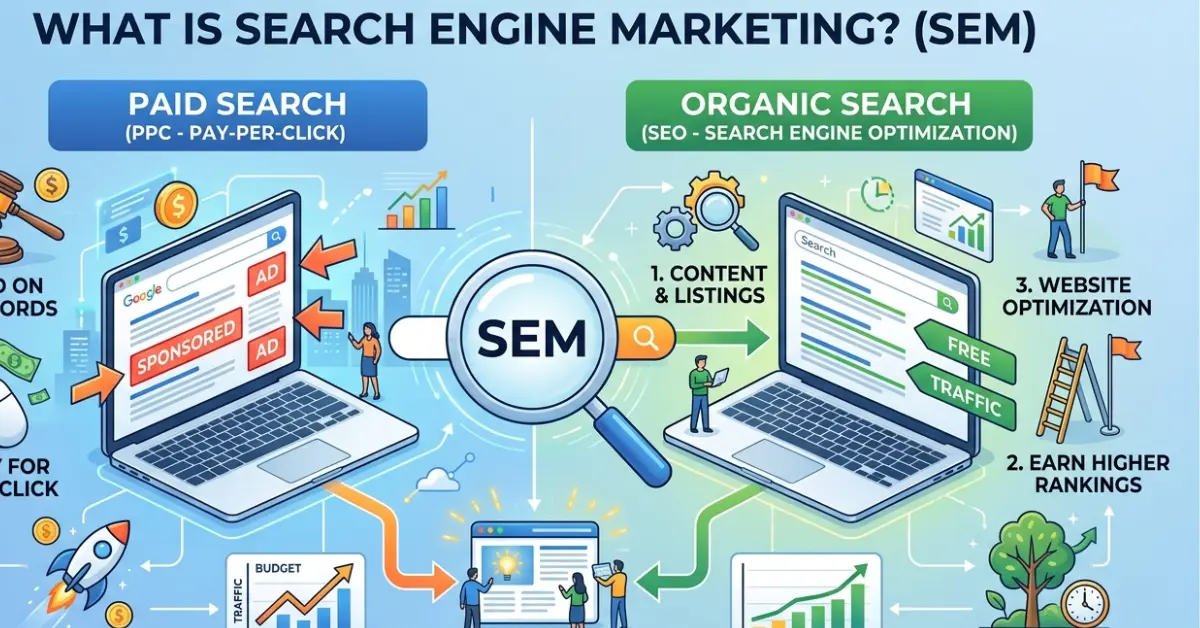
Search engine marketing (SEM) is a digital marketing strategy used to increase a website’s visibility on search engine results pages (SERPs) through paid advertising.
In simple terms:
SEM means paying to display your website to users who are actively searching for products or services like yours.
When you understand what is search engine marketing, you realize it focuses on reaching high-intent users at the exact moment they need a solution. Instead of waiting for organic rankings, SEM allows businesses to appear instantly at the top of search results.
Platforms like Google Ads make this possible by letting advertisers bid on keywords and compete for visibility based on relevance, quality, and budget.
Unlike SEO, which takes time to build authority and rankings, SEM delivers immediate visibility, faster traffic, and measurable results. This makes it a powerful strategy for businesses that want quick growth, better targeting, and full control over their marketing performance.
SEM Meaning in Digital Marketing
The SEM meaning in digital marketing goes far beyond simply running ads on search engines. It represents a complete, performance-driven system designed to attract, engage, and convert high-intent users.
A well-executed SEM strategy includes:
- Keyword research to identify what users are actively searching
- Ad copy creation that matches intent and drives clicks
- Bid management to control costs and maximize visibility
- Audience targeting to reach the right users
- Landing page optimization to improve conversions
- Conversion tracking to measure and refine performance
Platforms like Google Ads enable marketers to manage all these elements in one place, making SEM highly measurable and scalable.
When you understand what is search engine marketing, you see that it focuses on users who are already searching for a solution. This makes SEM one of the most effective channels in digital marketing, as it connects businesses with potential customers at the exact moment they are ready to take action.
What is SEM in Marketing?
To clearly understand what is SEM in marketing, you need to focus on one key factor: user intent.
When people search on platforms like Google, they usually have a specific goal. For example:
- “buy running shoes online”
- “best Google Ads services”
- “digital marketing agency near me”
These are not casual searches. They show strong intent to take action—whether it’s making a purchase, comparing services, or contacting a business.
Search Engine Marketing (SEM) allows businesses to appear exactly at this decision-making moment. By targeting the right keywords and crafting relevant ads, companies can position themselves in front of users who are already looking for solutions.
This is what makes SEM powerful.
Unlike organic marketing, which takes time to build visibility, SEM delivers immediate exposure, targeted traffic, and faster results. When done correctly, it connects demand with the right offer—turning searches into clicks and clicks into conversions.
Paid Search Marketing Explained
Paid search marketing is the core of Search Engine Marketing (SEM). It allows businesses to place ads directly on search engine results pages and reach users who are actively looking for solutions.
This system works through a real-time auction model used by platforms like Google Ads.
Here’s how it works when a user performs a search:
- Advertisers bid on specific keywords related to their business
- The search engine evaluates each ad based on bid, relevance, and quality
- Only the most relevant and useful ads appear at the top of results
But here’s the important part—you don’t just win by bidding more. Search engines prioritize user experience, so ad quality and relevance often matter more than budget.
You only pay when someone clicks your ad. This model is called Pay-Per-Click (PPC).
This makes paid search marketing highly efficient because:
- You target high-intent users
- You control your spending
- You measure every click and result
In short, paid search marketing connects your business with people who are already searching—making every click more valuable and results more predictable.
How Search Engine Advertising Works
Understanding search engine advertising helps you avoid wasted spend and improve campaign performance. It’s not just about running ads—it’s about following a structured process that connects user intent with the right message.
Step-by-Step Process
1. Keyword Selection
Identify keywords your target audience is actively searching for.
2. Ad Creation
Write relevant and compelling ads that match user intent.
3. Bidding Strategy
Set how much you’re willing to pay for each click.
4. Auction Process
Every search triggers a real-time auction among advertisers.
5. Ad Display
The most relevant ads appear on the search results page.
6. Click and Conversion
Users click your ad and take action on your website.
Platforms like Google Ads use a system called Ad Rank to decide which ads appear and in what order.
Ad Rank depends on:
- Bid amount
- Ad relevance
- Expected click-through rate (CTR)
- Landing page experience
This means a well-optimized ad can outperform competitors even with a lower budget.
How Search Engine Marketing Works (Simple Logic)
To truly understand how search engine marketing works, focus on the flow of user intent and experience. SEM is not random—it follows a clear, logical path:
- A user searches with intent
- Your ad appears at the right moment
- The user clicks your ad
- Your landing page delivers relevant value
- The user takes action (conversion)
Each step depends on the previous one. If your targeting is weak, the wrong users click. If your ad message is unclear, users won’t engage. If your landing page fails to match expectations, conversions drop.
This entire process is powered by platforms like Google Ads, which connect search queries with relevant ads in real time.
The key insight: SEM is not about getting more clicks—it’s about getting the right clicks.
When all elements align—keywords, ads, and landing pages—you attract qualified traffic that is more likely to convert. That’s what turns SEM from a cost into a profitable growth channel.
Types of Search Engine Marketing
There are different types of search engine marketing, and each one serves a specific goal within a campaign. Choosing the right type depends on whether you want traffic, conversions, or brand awareness.
1. Search Ads
Search ads are text-based ads that appear on search engine results pages. They target users who are actively searching for specific keywords, making them highly effective for lead generation and sales.
2. Display Ads
Display ads are visual banner ads shown across websites within advertising networks. They help increase brand awareness and are often used for remarketing campaigns.
3. Shopping Ads
Shopping ads showcase products with images, prices, and store details. These ads are ideal for ecommerce businesses looking to attract buyers ready to purchase.
4. Video Ads
Video ads appear on platforms like YouTube and help businesses engage users through visual storytelling and brand messaging.
5. Remarketing Ads
Remarketing ads target users who have previously visited your website. They remind potential customers about your products or services and increase the chances of conversion.
Each type plays a unique role, but the best SEM strategies combine multiple formats to maximize reach, engagement, and conversions.
Google Ads Marketing: The Core Platform
Most Search Engine Marketing campaigns run on Google, and for good reason. With billions of searches happening every day, Google offers unmatched reach and access to users with clear intent.
Google Ads marketing is the platform that powers these campaigns. It allows businesses to place ads directly in front of users who are actively searching for products or services.
With Google Ads, businesses can:
- Target specific keywords to reach the right audience
- Control budgets and adjust spending anytime
- Track conversions to measure real results
- Optimize campaigns in real time based on performance data
The biggest advantage of Google Ads is control. You don’t just run ads—you continuously refine them using real data.
This makes Google Ads marketing one of the most powerful tools in SEM, helping businesses scale faster while maintaining efficiency and performance.
SEM vs SEO Difference
Many beginners confuse SEM with SEO, but they serve different purposes in digital marketing.
Here’s a clear comparison:
|
Feature |
SEM | SEO |
|
Traffic |
Paid | Organic |
|
Speed |
Instant results |
Takes time |
| Cost | Pay per click |
No direct cost (time & effort) |
|
Control |
High (budget, targeting) | Limited |
| Visibility |
Immediate top placement |
Gradual ranking |
Search Engine Marketing (SEM) focuses on paid visibility through platforms like Google Ads, while SEO focuses on improving organic rankings over time.
The smartest approach is not choosing one over the other—it’s combining both.
- Use SEM for quick traffic and testing
- Use SEO for long-term growth and authority
When used together, they create a balanced strategy that delivers both immediate results and sustainable traffic.
Benefits of Search Engine Marketing
The benefits of search engine marketing are practical and measurable.
- Instant visibility
- High-intent traffic
- Full budget control
- Measurable performance
- Scalable campaigns
Importance of SEM in Digital Marketing
The importance of SEM in digital marketing continues to grow as online competition becomes more intense. Businesses no longer rely only on organic reach—paid visibility plays a key role in capturing attention at the right moment.
According to Statista, search advertising remains one of the largest segments in global digital ad spending. This highlights how essential SEM has become for businesses aiming to stay competitive.
SEM helps businesses:
- Capture demand instantly
Appear in front of users exactly when they are searching for a solution
- Compete in crowded markets
Even new businesses can gain visibility alongside established brands
- Generate leads faster
Target high-intent users who are ready to take action
- Maintain full control over campaigns
Adjust budgets, targeting, and messaging in real time
In simple terms, SEM bridges the gap between user intent and business visibility. It allows companies to reach potential customers quickly, making it one of the most effective strategies in modern digital marketing.
Advanced SEM Strategy: Campaign Structure
Successful campaigns don’t rely on guesswork. Professionals follow a clear structure to improve performance, control budgets, and increase conversions.
A well-organized search engine marketing campaign looks like this:
|
Level |
Example | Purpose |
| Campaign | “SEM Services” | Controls budget, location, and targeting |
|
Ad Group |
“Google Ads Services” |
Groups related keywords for relevance |
|
Keywords |
“google ads services near me” |
Triggers ads for user searches |
|
Ads |
Text ads with clear CTA |
Attract clicks and match intent |
| Landing Page |
Service page |
Converts visitors into leads |
This structure is commonly used in platforms like Google Ads, where relevance plays a major role in performance.
Why this matters:
- Better structure improves Quality Score
- Higher relevance leads to lower cost per click (CPC)
- Organized campaigns are easier to optimize and scale
For example, mixing unrelated keywords in one ad group often reduces performance. But when each ad group focuses on a specific theme, your ads become more relevant—and users are more likely to click and convert.
In short, a clean campaign structure turns SEM from a basic setup into a high-performing growth system.
Keyword Match Types (Cost Control)
Choosing the right keyword match types is essential for controlling costs and improving the quality of your traffic. The wrong match type can bring irrelevant clicks, while the right one helps you reach users with strong intent.
Here’s a clear breakdown:
| Match Type | Benefit |
Risk |
| Broad Match | Maximum reach and more impressions | Low relevance, can attract unrelated searches |
| Phrase Match | Balanced targeting with better intent matching | Moderate control, still allows variations |
| Exact Match | High precision and strong conversion potential | Limited reach and lower traffic volume |
Platforms like Google Ads use these match types to determine when your ads appear based on user queries.
Best practice:
Start with phrase match and exact match to maintain control over your traffic and budget. Once you gather enough data, you can expand using broad match carefully.
Pro tip:
Always combine match types with negative keywords. This prevents your ads from showing on irrelevant searches and helps reduce wasted spend.
In short, match types are not just settings—they are a core part of your SEM strategy that directly impacts performance and ROI.
Bidding Strategies in Google Ads Marketing
Choosing the right bidding strategy directly impacts your campaign performance and ROI. Each strategy serves a different goal depending on your data and objectives.
| Strategy | Best For | Control |
|
Manual CPC |
Beginners and learning phase | High |
| Maximize Clicks | Driving traffic | Medium |
|
Target CPA |
Lead generation |
Low |
| Target ROAS | Ecommerce sales |
Low |
According to Google Ads, automated bidding uses machine learning to optimize bids based on real-time signals like device, location, and user behavior.
Start with Manual CPC, then switch to automated strategies once you have enough conversion data.
Real-World SEM Case Study
Business Type:
Local service provider
Before Optimization
|
Metric |
Value |
|
Budget |
₹25,000 |
|
CPC |
₹42 |
|
CTR |
2.1% |
|
Conversion Rate |
2.3% |
| Cost per Lead |
₹1,826 |
After Optimization
|
Metric |
Value |
| Budget |
₹25,000 |
| CPC |
₹24 |
| CTR |
4.8% |
| Conversion Rate |
5.6% |
| Cost per Lead |
₹428 |
Key Improvements:
- Better keyword targeting
- Added negative keywords
- Improved landing page experience
Result: Lower cost per click, higher conversion rate, and significantly improved ROI.
SEM Performance Benchmarks
These benchmarks help you evaluate campaign performance.
| Metric | Average Range |
| CTR | 3% – 6% |
| Conversion Rate | 2% – 5% |
| CPC | ₹15 – ₹150+ |
| Quality Score | 6 – 10 |
These ranges align with insights from Google and Statista.
Keyword Intent Strategy
Understanding intent improves targeting and conversions.
| Type | Example | Intent |
| Informational | “what is SEM” | Learning |
| Commercial | “best SEM services” | Comparison |
| Transactional | “hire Google Ads agency” | Purchase |
Focus on transactional keywords to drive conversions and revenue.
Negative Keywords Example
Negative keywords help eliminate irrelevant traffic.
| Keyword | Unwanted Search | Fix |
| “SEM services” | “free SEM course” | Add “free” |
| “Google Ads services” | “tutorial” | Add “tutorial” |
This simple step reduces wasted spend and improves targeting accuracy.
Landing Page Optimization (Critical)
Most SEM campaigns fail not because of ads—but because of poor landing pages.
To improve performance, focus on:
- Clear and relevant headline
- Strong call-to-action (CTA)
- Fast loading speed
- Mobile-friendly design
- Trust signals (reviews, testimonials, guarantees)
Research from Google shows that slow-loading pages significantly increase bounce rates.
In simple terms:
Even the best ad won’t convert if your landing page fails to deliver value.
Search Engine Marketing Tutorial
Step-by-Step:
- Define goal
- Research keywords
- Structure campaigns
- Write ads
- Optimize landing page
- Track conversions
- Optimize regularly
Search Engine Marketing Services
Businesses often use search engine marketing services for better results.
Services include:
- Campaign setup
- Keyword research
- Optimization
- Reporting
Google Ads Services
Professional Google Ads services provide:
- Strategy planning
- Campaign management
- Testing and optimization
Common SEM Mistakes
- Wrong keyword targeting
- No negative keywords
- Weak ads
- Poor landing pages
- No tracking
Final Thoughts
Search Engine Marketing is powerful—but only when used correctly.
Success depends on:
- Understanding user intent
- Choosing the right keywords
- Creating relevant ads
- Optimizing landing pages
It’s not about spending more.
It’s about spending smarter.
When done right, SEM becomes one of the most reliable ways to grow traffic, leads, and revenue.
What is Search Engine Marketing? (Quick Answer)
Search engine marketing is a paid digital strategy where businesses promote their websites on search engines by bidding on keywords to attract high-intent users and drive conversions.
Frequently Asked Questions (FAQs)
1. What is search engine marketing in simple terms?
Search engine marketing is a paid digital strategy where businesses promote their websites on search engines by bidding on keywords to appear in search results.
2. What is the difference between SEM and SEO?
SEM focuses on paid advertising, while SEO focuses on organic rankings. SEM delivers instant results, whereas SEO takes time to build traffic.
3. How does search engine marketing work?
SEM works by targeting keywords, creating ads, bidding in auctions, and displaying ads to users who are actively searching for related products or services.
4. What is paid search marketing?
Paid search marketing is a method where advertisers pay to show ads on search engines and only pay when users click on those ads.
5. Is Google Ads part of SEM?
Yes, Google Ads is one of the main platforms used for search engine marketing campaigns.
6. How much does SEM cost?
SEM costs vary depending on industry competition, keywords, and bidding strategy. Businesses can control their budget and spend as per their goals.
7. What are the benefits of search engine marketing?
SEM offers instant visibility, high-intent traffic, measurable results, and better control over targeting and budget.
8. What is a good conversion rate in SEM?
A typical conversion rate ranges between 2% and 5%, but this can vary based on industry and campaign quality.
9. Why are landing pages important in SEM?
Landing pages are important because they convert visitors into leads or customers. A well-optimized landing page improves conversion rates and ROI.
10. What are negative keywords in SEM?
Negative keywords prevent ads from appearing for irrelevant searches, helping reduce wasted spend and improve targeting accuracy.