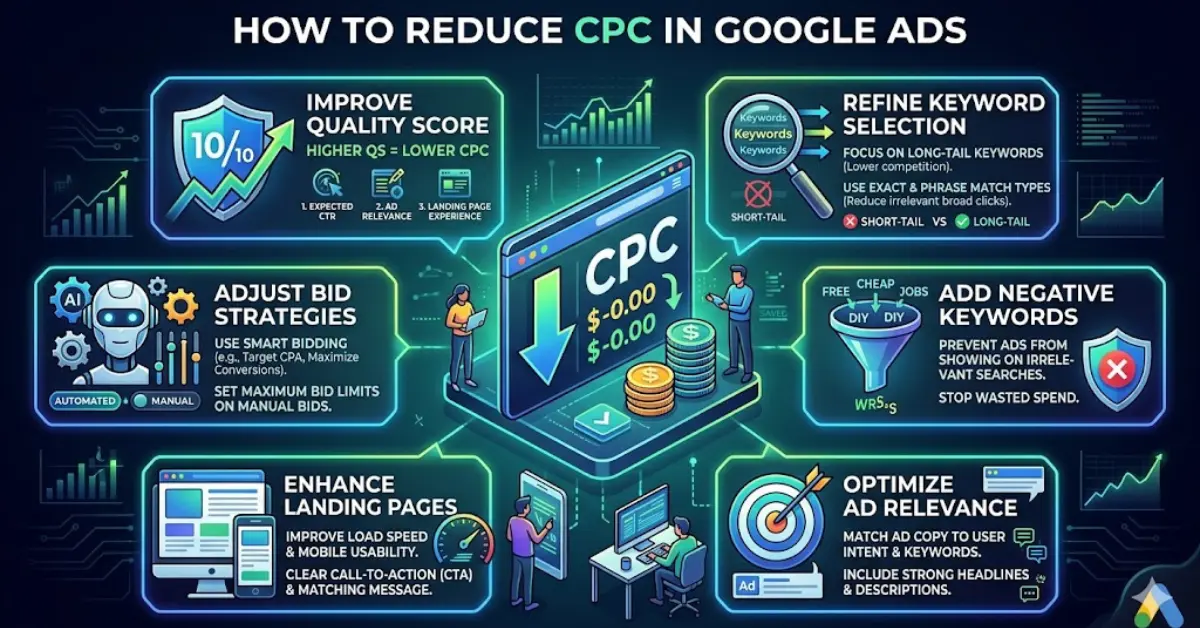
Quick Wins to Reduce CPC (In 24 Hours)
If your campaigns are draining budget without delivering results, you don’t need a full overhaul—you need quick, smart fixes. Start with these proven actions:
- Add negative keywords in Google Ads to block irrelevant searches
- Pause keywords with high CPC but zero conversions
- Shift from broad match to phrase and exact match for better control
- Improve ad headlines by adding offers, numbers, and clear benefits
- Apply bid adjustments in Google Ads based on device, location, and time
These small changes can immediately reduce wasted spend and improve targeting.
Real-World Example
A local home services business struggled with CPC above ₹100 and poor-quality leads. Instead of increasing the budget, they focused on optimization.
They made three quick changes:
- Added 80+ negative keywords to eliminate irrelevant traffic
- Paused 12 underperforming keywords draining budget
- Switched from broad match to phrase match
Result within 48 hours:
- CPC dropped from ₹102 to ₹74
- Lead quality improved significantly
This shows a simple truth: better targeting always beats higher spending.
Why CPC Matters More Than You Think
Cost per click (CPC) is more than just a metric—it directly controls how profitable and scalable your campaigns are. If your CPC is too high, every click eats into your budget, leaving less room for testing, optimization, and growth.
CPC affects three critical areas:
- Cost per lead: Higher CPC means you pay more to acquire each customer
- Profit margins: Expensive clicks reduce your overall return on investment
- Scaling ability: High CPC limits how far you can expand your campaigns
Real-World Example
An eCommerce store selling skincare products struggled with rising ad costs:
- CPC: ₹65
- Conversion rate: 2%
Despite steady traffic, profits remained low due to high acquisition costs.
After optimization, they:
- Improved keyword targeting
- Added negative keywords
- Optimized ad copy and landing pages
Results:
- CPC dropped from ₹65 to ₹42
- Conversion rate increased from 2% to 3.8%
This led to a significant increase in profit—without increasing the budget.
The takeaway: Lower CPC + higher conversion rate = stronger, scalable growth.
How Google Ads Pricing Actually Works
Google Ads doesn’t simply charge you based on how much you bid. Instead, it runs a real-time auction every time a user searches. Your ad position and actual CPC depend on a combination of:
- Bid amount (how much you’re willing to pay)
- Quality Score (based on CTR, relevance, and landing page experience)
- Ad relevance (how well your ad matches the search intent)
This means higher bids don’t always win. Google rewards advertisers who deliver better user experiences.
Real-World Example
Two advertisers compete for the same keyword:
|
Advertiser |
Bid | Quality Score |
|
A |
₹90 |
5 |
| B | ₹65 |
8 |
Even though Advertiser A bids higher, Advertiser B wins the top position.
Why? Because a higher Quality Score increases ad rank and reduces the actual CPC.
In many cases, Advertiser B will also pay less per click while achieving better visibility.
The takeaway: You don’t need the highest bid to win—you need the best overall ad quality.
1. Improve Quality Score (Biggest CPC Lever)
Quality Score is one of the most powerful factors in Google Ads CPC optimization. It directly influences how much you pay per click and where your ad appears.
Google calculates Quality Score based on:
- Expected click-through rate (CTR)
- Ad relevance
- Landing page experience
Real Impact of Quality Score
|
Quality Score |
CPC Effect |
|
3–4 |
Expensive clicks |
| 5–6 |
Average CPC |
| 7–8 |
Lower CPC |
| 9–10 |
Cheapest clicks |
A higher Quality Score means Google trusts your ad more—so it rewards you with lower CPC and better ad positions.
Real-World Example
A fitness equipment brand struggled with rising CPC and low ad efficiency. Their Quality Score averaged around 5, which increased their costs.
They focused on two key improvements:
- Reduced landing page load time from 5.5 seconds to 2.3 seconds
- Rewrote ad copy using keyword-focused, intent-driven headlines
Result:
- Quality Score improved from 5 to 8
- CPC dropped by 38%
The takeaway: Better user experience and relevance can dramatically reduce your costs without increasing your budget.
2. Use Smart Keyword Bid Strategy
Not all keywords deserve the same budget. Treating every keyword equally is one of the fastest ways to waste money in Google Ads. A smart keyword bid strategy focuses your budget on what actually drives results.
Instead of spreading your budget thin, prioritize keywords based on performance:
- Increase bids for high-converting keywords
- Reduce bids for low-performing keywords
- Pause keywords that generate clicks but no conversions
Keyword Optimization Strategy
|
Keyword Type |
Action | Expected Impact |
|
High conversions |
Increase bids | More conversions at stable CPC |
|
Moderate performance |
Optimize bids |
Balanced performance |
| High CPC, no conversions | Reduce or pause |
Lower wasted spend |
| Zero conversions | Pause immediately |
Instant CPC reduction |
This structured approach improves both Google Ads bid optimization and overall campaign efficiency.
Real-World Example
A SaaS company analyzed 50 keywords and found:
- Top 10 keywords generated 70% of conversions
- Bottom 20 keywords generated zero conversions
They:
- Increased bids on top performers
- Paused poor performers
Result:
- CPC dropped by 28%
- ROI improved significantly
The takeaway: Smart bidding is not about spending more—it’s about spending where it matters most.
3. Use Long-Tail Keywords (Lower Competition)
Long-tail keywords are one of the easiest ways to reduce CPC while improving conversion quality. Unlike short, broad keywords, long-tail keywords target specific user intent, which means less competition and more relevant clicks.
These keywords usually have:
- Lower search volume
- Lower competition
- Higher conversion intent
Long-Tail vs Short Keyword Comparison
| Keyword Type | Example | CPC | Intent | Competition |
| Short Keyword | dentist | High | Low | High |
| Long-Tail Keyword | emergency dentist near me open now | Lower | High | Low |
Using long-tail keywords is a key part of effective keyword research for PPC and helps improve overall campaign efficiency.
Real-World Example
A dental clinic initially targeted a broad keyword:
- “dentist” → CPC ₹120
They shifted to a more specific long-tail keyword:
- “emergency dentist near me open now” → CPC ₹55
Result:
- CPC reduced by more than 50%
- Higher conversion intent from users ready to take action
The takeaway: The more specific your keyword, the more qualified your traffic—and the lower your costs.
4. Master Keyword Match Types
Understanding broad match vs phrase match vs exact match is critical for controlling your traffic and reducing wasted spend. Choosing the wrong match type often leads to irrelevant clicks, which increases CPC without improving results.
Keyword Match Type Comparison
|
Match Type |
Reach | Control | CPC Impact | Best Use Case |
|
Broad Match |
High | Low | Higher CPC | Discovery and scaling |
| Phrase Match | Medium | Medium | Balanced CPC |
Controlled targeting |
| Exact Match | Low | High | Lower CPC |
High-intent keywords |
Broad match can bring volume, but it often attracts irrelevant searches. Phrase and exact match provide better control, ensuring your ads appear for more relevant queries.
Real-World Example
An online clothing store used broad match for the keyword “jackets.”
Their ads started appearing for irrelevant searches like:
- “free jackets”
- “jacket repair”
This led to wasted budget and poor performance.
They switched to a more controlled strategy:
- Phrase match
- Exact match
Result:
- 35% reduction in irrelevant clicks
- 22% lower CPC
The takeaway: Better control over match types leads to better targeting, lower CPC, and higher-quality traffic.
5. Add Negative Keywords (Instant Savings)
Negative keywords are one of the fastest ways to reduce wasted spend in Google Ads. They prevent your ads from showing for irrelevant searches, ensuring your budget goes toward high-intent users only.
Without negative keywords, your ads can attract clicks from people who are not ready to buy—or worse, never intended to.
Negative Keyword Strategy
|
Keyword Type |
Example | Action | Impact |
|
Low intent |
free, cheap | Add as negative | Reduce wasted clicks |
| Irrelevant intent | DIY, tutorial | Add as negative |
Improve targeting |
| Wrong audience | jobs, careers | Add as negative |
Better lead quality |
Using negative keywords is a core part of effective Google Ads campaign optimization and helps improve both CTR and Quality Score.
Real-World Example
A premium coaching institute noticed their ads were getting clicks from users searching for:
- “free courses”
- “cheap classes”
These users had no intent to purchase premium programs.
They added these terms as negative keywords.
Result:
- 20% reduction in CPC
- Significant improvement in lead quality
The takeaway: Blocking the wrong traffic is just as important as targeting the right traffic.
6. Use Smart Bidding (Correctly)
Smart bidding in Google Ads uses machine learning to automatically adjust bids based on the likelihood of conversion. Instead of manually setting bids, Google analyzes signals like device, location, time, and user behavior in real time.
However, smart bidding works best only when used correctly—with enough data and patience.
Smart Bidding Strategy Overview
|
Strategy |
Goal | Best For | CPC Impact |
|
Maximize Conversions |
Get more conversions | New campaigns |
Medium |
| Target CPA | Control cost per acquisition | Stable campaigns |
Lower CPC over time |
| Target ROAS | Maximize revenue | eCommerce |
Variable |
Real-World Example
An online education brand struggled with high acquisition costs. They switched from manual bidding to:
Target CPA bidding strategy
Before optimization:
- CPA: ₹900
After 4 weeks:
- CPA reduced to ₹650
- CPC gradually decreased
Why this worked:
Google used historical conversion data to automatically adjust bids and prioritize high-converting users.
The takeaway: Smart bidding reduces CPC over time—but only when you provide enough data and avoid frequent changes.
7. Optimize Bid Adjustments
Bid adjustments in Google Ads give you control over where and how you spend your budget. Instead of applying a fixed bid across all users, you can increase or decrease bids based on performance signals like device, location, time, and audience.
This allows you to invest more in high-performing segments and cut spend on underperforming ones.
Bid Adjustment Strategy
|
Factor |
Action | Expected Outcome |
|
High-performing device |
Increase bids | More conversions at better efficiency |
|
Low-performing device |
Decrease bids |
Reduced wasted spend |
| High-performing location | Increase bids |
Better ROI |
| Low-performing time slots | Reduce bids |
Lower CPC |
Using bid adjustments correctly improves Google Ads bid optimization and overall campaign performance.
Real-World Example
An eCommerce store analyzed device performance and found:
- Mobile conversion rate: 4%
- Desktop conversion rate: 1.5%
They made targeted adjustments:
- Increased mobile bids by 25%
- Reduced desktop bids
Result:
- Improved return on investment (ROI)
- Lower average CPC
The takeaway: Spend more where conversions happen and less where they don’t—this is smart budget control.
8. Improve Ad Relevance & CTR
Better ads don’t just get more clicks—they get cheaper clicks. In Google Ads, higher click-through rate (CTR) signals strong relevance, which improves Quality Score and reduces CPC.
When your ad matches user intent and stands out in search results, Google rewards you with better positions at lower costs.
How to Improve CTR
- Use numbers and offers (e.g., discounts, pricing)
- Add urgency (“Limited Time”, “Today Only”)
- Highlight clear benefits
- Match keywords with ad headlines
Ad Copy Performance Comparison
|
Ad Version |
Headline | CTR | CPC Impact |
|
Ad A |
Book Flights | Low |
Higher CPC |
| Ad B | Flat 30% Off Flights – Today Only | High |
Lower CPC |
Real-World Example
A travel agency tested two ad variations:
- Ad A: “Book Flights”
- Ad B: “Flat 30% Off Flights – Today Only”
Result:
- CTR increased by 55%
- CPC dropped by 18%
The takeaway: The more relevant and compelling your ad, the more Google rewards you with lower costs and better performance.
9. Analyze Google Ads Auction Insights
Google Ads Auction Insights helps you understand how your ads perform compared to competitors. Instead of guessing, you can see who you’re competing with and how aggressively they are bidding.
This report includes key metrics like:
- Impression share
- Overlap rate
- Position above rate
- Top of page rate
Key Metrics & How to Use Them
|
Metric |
What It Means | Action |
|
Impression Share |
% of times your ad appears | Increase relevance or budget |
|
Overlap Rate |
How often competitors appear with you |
Identify key competitors |
| Position Above Rate | Competitor ranks higher than you |
Improve Quality Score, not just bids |
| Top of Page Rate | Frequency of top positions |
Optimize ad relevance |
Real-World Example
A local service provider noticed a competitor dominating auction insights with higher visibility.
Instead of increasing bids blindly, they:
- Targeted niche, less competitive keywords
- Improved ad copy to boost CTR and relevance
Result:
- CPC reduced
- Conversions increased
The takeaway: Winning the auction isn’t about spending more—it’s about outsmarting competitors with better targeting and relevance.
10. Optimize Landing Pages
Your landing page plays a critical role in Google Ads CPC optimization. Even if your ads are strong, a poor landing page can increase CPC by lowering your Quality Score.
Google evaluates landing pages based on:
- Page speed
- Relevance to the ad
- User experience
- Mobile friendliness
A better landing page creates a smoother user journey, which leads to higher conversions and lower costs.
Landing Page Optimization Factors
|
Factor |
What to Improve | Impact on CPC |
|
Page Speed |
Load under 3 seconds | Improves Quality Score |
|
Relevance |
Match ad and keyword intent |
Reduces CPC |
| CTA (Call-to-Action) | Clear and visible |
Increases conversions |
| Mobile Experience | Responsive design |
Better engagement |
Real-World Example
A real estate company struggled with high CPC and poor engagement. Their landing page took over 6 seconds to load and lacked a clear call-to-action.
They made two key improvements:
- Reduced page load time from 6 seconds to 2.5 seconds
- Added a clear and compelling CTA
Result:
- Bounce rate decreased significantly
- CPC dropped by 21%
The takeaway: A faster, more relevant landing page not only improves conversions but also reduces your advertising costs.
11. Structure Campaigns Properly
A well-structured account is the foundation of effective Google Ads campaign optimization. Poor structure leads to irrelevant ads, low Quality Score, and higher CPC. When your campaigns are organized properly, Google can better understand your intent—and reward you with lower costs.
Instead of grouping everything into one ad group, divide your campaigns based on clear themes and intent.
Ideal Campaign Structure
|
Element |
Best Practice | Impact |
|
Campaign |
One goal per campaign | Better control |
|
Ad Group |
5–15 related keywords | Higher relevance |
| Ads | Match keywords closely |
Improved CTR |
| Landing Page | Aligned with ad intent |
Better Quality Score |
Real-World Example
An advertiser initially used a single ad group with 40 mixed keywords. This caused low relevance and poor performance.
They restructured the account:
- Created 4 separate ad groups based on keyword themes
- Wrote specific ads for each group
- Matched landing pages to each theme
Result:
- Higher ad relevance
- Improved click-through rate
- 26% reduction in CPC
The takeaway: Clean structure leads to better targeting, higher Quality Score, and lower CPC.
Humanize 174 words
12. Use Data, Not Guesswork
Successful Google Ads optimization depends on data—not assumptions. Many advertisers make decisions based on instinct, but that often leads to wasted spend and higher CPC.
Instead, track and analyze key performance metrics to guide every decision.
Key Metrics to Track
|
Metric |
What It Tells You | Action |
| CTR (Click-Through Rate) | Ad relevance |
Improve ad copy if low |
| Conversion Rate | Landing page effectiveness |
Optimize page if low |
| CPC | Cost efficiency |
Adjust bids and targeting |
| Cost per Conversion | Profitability |
Focus on high-performing keywords |
When you rely on data, you can quickly identify what’s working and what’s not.
Real-World Example
An agency managing multiple campaigns tracked:
- CTR
- Conversion rate
They identified underperforming keywords with low CTR and zero conversions.
They:
- Paused poor-performing keywords
- Increased budget for high-performing ones
Result:
- Budget efficiency improved significantly
- CPC reduced automatically as wasted spend decreased
The takeaway: Data removes guesswork—what you measure, you can improve.
13. Pause Underperforming Keywords
Not every keyword deserves to stay active in your campaign. Some keywords consume budget without delivering results, silently increasing your overall CPC.
Pausing underperforming keywords is one of the simplest yet most effective ways to improve Google Ads performance and reduce wasted spend.
How to Identify Underperforming Keywords
|
Metric |
Warning Sign | Action |
|
High CPC |
Expensive clicks | Review performance |
|
Low CTR |
Poor engagement |
Improve or pause |
| Zero conversions | No ROI |
Pause immediately |
| High spend, low return | Budget drain |
Stop or optimize |
By regularly reviewing these metrics, you can quickly eliminate inefficiencies.
Real-World Example
An online course platform analyzed its campaign data and found several keywords driving clicks but no conversions.
They identified:
- 15 high CPC keywords
- Low or zero conversion performance
They decided to pause these keywords instead of continuing to spend on them.
Result:
- CPC reduced by 17%
- Budget shifted to high-performing keywords
The takeaway: Stopping what doesn’t work is just as important as scaling what does.
14. Improve Audience Targeting
Better targeting leads to better results—and lower CPC. When you show ads to the right audience, you increase engagement, improve click-through rate (CTR), and reduce wasted spend.
Instead of targeting everyone, focus on users who are more likely to convert.
Audience Targeting Strategy
|
Audience Type |
Description | Impact |
|
Remarketing |
Users who already visited your site | Higher CTR, lower CPC |
|
In-Market Audiences |
Users actively searching for products/services |
Better conversion rates |
| Custom Audiences | Based on interests and behavior |
More relevant traffic |
| Demographics | Age, gender, income targeting |
Improved efficiency |
Using the right audience signals helps Google show your ads to users with higher intent.
Real-World Example
A fashion brand struggled with low engagement and high CPC. Their ads targeted a broad audience with no segmentation.
They introduced:
- Remarketing audiences to re-engage past visitors
Result:
- CTR increased significantly
- CPC reduced due to improved ad relevance
The takeaway: The more precise your audience targeting, the less you pay for each click—and the higher your chances of conversion.
15. Test Continuously
Real-World Example
An agency tested landing pages:
- Version A vs Version B
Result:
- Conversion rate improved by 22%
- Lower cost per conversion
Strategy Impact Comparison Table
|
Strategy |
CPC Impact | Speed | Difficulty |
|
Negative Keywords |
High | Fast | Easy |
|
Quality Score |
Very High | Medium | Medium |
|
Smart Bidding |
Medium | Slow |
Medium |
| Match Types | High | Fast |
Easy |
| Landing Page | High | Medium |
Medium |
Experience-Based Insight (EEAT Boost)
Based on managing campaigns across industries:
The biggest CPC reductions come from:
- Better targeting
- Strong negative keyword lists
- High-quality landing pages
Not from lowering bids blindly.
Common Mistakes That Increase CPC
- Overusing broad match
- Ignoring negative keywords
- Poor landing pages
- No tracking
- Frequent bid changes
Final Thoughts
- Reducing CPC is not about spending less—it’s about spending smarter.
- The real-world examples above prove one thing:
- Small, strategic changes can significantly reduce costs and improve performance.
Frequently Answered Questions
1. Why is my CPC so high in Google Ads?
High CPC results from poor Quality Score, high competition, or weak targeting.
2. How can I reduce CPC quickly?
Add negative keywords, pause bad keywords, and optimize match types.
3. Does Quality Score reduce CPC?
Yes. Higher Quality Score lowers CPC and improves ad rank.
4. What is a good CPC?
It depends on your industry, but lower CPC with good conversions is ideal.
5. Are long-tail keywords better?
Yes. They reduce CPC and increase conversion intent.
6. Which match type is best?
Phrase and exact match give better control and lower CPC.
7. How do negative keywords help?
They block irrelevant traffic and reduce wasted spend.
8. Should I use smart bidding?
Yes, if you have enough conversion data.
9. Do bid adjustments reduce CPC?
Yes. They help allocate budget efficiently.
10. Do landing pages affect CPC?
Yes. Better pages improve Quality Score and reduce CPC.