
RAG vs AI Agents for Beginners: A Complete Guide (2026)
Artificial Intelligence (AI) is evolving rapidly, and two terms you’ll hear often are Retrieval-Augmented Generation (RAG) and AI Agents. While they may sound similar, they solve different problems.
If you’re new to AI, this guide explains RAG vs AI Agents in simple language, using real-world examples to help you understand when each technology is the right choice.
What is RAG?
Retrieval-Augmented Generation (RAG) is an AI technique that improves answer quality by retrieving relevant information from external knowledge sources before generating a response.
Instead of depending only on what the AI learned during training, RAG searches trusted sources such as:
- Company documents
- PDFs
- Databases
- Websites
- Knowledge bases
- Product manuals
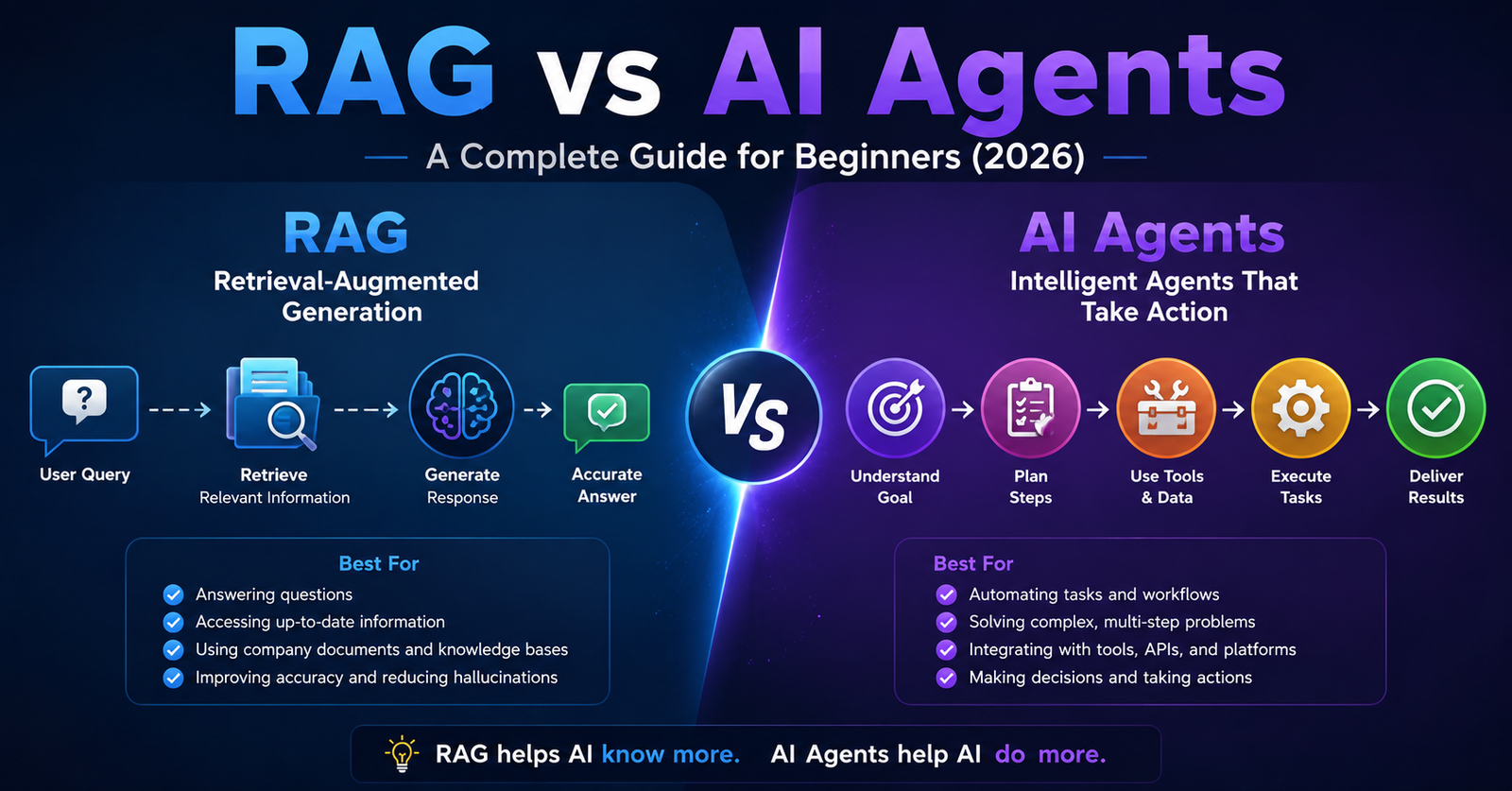
How RAG Works
- A user asks a question.
- The system searches relevant documents.
- The most useful information is retrieved.
- The AI reads the retrieved content.
- The AI generates a response based on that information.
Example
Imagine your company stores thousands of HR documents.
A user asks: What is our company’s leave policy?
Without RAG, the AI may provide a generic answer.
With RAG, the AI searches the latest HR policy documents and returns the correct leave policy based on your organization’s current rules.
What Are AI Agents?
AI Agents are intelligent software systems that can understand a goal, make decisions, and perform tasks with minimal human intervention. Unlike traditional AI chatbots that simply answer questions, AI Agents can plan, reason, use tools, and complete multi-step tasks to achieve a specific objective.
Think of an AI Agent as a digital assistant that not only provides information but also takes action. Depending on the task, it can search the web, retrieve data from databases, write content, analyze documents, generate code, send emails, schedule meetings, or interact with other software and APIs.
How AI Agents Work
AI Agents work by understanding a user’s goal, creating a plan, using the right tools, and completing tasks with minimal human intervention. Unlike traditional AI chatbots that simply answer questions, AI Agents can reason, make decisions, and execute multi-step workflows to achieve a desired outcome.
Whether it’s planning a trip, generating a report, analyzing data, or automating business processes, AI Agents follow a structured workflow to complete the task efficiently.
1: Receive a Goal
The process begins when a user provides a task or objective.
Example: Plan a 5-day trip to Goa with a budget of ₹30,000.
2: Analyze the Request
Next, the AI Agent analyzes the request by identifying important details such as:
- Budget
- Destination
- Travel dates
- User preferences
- Constraints
3: Create a Plan
Instead of solving everything at once, the AI Agent breaks the task into smaller, manageable steps.
For the travel example, the plan might include:
- Search for flights
- Compare hotel prices
- Estimate travel expenses
- Find popular attractions
- Create a daily itinerary
4: Use the Right Tools
AI Agents can interact with external tools and services to gather information and perform actions.
These tools may include:
- Search engines
- Company databases
- APIs
- CRM platforms
- Email services
- Calendars
- Code interpreters
- Knowledge bases
5: Execute the Task
Once the plan is ready, the AI Agent carries out each step in sequence.
For example, it may:
- Search for available flights.
- Compare hotel options.
- Calculate the total cost.
- Build a day-by-day itinerary.
- Prepare a complete travel plan.
6: Evaluate the Results
Before delivering the final response, the AI Agent reviews the outcome to ensure it meets the user’s requirements.
If necessary, it can adjust the plan, gather additional information, or retry certain steps to improve the results.
7: Deliver the Final Output
Finally, the AI Agent presents a complete and actionable solution.
Instead of only answering the question, it provides a finished result that aligns with the user’s goal.
Key Features of AI Agents
- Understand user goals and intent.
- Break complex tasks into smaller steps.
- Make decisions based on available information.
- Access external tools and APIs.
- Automate repetitive workflows.
- Adapt to new information during execution.
- Deliver complete, goal-oriented solutions.
RAG vs AI Agents: Key Differences
| Feature | RAG | AI Agents |
|---|---|---|
| Primary Purpose | Retrieve accurate information | Perform tasks and achieve goals |
| Uses External Knowledge | Yes | Yes |
| Planning Ability | No | Yes |
| Decision Making | No | Yes |
| Tool Usage | Limited | Extensive |
| Workflow Automation | No | Yes |
| Best For | Question answering | Task automation |
| Complexity | Simple | Advanced |
When Should You Use RAG?
Choose RAG if you need:
- Internal knowledge search
- Customer support chatbots
- Company documentation
- FAQ systems
- Policy lookup
- Product documentation
- Legal document search
- Medical knowledge retrieval
When Should You Use AI Agents?
AI Agents are a better choice if you need:
- Business process automation
- Personal assistants
- Marketing automation
- Software development assistance
- Research workflows
- Project management
- Report generation
- Data analysis
- Customer service automation
Advantages of RAG
- Provides more accurate responses
- Uses current information
- Reduces hallucinations
- Works well with private company data
- Easy to integrate with existing knowledge bases
Limitations
- Cannot independently perform actions
- Depends on the quality of retrieved documents
- Focuses mainly on answering questions
Advantages of AI Agents
- Can plan and execute multi-step tasks
- Uses multiple tools and APIs
- Saves time through automation
- Handles complex workflows
- Learns from context during execution
Limitations
- More complex to build
- Higher infrastructure costs
- Requires careful monitoring and permissions
RAG + AI Agents: Better Together
Many modern AI applications combine both technologies.
For example, a customer support assistant can:
- Use RAG to retrieve the latest company policies.
- Use an AI Agent to create a support ticket, send follow-up emails, update the CRM, and notify the appropriate team.
Which One Should Beginners Learn First?
If you’re just starting with AI:
- Learn the basics of Large Language Models (LLMs).
- Understand how RAG retrieves and uses external knowledge.
- Explore vector databases and embeddings.
- Move on to AI Agents and learn how they plan, reason, and use tools. A solid understanding of RAG provides a strong foundation before diving into more advanced AI Agent systems.
Final Thoughts
RAG and AI Agents are both powerful AI technologies, but they serve different purposes.
If your goal is to deliver accurate, up-to-date answers from trusted information sources, RAG is the right choice.
If your goal is to automate tasks, make decisions, and complete workflows, AI Agents are the better option.
In many real-world applications, combining RAG with AI Agents creates intelligent systems that can both retrieve reliable information and take meaningful action, making them more effective than using either approach alone.

Bài viết rất hữu ích, cảm ơn đã chia sẻ! Letco là công ty tư vấn du học Hàn Quốc uy tín, hỗ trợ trọn gói từ hồ sơ, visa đến học bổng. Tham khảo thêm tại letco.vn nhé.
[202570]supplies professional anti-violence equipments and solutions for the whole world with strong and perfect production capacity. anti-violence.org