
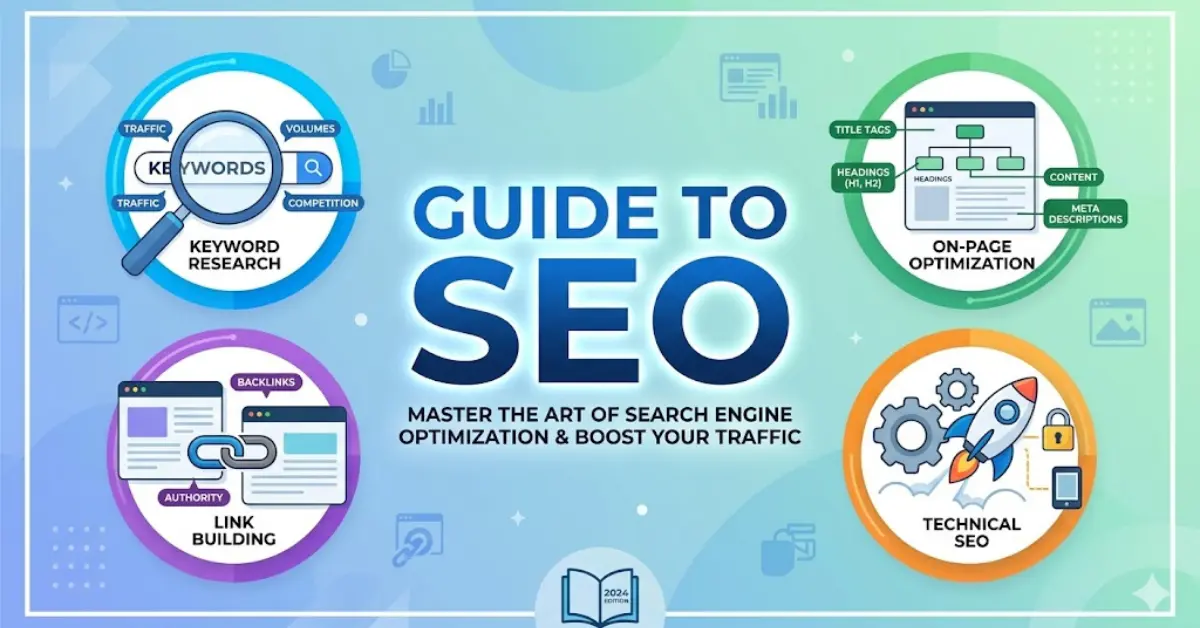
One of the most dependable strategies for creating a regular flow of quality traffic is that of search engine optimization. Although digital marketing is constantly evolving, the importance of search engine optimization as one of the primary growth channels remains due to the nature of how individuals seek information. According to BrightEdge, more than half of the total website traffic originates from organic searches.
In simple terms, search engine optimization is defined by the process whereby websites are optimized such that search engines like Google can understand the content of the website and rank it appropriately on the search engine.
What is SEO and How It Works
Definition of SEO
SEO stands for Search Engine Optimization. As you have already guessed, SEO is a set of processes which are aimed at making your website better in order to rank higher in organic search results. It is a set of measures designed to make your content visible when your users type specific keywords. You will not have to pay for this result – you will earn it organically.
Why does organic search matter? According to a study conducted by BrightEdge, more than half of website visitors come through organic search. Users are looking for answers to their questions in search engines, and your SEO efforts can help you to be one of those answers.
How Search Engines Work
Search engines like Google follow a structured process to deliver results. This process includes crawling, indexing, and ranking.
Crawling is the discovery stage. Search engines use automated bots to scan web pages across the internet. These bots follow links and collect data from different pages. If your website is not properly structured or linked, it becomes harder for these bots to find your content.
Indexing is where the collected data is organized. Once a page is crawled, the search engine analyzes its content and stores it in a large database called an index. This step helps search engines understand what your page is about.
Ranking happens when a user searches for something. The search engine evaluates all relevant pages in its index and ranks them based on factors like content quality, relevance, user experience, and authority. The goal is to show the most useful results at the top.
Why SEO is Important for Websites
SEO directly impacts how much traffic your website receives. Higher rankings lead to more clicks, which means more visitors without ongoing ad spend. It also improves visibility, helping your brand appear consistently in front of your target audience.
Beyond traffic, SEO supports long term business growth. When your content ranks well, it builds credibility and trust. Over time, this leads to better engagement, higher conversions, and a stronger online presence.
Types of SEO Explained
In order to create a solid base, it must be clear that SEO is not just one technique but rather a blend of various techniques. This blend helps in ranking websites and making sure that users have a pleasant experience while using the website. There are three broad types of SEO techniques, namely on-page SEO, off-page SEO, and technical SEO.
On Page SEO
In on page SEO, everything from the website is optimized for relevance and usability for the benefit of the users and the search engines. In on page SEO, content optimization becomes extremely crucial. Content has to be clear and must relate to the query of the user. It cannot consist of merely keywords any more. Search engines will assess whether the content provides a complete answer to the user’s query.
Keyword optimization is still very important, but it needs to become less repetitive in nature. You should vary the usage of the keywords and their variants in order to optimize semantics for search engines.
Meta tags also play a key role. Title tags and meta descriptions influence how your page appears in search results. A well written title can improve click through rates, while a clear meta description gives users a reason to visit your page.
Off Page SEO
Off page SEO focuses on building your website’s credibility outside of your own platform. The most important factor here is backlinks, which are links from other websites pointing to your content. Search engines treat these links as signals of trust.
However, not all backlinks are equal. Links from high quality and relevant websites carry more value than links from low quality sources. According to Ahrefs, pages with a higher number of referring domains tend to rank better in search results.
Authority building goes beyond backlinks. Brand mentions, content sharing, and online reputation also contribute to how search engines perceive your website. The stronger your authority, the higher your chances of ranking competitively.
Technical SEO
Technical SEO makes sure that your website is easily accessed, understandable, and navigable by search engines. Even great-quality content will have a hard time ranking if there are technical issues on your site.
Site performance plays an important role here. Factors such as page speed and mobile optimization have a direct effect on the user experience. Slow-loading pages reportedly result in more bounce rates, according to research done by Google.
Other important aspects include crawling. The ability of search engines to crawl and index your pages is essential for successful SEO.
Keyword Research Fundamentals
Keyword research is the foundation of any successful SEO strategy. It helps you understand what your audience is searching for and how you can create content that matches those queries. Without proper keyword research, even well written content may fail to reach the right audience.
What are Keywords
Keywords are the words or phrases that people enter in search engines to search for information. They range from general keywords such as “basics of SEO” to more targeted keywords like “step by step SEO guide for beginners.” When performing SEO, keywords serve as a link between the searches and the content developed.
It is important to understand keywords because this process does not merely involve finding popular keywords. One should find keywords that match the content developed and the user base. According to Ahrefs research, more than half of all search queries entered by users in search engines are highly targeted and specific.
Types of Keywords
Keywords can be classified according to their length and purpose.
Short-tail keywords are general keywords that consist of one or two words such as “SEO” and “digital marketing.” Short-tail keywords have high search volumes, although they are very competitive and do not clearly indicate users’ intentions.
Long-tail keywords are more specific than short-tail keywords. For instance, long-tail keywords include phrases such as “a guide to SEO for beginners in 2026.” Long-tail keywords have low search volumes, although they have high conversion rates because they reflect users’ intentions.
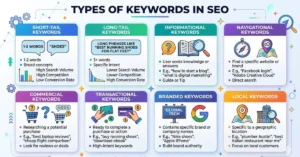
Keywords can be categorized according to purpose. Informational keywords are used when users are searching for information about a topic. Users may want to find out “what is SEO.” On the other hand, transactional keywords are used when users are ready to act. Users may want to buy SEO tools or hire SEO services.
How to Find Keywords
There are several tools and methods available for keyword research. Platforms like Ahrefs and SEMrush provide insights into search volume, competition, and keyword variations.
You can also use autocomplete suggestions from Google, along with the “People also ask” section, to discover related queries. Analyzing competitor content is another effective method, as it reveals which keywords are already driving traffic in your niche.
Understanding Search Intent
Search intent is the reason why someone uses search terms. It is one of the most crucial concepts in today’s SEO landscape.
When users want information on any topic, it is called informational intent. Users’ desire to find a particular site or brand falls under navigational intent. When users are prepared to take an action, it can be called transactional intent.
Matching the right intent will give you better odds at ranking.
On Page SEO Best Practices
On page SEO is where you have the most direct control over your rankings. It involves optimizing individual pages so that both users and search engines can clearly understand your content. When done correctly, on page SEO improves relevance, user experience, and click through rates, all of which influence rankings.
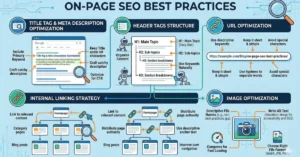
Title Tag and Meta Description Optimization
The title tag is among the most crucial elements on a web page. Search engines use it to understand the essence of your page, and it will be the first item users see when searching. Therefore, the title must contain your main keyword seamlessly and concisely without compromising its attractiveness to readers.
A meta description does not impact rankings but contributes significantly to improving the click through rate. Ideally, a good meta description will be a summary of your page’s contents and offer a convincing reason why users should click. As observed by Backlinko, pages with attractive meta descriptions attract more traffic due to increased engagement.
Header Tags Structure
Header tags make sure that you can present the information in a hierarchical manner. This means that the H1 header is going to show the subject, and H2/H3 headers will split the information into smaller chunks. This way, the text becomes more readable, and Google understands the meaning behind the information presented.
An effective structure will allow readers to navigate through the text more efficiently and thus improve the dwell time. Do not use too many keywords in the headers; it will negatively impact the structure.
URL Optimization
URLs should be simple, descriptive, and easy to understand. A clean URL structure helps both users and search engines identify the topic of the page. Short URLs with relevant keywords tend to perform better than long and complex ones.
For example, a URL like “yourwebsite.com/guide-to-seo” is more effective than one filled with random numbers or unnecessary words. Research from Ahrefs suggests that shorter URLs are often associated with higher rankings, mainly because they are easier to read and share.
Internal Linking Strategy
The internal linking strategy links the pages on your site. Internal linking allows search engines to find new content as well as establish connections between the pages on your site. Good internal linking distributes page authority.
From a visitor’s standpoint, internal linking improves navigation and encourages visitors to visit other pages on your site. As a result, you will have a higher session time, and the bounce rate will be lower.
Image Optimization
While images provide a great user experience, you have to optimize your images effectively to prevent your site from becoming slow. Unoptimized images are one of the things that will make your site load slowly, and a slower loading time is among the ranking factors.
Compressed images with good file names and alt texts can help you achieve both accessibility and SEO benefits from your images. Alt texts enable search engines to determine what the images mean and help blind visitors access your web content too.
The findings of Google show that fast-loading websites are more engaging to users.
Introduction to Technical SEO
Technical SEO refers to making sure that your website performs well when it comes to accessibility and speed. Even the best content won’t work effectively when the technical SEO basics are lacking. You’ll be able to get higher ranking on search engine results when you have good site performance.
Website Speed Optimization
Website speed is an important element for ranking and plays a direct role in the overall user experience. Pages that take a long time to load will discourage users and will result in increased bounce rate. Based on data provided by Google, there is a significant increase in the likelihood of users leaving the website when their page load time goes beyond 1 to 3 seconds.
There are several ways to optimize website speed; these include image optimization, browser caching, script reduction, using quality hosting and content delivery network.
Mobile-Friendly Webpages
Given that the large number of searches being conducted today takes place via smartphones, the need for mobile-friendly webpages is crucial. Search engines operate based on mobile-first indexing, where their main focus is on the mobile version of your webpage when ranking sites.
The design of a responsive website helps to accommodate various screen sizes with similar ease for all users. Having a bad mobile user experience may affect rankings and other factors negatively.
XML Sitemap and Robots.txt
While an XML sitemap serves as a guide map to the search engines, assisting them in knowing the site map of your website and allowing the crawling and indexing process to go smoothly, a robots.txt file allows controlling which sections of your website the search engines will be able to crawl and index.
The latter is needed in order to avoid indexing of extra pages that you do not want to be crawled by the search engines.
Crawl Errors Fix
Crawl errors arise when there are technical problems that prevent crawlers from accessing specific pages on your website. This may result in failure to index some valuable pages.
These may range from dead links, server errors, and status code errors. You can easily spot crawl errors by frequently checking your website using Search Console.
Off Page SEO Techniques
Off page SEO is about improving the reputation of your website outside your own domain. Whereas on page and technical SEO techniques help search engines to read what your website is all about, off page SEO techniques are a message to the search engines about the authority and value that your website holds compared to others.
Link Building Techniques
Link building is the essence of off-page SEO. Link building is the practice of generating backlinks that will lead to your site from other sites. These backlinks are regarded as votes for your website, which means that the more high-quality backlinks your site has, the more authoritative it becomes.
But quality is always more important than quantity when it comes to link building. Just having a handful of backlinks from authority and relevant websites is much better than having a ton of backlinks that aren’t high-quality at all. As stated by Ahrefs in their study, web pages with more referring domains rank higher in search results.
Guest Posting
Guest posting is one method that can be used to obtain backlinks and increase exposure. This means writing blog posts for websites within the same industry and adding a link to your website.
This can be done effectively by ensuring that guest posting is more than just acquiring backlinks but also establishing yourself as an authority in the industry. Only submit articles to websites that will benefit your SEO strategy.
Social Shares and Brand Mentions
The social shares and engagements, although not directly responsible for any improvement in rankings, help make your content visible to more people and attract traffic. More your content gets shared, better are your chances to earn links from those shares.
Another critical factor is that of the brand mentions on the Web. It is very significant to get your brand/website name mentioned again and again in order to establish yourself as an authority.
Essential SEO Tools for Beginners
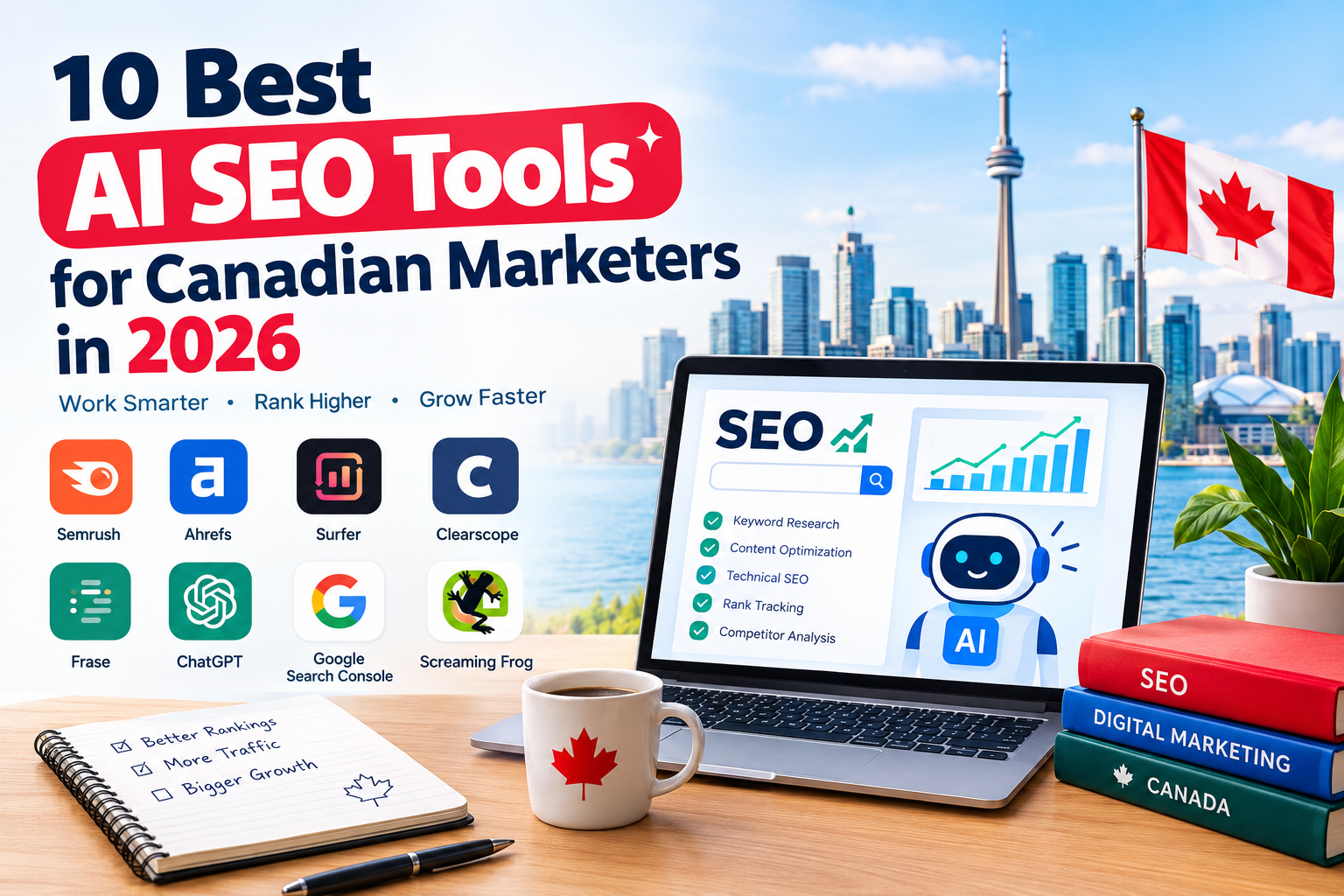
The proper use of tools makes SEO a lot easier to handle and enables you to make informed decisions. Unlike making guesses about which tactics work, SEO tools allow you to have an idea regarding keywords, technicalities, and more. You only need a few important SEO tools as a newbie.
Tools for Keyword Research
These tools will assist you in finding what the audience is looking for as well as the competitiveness of these keywords. These tools provide information about searches made, the level of keyword competition, and also give ideas about other keywords you may need to consider.
For the novice keyword researcher, even using Google autocomplete and its “People also ask” tool will be very insightful.
Technical SEO Tools
The use of technical SEO tools enables you to spot any problem that may arise within your website that could affect its performance or visibility. Using Google Search Console is important because it allows you to check the indexing process and monitor any crawling problems that may arise.
Other tools such as Screaming Frog SEO Spider enable you to audit your website and look at the links within it.
Analytics and Tracking Tools
Analytics tools help you measure the effectiveness of your SEO efforts. Google Analytics provides insights into user behavior, traffic sources, and engagement metrics.
Tracking performance allows you to understand what is working and where improvements are needed. By regularly analyzing data, you can refine your strategy and achieve better long term results.
Step by Step SEO Strategy for Beginners
Building a successful SEO strategy does not require complex tactics in the beginning. What matters is following a structured process and improving consistently over time. The steps below provide a practical roadmap to help beginners move from research to results.
Step 1: Keyword Research
No matter how you wish to optimize, you must first know what your target audience is searching for. It will allow you to recognize some good topics and phrases to write about. Using the help of tools such as Ahrefs and SEMrush, one can collect information regarding traffic.
At this point, one should be choosing long tail keywords for optimization because they are less competitive and more likely to generate traffic.
Step 2: Content Creation
After you get the keyword list, the next process is making high-quality content. Your content must be helpful in solving an actual problem. It will not serve its purpose if you write your content in a way that appeals to search engines.
According to Backlinko’s research, long content performs better in searches as it addresses topics comprehensively.
Step 3: On Page Optimization
Once you have written your content, optimizing that content becomes important. You should optimize content by including your keywords within the title, headings, and other places within your content.
On-page optimization ensures that your website’s content is better understood by search engines and gives a chance to rank high.
Step 4: Technical SEO Corrections
Make sure your website has the proper technical components. These include boosting page speed, repairing broken links, and ensuring mobile compatibility. Tools such as Google Search Console can be used to diagnose technical problems.
An optimal technical structure guarantees efficient crawling and indexing by search engines.
Step 5: Backlinking
Backlink building is necessary for increasing authority. You should earn backlinks from websites related to your niche that have good quality content by means of content marketing and guest posting.
Good backlinks will indicate reliability and ensure competition of your website on SERPs.
Step 6: Monitoring and Optimization
The SEO process never stops. With the help of Google Analytics you can monitor the behavior of users visiting your website.
Analyzing your results on a regular basis and updating your content accordingly will make the process more efficient.
Common SEO Mistakes to Avoid
In addition to using the proper SEO techniques, you should be careful to avoid common mistakes associated with the process. It is surprising how many web pages do not rank high on search engine results because they follow strategies that are ineffective and counterproductive.
Keyword Stuffing
One of the most frequent errors made by website owners is keyword stuffing. Although keywords are a very useful tool, the misuse of them can hurt you and get your page penalized by Google.
Neglecting Technical SEO
While concentrating solely on content is important, neglecting the technical part will not give you desired outcomes. Slow page loading speed, dead links, poor mobile experience and other factors influence both ranking and user experience, and Google Search Console can help to find and resolve such problems quickly.
Backlinks of Poor Quality
It should be remembered that not all backlinks are helpful for boosting rankings. Links from spammy sites can actually be damaging to your website’s reputation. As mentioned by Ahrefs, high quality backlinks have far more influence on rankings compared to the quantity of poor-quality links.
Duplicate Content
The publication of similar content on different pages will just mess up your search engine ranking efforts. It is recommended that each page contain something unique and relevant.
How Long Does SEO Take to Work
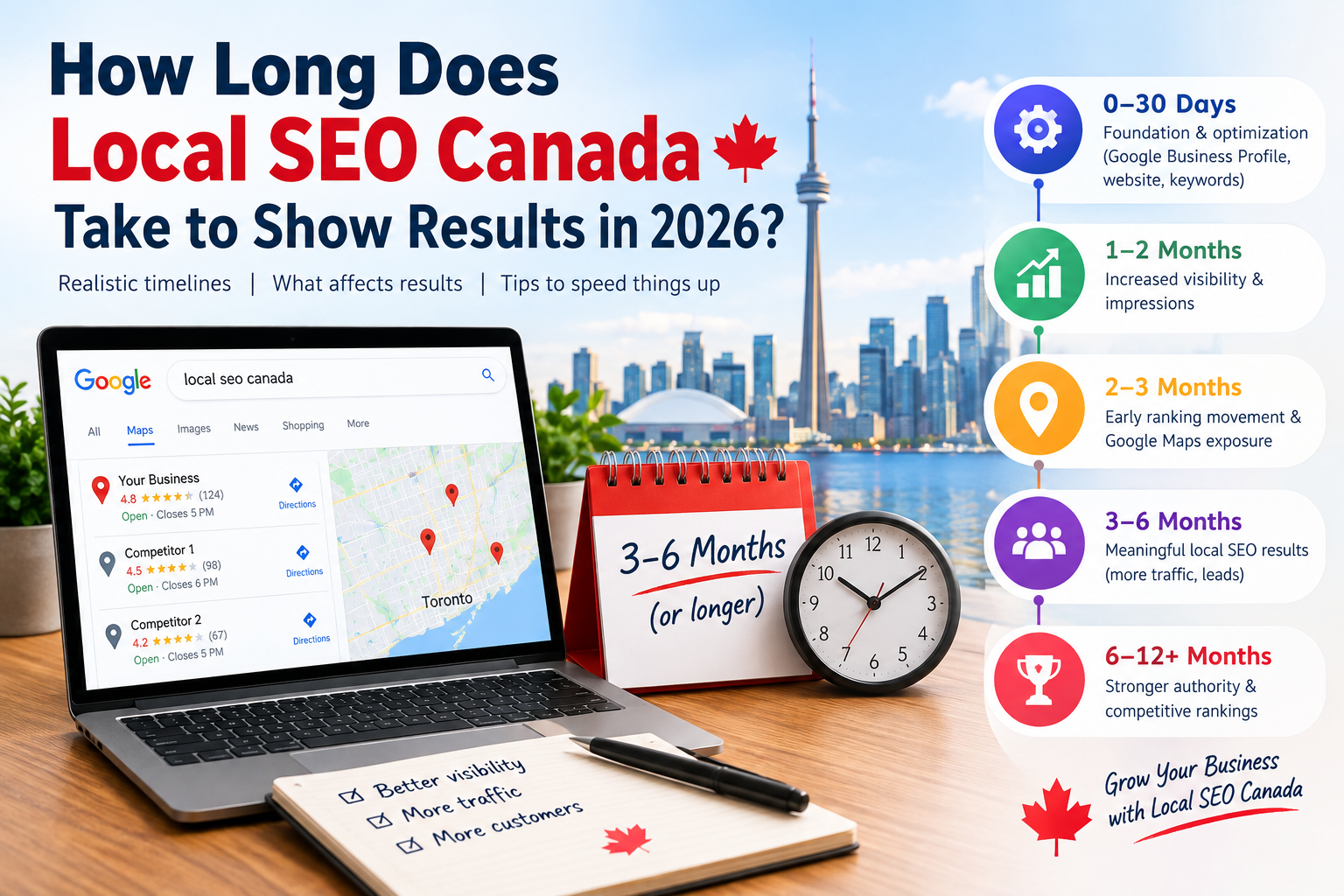
SEO is a long-term process. It doesn’t yield immediate results, unlike ads which provide instant results through traffic generation. SEO involves building authority and ranking to get continuous visibility and traction.
Expected Timeline
It takes 3 to 6 months to see meaningful results with SEO. According to Ahrefs‘ research, the majority of the pages that appear on top positions have been in existence for some months now.
Improvement through indexing, minor rankings, and traffic improvement occurs during the early stages of SEO implementation. However, more significant results like ranking on the first page require more time.
Factors that Affect SEO Outcomes
A number of factors affect the time frame for achieving SEO results. The degree of competitiveness is among those. Competitive industries take longer to rank than niche categories with little competition.
The quality of content also contributes immensely. Quality content ranked high on research is likely to generate results faster due to its ability to meet user intention. Web site authority, which is created through backlinks and brand reputation, affects the time frame for ranking.
Website technical performance is equally significant. A responsive web site ensures efficient crawling and indexing by search engines.
The Future of SEO in 2026 and Further
SEO is developing extremely fast now that search engines are becoming increasingly smart and user-oriented. If you want to be up to date with the competition, it is essential that you familiarize yourself with the latest trends in the field of search.
AI and Search
With the rise of artificial intelligence, searches have completely changed. Instead of focusing only on keywords, search engines are now trying to understand their meaning, intention, and relevance to the actual content. Content thus should not only be informative, but also rich in information. Generic and shallow content does not do well with AI-driven systems.
Voice Search
The trend of voice search is evolving owing to the rise in mobile and assistant use by customers. People are now typing searches using phrases as opposed to short-keywords searches. This will affect how content will be optimized for voice search queries that are conversational in nature.
User Experience Signals
User experience is gaining significance as a ranking factor. Factors like page speed, mobile-friendliness, and user engagement are essential in boosting performance. Google has noted that user experience signals like Core Web Vitals aid in understanding how people engage with a website.
Conclusion
In this guide to SEO, all the fundamentals that will help you establish and expand an organic presence online have been outlined. From comprehending how search engines operate to becoming proficient in keyword research, on-page SEO, technical SEO, and backlinking, all these factors contribute to better rankings and increased visibility.
The point here is very straightforward. Concentrate on developing value-based content and optimize your website’s architecture while building authority over time. SEO is definitely not an overnight solution but requires consistency in effort.
Begin with implementing at least one strategy described in this guide and monitor your development along the way.



This platform completely changed how I approach online gaming. The daily rewards keep my momentum going and the game library never gets stale. I especially love the live chat feature that makes me feel supported from the moment I sign in. Visit surga11login