
What Is Search Engine Marketing and How It Works
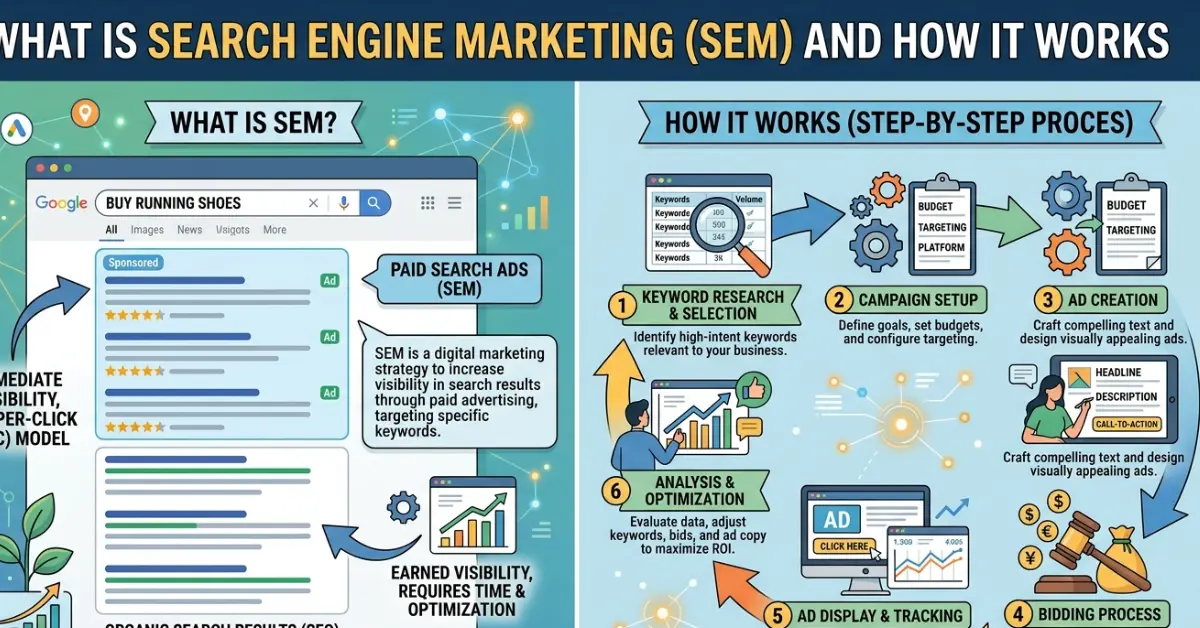
What Is Search Engine Marketing and How It Works is a common question for businesses looking to grow their online presence quickly. Search Engine Marketing (SEM) is a digital marketing strategy that helps businesses reach potential customers through paid ads on search engines. Instead of waiting months to gain organic visibility, SEM allows businesses to appear instantly at the top of search results when users search for specific products or services.
SEM operates on a pay-per-click (PPC) model. This means businesses bid on relevant keywords and pay only when a user clicks their ad. These ads typically appear above or below organic search results, making them highly visible to users with strong purchase intent.
For example, when someone searches for “affordable web hosting,” companies offering hosting services can display ads targeting that keyword. If a user clicks on the ad, the advertiser pays for that click and gains a potential customer.
One of the biggest advantages of SEM is control. Businesses can set budgets, target specific locations, devices, and audiences, and track performance in real time. This makes SEM effective for both small businesses and large enterprises. When combined with strong keyword research and optimized landing pages, SEM becomes a powerful tool for driving targeted traffic, leads, and conversions.
What Is Search Engine Marketing?
Search Engine Marketing (SEM) is a digital marketing strategy that helps businesses promote their products and services through paid advertisements on search engines. When users search for specific keywords, paid ads appear at the top or bottom of the search results, making it easier for businesses to reach people who are actively looking for their offerings.
The main objective of SEM is to connect businesses with high-intent users people who are already searching for a solution, product, or service. Because these users already have intent, SEM often delivers faster results and higher conversion rates compared to many other marketing channels.
Real-World Example
Consider a student searching for: online MBA programs
Universities, colleges, and e-learning platforms frequently run paid ads targeting this keyword. When the user sees the ad and clicks it, they are directed to a landing page with course details, fees, and enrollment options. This works well because the person is already interested in pursuing an MBA, making them more likely to take action.
In short, SEM helps businesses reach the right audience at the right time with measurable and immediate results.
How Search Engine Marketing Works
Search Engine Marketing (SEM) works on a Pay-Per-Click (PPC) model. This means advertisers don’t pay just to display their ads they only pay when someone actually clicks on the ad. This makes SEM a cost-effective way to reach people who are actively searching for products or services.
Here’s how the process works: businesses choose relevant keywords related to their products, create ads, and place bids on those keywords. When someone searches for those keywords, the search engine runs a real-time auction to decide which ads appear and in what order. The ad position depends on factors like bid amount, ad quality, and relevance.
For example, if a company sells digital marketing courses, it might bid on keywords like “digital marketing training online.” When a user searches for that term, the company’s ad can appear at the top of the results. If the user clicks on the ad, the company pays for that click.
This model allows businesses to control their budget, target specific audiences, and measure performance accurately, making SEM a powerful and scalable marketing strategy.
SEM Workflow Overview
|
Step |
Description | Purpose |
|
Keyword Selection |
Identify relevant search terms |
Reach targeted users |
|
Ad Creation |
Write ad headlines and descriptions |
Attract clicks |
|
Bidding |
Set a maximum cost per click |
Control budget |
| Auction Process | Search engine ranks ads |
Determines ad position |
| User Clicks | User clicks the ad |
You pay for that click |
Real-World Example
A cleaning company bids on: home cleaning services near me
When users search this term, the company’s ad appears. They pay only when someone clicks, ensuring cost efficiency.
Why Businesses Use Search Engine Marketing
Businesses use Search Engine Marketing (SEM) because it delivers fast, measurable, and highly targeted results. Unlike organic marketing methods that can take months to show results, SEM allows businesses to appear at the top of search results almost instantly. This immediate visibility is especially useful for new businesses, product launches, or time-sensitive promotions.
One of the biggest advantages of SEM is its ability to reach people with high purchase intent. When someone searches for a product or service, they are already interested making them more likely to click an ad and convert. This makes SEM a powerful channel for generating qualified leads and sales.
Another major benefit is budget control. Businesses can set daily or monthly budgets, adjust bids, and scale campaigns up or down based on performance. This flexibility allows both small businesses and large enterprises to compete effectively.
SEM also provides detailed performance data, including clicks, impressions, conversions, and return on investment. This data helps marketers understand what works, optimize campaigns, and improve overall results. Because of its speed, precision targeting, and measurable outcomes, SEM remains a key component of modern digital marketing strategies.
Key Benefits of SEM
|
Benefit |
Explanation |
|
Immediate Visibility |
Ads appear instantly after campaign launch |
| Highly Targeted |
Reach users by keyword, location, device |
| Budget Control |
Set daily or monthly budgets |
| Measurable Results |
Track clicks, conversions, and ROI |
| Scalability |
Increase or decrease spend anytime |
Example
A new skincare brand might run ads on keywords like: “natural skincare products”
Instead of waiting for SEO rankings, SEM brings immediate traffic and sales.
Search Engine Marketing for Small Businesses
Small businesses benefit greatly from SEM because it levels the playing field with larger competitors.
How SEM Helps Small Businesses
|
Benefit |
Impact |
|
Local Reach |
Attract nearby customers |
|
Budget Flexibility |
Spend based on capacity |
|
High Intent Leads |
Reach people ready to buy |
| Quick Results |
Generate traffic immediately |
Example
A local bakery runs ads for: “custom birthday cakes near me”
This allows them to compete directly with larger bakeries in the area.
SEO vs SEM: Key Differences
Although both aim to increase visibility, SEO and SEM work differently.
SEO vs SEM Comparison
|
Factor |
SEM | SEO |
|
Cost |
Paid | Free (organic) |
| Speed | Instant |
Takes time |
|
Placement |
Paid ads | Organic listings |
| Control | High |
Limited |
| Longevity | Ends when budget stops | Long-term benefits |
Example
Search for “project management software.”
You’ll see paid ads at the top (SEM), followed by organic listings (SEO). Businesses often use both for maximum visibility.
What Is Quality Score in Google Ads?
Quality Score is a performance metric used by Google Ads to measure the relevance and overall quality of your ads, keywords, and landing pages. It plays a major role in determining how often your ad appears, where it appears, and how much you pay per click.
Quality Score is measured on a scale from 1 to 10, with 10 being the highest. A higher score means Google considers your ad more relevant and useful to users, which can lower your cost per click (CPC) and improve your ad position.
What Affects Quality Score?
| Factor |
What It Means |
|
Ad Relevance |
How closely your ad matches the user’s search intent |
|
Expected Click-Through Rate (CTR) |
The likelihood users will click your ad |
|
Landing Page Experience |
Page speed, relevance, mobile-friendliness, and clarity |
Why Quality Score Matters
A high Quality Score helps you:
- Pay less for each click
- Achieve better ad positions
- Improve campaign performance
Example
If you advertise for “running shoes”, but your landing page shows unrelated products, your Quality Score will drop. This increases your cost and reduces visibility. However, a well-matched ad and landing page can lower costs and boost conversions.
Building a Successful SEM Strategy
A strong Search Engine Marketing strategy doesn’t rely on guesswork. It combines careful planning, keyword targeting, strong ad copy, and continuous optimization. Each stage directly affects campaign performance, cost efficiency, and return on investment.
1. Keyword Research
Keyword research helps you understand what your target audience is searching for and how competitive those searches are. Selecting the right keywords ensures your ads reach users who are more likely to convert.
|
Keyword Type |
Example | Intent |
|
Broad |
shoes | General interest |
|
Phrase |
running shoes |
Product-focused |
| Long-Tail | best running shoes for flat feet |
High purchase intent |
Long-tail keywords often deliver better conversions and lower costs.
Explanation:
Broad keywords generate more traffic but often bring low-intent visitors. Phrase keywords offer better targeting by focusing on product intent. Long-tail keywords usually have lower search volume but higher conversion rates because they reflect specific user needs. For example, someone searching for “best running shoes for flat feet” is closer to making a purchase than someone searching just “shoes.”
2. Writing Effective Ads
Ad copy plays a major role in attracting clicks. Well-written ads increase click-through rates and help improve Quality Score, which lowers advertising costs.
|
Element |
Best Practice |
|
Headline |
Include primary keyword |
| Description |
Highlight benefits |
| CTA |
Encourage action (Buy Now, Learn More) |
Explanation:
Your headline should match the user’s search intent. The description should highlight value, such as savings, quality, or unique features. A clear call-to-action motivates users to click. For instance, “Lightweight Running Shoes – Free Shipping” is more compelling than simply “Buy Shoes” because it includes a benefit and a reason to act.
Example
Instead of:
“Buy Shoes”
Use:
“Lightweight Running Shoes – Free Shipping”
3. Landing Page Optimization
Your landing page is where users decide whether to take action. Even the best ad won’t perform well if the landing page doesn’t deliver a good user experience.
|
Element |
Why It Matters |
|
Relevance |
Matches user intent |
|
Load Speed |
Improves user experience |
| Clear CTA |
Increases conversions |
| Mobile Friendly |
Captures mobile traffic |
Explanation:
If users click an ad for running shoes, they expect to see relevant products, not a generic homepage. Fast-loading pages reduce bounce rates, and clear calls-to-action like “Buy Now” or “Get a Quote” guide users toward conversion. Mobile optimization is critical because most searches now happen on smartphones.
4. Choosing the Right Bidding Strategy
Selecting the right bidding strategy helps control costs and achieve specific marketing goals.
|
Goal |
Recommended Strategy |
|
Increase Traffic |
Maximize Clicks |
| Generate Leads |
Maximize Conversions |
| Control Costs |
Target CPA |
Explanation:
If your goal is brand awareness, maximizing clicks can drive more visitors to your site. For lead generation, maximizing conversions focuses on users more likely to complete actions like form submissions. Target CPA (Cost Per Acquisition) helps control how much you pay for each conversion.
PPC Optimization Tips
Optimizing your PPC campaigns ensures you get better results while reducing unnecessary spending.
PPC Best Practices
|
Strategy |
Benefit |
|
Improve Quality Score |
Lower CPC |
| Use Negative Keywords |
Reduce wasted spend |
| A/B Testing |
Improve ad performance |
| Track Metrics |
Increase ROI |
Explanation:
Improving Quality Score makes your ads more competitive and reduces cost per click. Negative keywords help avoid irrelevant searches, saving money. A/B testing different headlines, descriptions, or landing pages helps identify what works best. Tracking key metrics like click-through rate, cost per click, and conversion rate allows data-driven improvements.
Example
A premium furniture brand might exclude keywords like: “cheap furniture”
to avoid irrelevant traffic.
SEM Campaign Optimization
Ongoing optimization is necessary to maintain and improve performance over time.
|
Area |
Optimization Action |
|
Keywords |
Remove low performers |
|
Ads |
Test new headlines |
| Budget |
Focus on high-ROI keywords |
| Audience |
Refine targeting |
Explanation:
Review keyword performance regularly and remove those that don’t generate conversions. Testing new ad variations helps improve engagement. Shifting budget toward high-performing keywords maximizes ROI. Refining audience targeting ensures ads reach the most relevant users.
Common SEM Mistakes to Avoid
Avoiding common mistakes can save budget and improve campaign success.
|
Mistake |
Consequence |
|
Broad Keywords Only |
Wasted budget |
|
Poor Landing Pages |
Low conversions |
| No Tracking |
No performance insight |
| Ignoring Mobile |
Missed traffic |
Explanation:
Relying only on broad keywords can attract irrelevant traffic. Poor landing pages result in low conversions even if clicks are high. Without tracking, you cannot measure success or optimize effectively. Ignoring mobile optimization leads to missed opportunities, as most searches happen on mobile devices.
Why SEM Still Matters Today
SEM remains a powerful marketing channel because it targets users who are ready to act.
|
Reason |
Benefit |
|
High Intent Users |
Better conversion potential |
|
Measurable Results |
Easy ROI tracking |
| Flexible Budgets |
Control spending |
| Scalable |
Grow campaigns easily |
Explanation:
SEM allows businesses to reach users actively searching for products or services, leading to higher conversion rates. Every click and conversion can be tracked, making ROI measurable. Flexible budgets allow businesses to start small and scale as performance improves.
Conclusion
Search Engine Marketing (SEM) is one of the most effective ways to connect with customers exactly when they are searching for products or services. By placing ads in front of high-intent users, businesses can generate traffic, leads, and sales faster than many other digital marketing methods.
A successful SEM strategy combines smart keyword research, relevant ad copy, optimized landing pages, and continuous performance tracking. When these elements work together, businesses can improve ad visibility, reduce costs, and increase conversions. Because SEM provides measurable data, advertisers can refine their campaigns over time and make smarter decisions based on real performance metrics.
When used alongside Search Engine Optimization (SEO), SEM creates a balanced digital marketing strategy. While SEO builds long-term organic visibility, SEM delivers immediate results and targeted traffic. Together, they help businesses achieve both short-term wins and sustainable growth, making SEM an essential part of a modern marketing strategy.
Frequently Asked Questions (FAQs)
1. What is search engine marketing?
SEM is a paid advertising strategy used to promote businesses on search engines.
2. How does SEM work?
Advertisers bid on keywords, create ads, and pay when users click.
3. What is an example of SEM?
A restaurant running ads for “best pizza near me” is a common example.
4. How is SEM different from SEO?
SEO focuses on organic rankings, while SEM involves paid ads.
5. What is Quality Score?
Quality Score measures ad relevance and affects cost and placement.
6. Is SEM good for small businesses?
Yes, it helps small businesses reach targeted customers quickly.
7. How much does SEM cost?
Costs depend on industry, keywords, and competition.
8. What are negative keywords?
They prevent ads from showing for irrelevant searches.
9. How can I improve SEM performance?
Improve Quality Score, optimize ads, and refine targeting.
10. Can SEM and SEO work together?
Yes. Combining both improves visibility and performance.

2 thoughts on “What Is Search Engine Marketing and How It Works”