
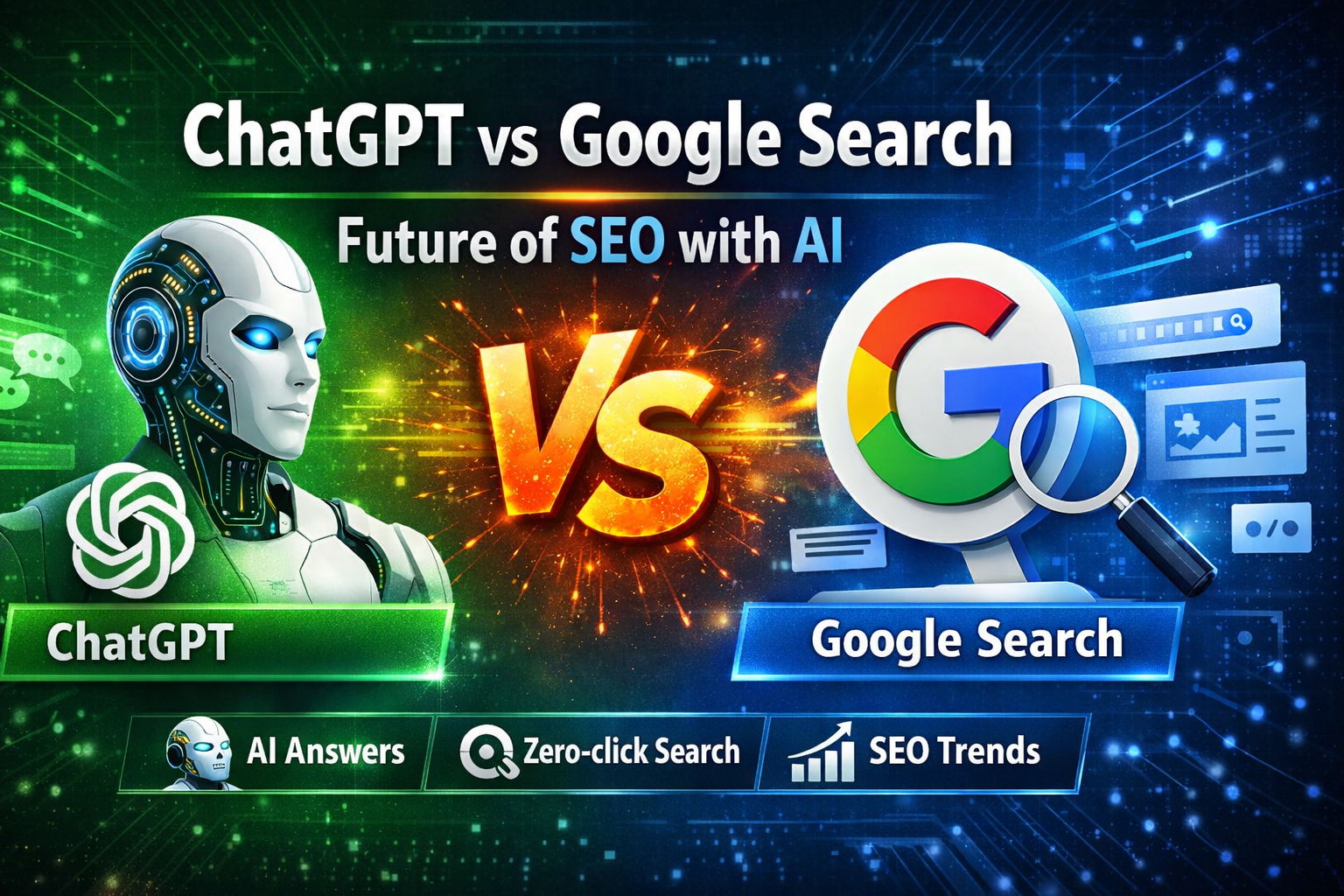
ChatGPT vs Google Search: Which One Is Better in 2026?
Search has evolved far beyond typing a few keywords and scrolling through blue links. In 2026, users expect instant answers, deeper context, and personalized experiences—often within seconds. This shift has sparked a major debate: ChatGPT vs Google Search—which one truly delivers better results?
On one side, you have ChatGPT, a conversational AI tool designed to provide direct, human-like answers. On the other, Google Search remains the world’s most trusted platform for discovering information across billions of web pages.
But this isn’t just a comparison between two tools—it’s a shift in how people interact with information.
Are AI chatbots replacing traditional search engines?
Is ChatGPT better than Google for everyday queries?
Or do both serve completely different purposes?
The reality is more nuanced than most headlines suggest.
In this guide, we’ll explore the real differences between an AI chatbot and a search engine, compare natural language search vs keyword search, and help you understand when to use each. No hype, no assumptions—just practical insights you can actually use.
What is ChatGPT?
ChatGPT is a conversational AI tool developed by OpenAI that allows users to interact with technology using natural language instead of traditional search queries.
Instead of showing a list of links like a search engine, ChatGPT generates direct, human-like responses to questions. It helps users understand complex topics, create content, solve problems, and even make decisions faster.
This shift from “searching” to “asking” is what makes ChatGPT a key part of the conversational AI search engine trend.
What Makes ChatGPT Different?
- Direct Answers, Not Links
You get clear responses without jumping between multiple websites. - Understands Context and Follow-Ups
Ask another question, and it remembers the conversation. - Step-by-Step Explanations
It breaks down complex ideas into simple, easy-to-follow steps. - Multi-Purpose Use Cases
From writing blogs to debugging code, it acts like an all-in-one assistant.
Think of ChatGPT as a smart digital assistant—one that doesn’t just find information but actually helps you understand and use it effectively.
What is Google Search?
Google Search is the world’s most widely used search engine, developed by Google. It helps users discover information by indexing and ranking billions of web pages across the internet.
Instead of providing a single direct answer, Google Search delivers multiple results from different sources, allowing users to compare, verify, and explore information in depth. These results are ranked using complex algorithms that evaluate relevance, quality, and trust signals.
According to industry reports like StatCounter, Google consistently holds over 90% of global search market share, making it the dominant platform for online discovery.
What Makes Google Search Powerful?
- Access to Real-Time Information
Get the latest updates on news, trends, and events as they happen. - Multiple Sources for Verification
Compare different websites to ensure accuracy and reliability. - Advanced Ranking Systems
Google prioritizes helpful, trustworthy content based on guidelines from Google Search Central. - Diverse Content Formats
Results include web pages, images, videos, maps, and more.
Think of Google Search as a powerful discovery engine—it doesn’t just answer your question, it helps you explore the entire web.
What Makes Google Search Powerful?
- Real-Time Web Access
Google Search provides up-to-date information, including breaking news, live events, and trending topics—something AI tools may not always deliver instantly. - Billions of Indexed Pages
Powered by Google, the search engine continuously crawls and indexes vast amounts of content across the web, giving users access to diverse perspectives. - Strong Ranking Systems Based on EEAT
Google evaluates content using quality signals like Experience, Expertise, Authority, and Trust, as outlined by Google Search Central. This helps surface reliable and helpful results. - Multi-Format Results
Users can access web pages, videos, images, maps, and shopping results—all in one place.
According to industry data (such as StatCounter), Google holds over 90% of the global search market share, making it the most dominant discovery platform on the internet.
In simple terms, Google doesn’t just find information—it helps you explore, compare, and verify it at scale.
ChatGPT vs Google Search: Quick Comparison Table
| Feature | ChatGPT | Google Search |
|
Type |
AI chatbot | Search engine |
|
Output |
Direct, conversational answers | Links to multiple websites |
|
Data Source |
Trained models + updates |
Real-time web indexing |
| Interaction | Natural language (conversation) |
Keyword-based queries |
| Speed | Instant responses |
Depends on browsing and clicks |
| Best For | Learning, writing, explanations |
Research, news, shopping, navigation |
Key Takeaway
At a fundamental level, the difference between an AI chatbot vs search engine comes down to how information is delivered.
- ChatGPT focuses on giving you a single, clear answer in a conversational format.
- Google Search focuses on giving you multiple sources so you can explore and verify information yourself.
Simple truth:
ChatGPT gives answers. Google gives choices.
And in real-world usage, the smartest approach isn’t choosing one—it’s knowing when to use each.
AI Chatbot vs Search Engine: Key Differences Explained
Understanding the difference between an AI chatbot vs search engine helps you choose the right tool for the right task. While both aim to deliver information, they do it in completely different ways.
1. Information Delivery
- ChatGPT → Provides summarized, human-like answers in a single response
- Google Search → Shows multiple sources so users can compare and explore
ChatGPT saves time. Google offers depth and variety.
2. User Experience
- ChatGPT → Fully conversation-based, like chatting with an expert
- Google → Traditional search-result browsing, requiring multiple clicks
ChatGPT feels more intuitive. Google gives you more control.
3. Control Over Information
- ChatGPT → Limited source visibility unless you ask for it
- Google → Full transparency with clickable links and references
If verification matters, Google has the edge.
4. Accuracy Approach
- ChatGPT → Generates responses based on training and patterns
- Google → Aggregates real-world content from trusted websites
Google relies on published sources, while ChatGPT focuses on explanation.
Final Insight
This comparison highlights a key shift in how we search:
- ChatGPT represents conversational AI search engines
- Google represents traditional keyword-based search systems
Both are powerful—but they serve different purposes.
Natural Language Search vs Keyword Search
This is where the biggest transformation in search behavior is happening. Users are moving from typing short keywords to asking complete, meaningful questions.
Comparison Table
| Type | Example Query | Platform |
| Natural Language Search | “Explain SEO for beginners step by step” | ChatGPT |
| Keyword Search | “SEO basics guide” | Google Search |
What’s Changing?
Natural language search allows users to interact with AI in a more human and conversational way. Instead of guessing the right keywords, users can simply ask what they want to know.
Keyword search, on the other hand, still relies on short, optimized phrases to match relevant web pages.
Key Insights
- Natural language search feels intuitive and human
You ask questions the way you speak, and the system understands intent. - Keyword search is fast and structured
It helps you quickly scan multiple sources and find specific information.
Why This Matters for SEO
This shift is redefining how content should be created. Search engines and AI tools now prioritize:
- Clear answers to specific questions
- Context-rich content
- Topic depth over keyword stuffing
In simple terms, the future of SEO is not just about ranking for keywords—it’s about answering real user questions effectively.
Google AI Overview vs ChatGPT
Google has started integrating AI directly into search results through AI-generated summaries, often referred to as AI Overviews. This move positions Google Search to compete more directly with conversational tools like ChatGPT.
While both use AI, their approach to delivering information is very different.
Comparison Table
| Feature | Google AI Overview | ChatGPT |
| Source Visibility | High (includes links to websites) | Limited (unless requested) |
| Depth of Information | Summary-level insights | Detailed, step-by-step explanations |
| Personalization | Low to moderate | High (based on conversation) |
| Interaction Style | Static (one-time response) | Interactive (ongoing conversation) |
Key Differences Explained
- Transparency vs Convenience
Google AI Overviews show where the information comes from, helping users verify sources. ChatGPT focuses on delivering a clean, direct answer without requiring extra clicks. - Summarization vs Explanation
Google provides quick summaries to guide users toward websites, while ChatGPT dives deeper to fully explain the topic. - Search Journey vs Answer Completion
Google still acts as a discovery platform, sending users to external sites.
ChatGPT acts as a destination, aiming to complete the user’s query within the conversation itself.
Simple takeaway:
Google helps you explore the web.
ChatGPT helps you understand it instantly.
Real-World Examples: When to Use What
Example 1: Learning a Skill
Query: “How does SEO work?”
- ChatGPT → Gives step-by-step explanation
- Google → Shows blogs, videos, courses
Best choice: ChatGPT for understanding, Google for deeper research
Example 2: Latest News
Query: “Latest AI updates 2026”
- ChatGPT → May summarize
- Google → Shows real-time news
Best choice: Google
Example 3: Writing Content
Query: “Write a blog intro for digital marketing”
- ChatGPT → Generates content instantly
- Google → Helps you research
Best choice: ChatGPT
Example 4: Buying a Product
Query: “Best smartphones under ₹20,000”
- ChatGPT → Suggestions
- Google → Reviews, pricing, comparisons
Best choice: Google
Why ChatGPT is Better Than Google (In Some Cases)
Let’s be practical—not biased.
- Faster Answers
No need to open multiple tabs.
- Better Learning Experience
It explains like a teacher, not a directory.
- Content Creation Power
Writers, marketers, and students benefit the most.
- Context Awareness
You can ask follow-ups without starting over.
Small humor:
Google gives you 10 links.
ChatGPT gives you the answer—and saves your coffee from getting cold.
Where Google Still Dominates
Even with AI growth, Google isn’t going anywhere.
1. Real-Time Information
Breaking news, stock updates, live events
2. Trust & Authority
Google ranks content based on signals explained by Google Search Central.
3. Local Search
Maps, reviews, directions—ChatGPT can’t match this yet.
4. Can ChatGPT Replace Google Search?
Let’s answer this clearly.
No, ChatGPT cannot fully replace Google.
But it can replace:
- Basic research
- Content writing
- Learning tasks
It cannot replace:
- Real-time search
- Navigation (maps, shopping)
- Source verification
Final thought:
ChatGPT changes how we search, not replaces search itself.
Conversational AI Search Engine: The Future
Search is moving toward conversation-first experiences.
Users now prefer:
- Asking questions
- Getting instant explanations
- Avoiding information overload
This trend is pushing both Google and AI tools to evolve.
SEO Impact: What Marketers Must Understand
1. Content Must Be Answer-Focused
AI tools prefer clear, structured answers.
2. EEAT is Critical
Trust signals matter more than ever.
3. Semantic SEO Wins
Cover topics deeply—not just keywords.
4. Structure for AI + Google
- Short paragraphs
- Clear headings
- Direct answers
ChatGPT vs Google: Final Verdict
After comparing features, use cases, and real-world performance, the answer becomes clear—there’s no single winner. It depends on what you want to achieve.
Use Case Comparison
| Use Case | Winner |
| Learning & Understanding | ChatGPT |
| In-Depth Research | Google Search |
| Content Writing | ChatGPT |
| Latest News & Updates | Google Search |
| Shopping & Local Search | Google Search |
What This Really Means
- Choose ChatGPT when you need clear explanations, quick answers, or content creation
- Choose Google Search when you need real-time data, multiple sources, or verification
The Smarter Approach
The debate around “chatgpt vs google which is better” misses a key point—these tools are not direct replacements. They are complements.
Smart users don’t pick sides. They build a workflow:
- Use ChatGPT to understand a topic quickly
- Use Google to verify facts and explore deeper
- Combine both for better decisions
Final takeaway:
The real winner isn’t ChatGPT or Google—it’s the user who knows how to use both strategically.
Because in 2026, search isn’t about tools anymore.
It’s about how intelligently you use them.
Final Thought
The debate around chatgpt vs google which is better often misses the bigger picture.
This isn’t a battle between tools. It’s a shift in how we search, learn, and make decisions online.
ChatGPT represents the future of understanding information through conversation, while Google Search remains the backbone of discovering and verifying information at scale.
Instead of choosing one over the other, the real advantage comes from using both strategically.
- Use ChatGPT to understand concepts quickly
- Use Google to verify facts and explore multiple sources
This hybrid approach saves time, improves accuracy, and helps you make smarter decisions.
The real shift isn’t about replacing search engines—it’s about evolving how we interact with information.
And in 2026, the smartest users aren’t the ones who pick sides.
They’re the ones who know how to use both tools together effectively.
FREQUENTLY ANSWERED QUESTIONS
1. What is the main difference between ChatGPT and Google?
ChatGPT provides direct answers, while Google shows links to multiple sources.
2. Is ChatGPT better than Google?
It depends on the task. ChatGPT is better for explanations, Google is better for research.
3. Can ChatGPT replace Google Search?
No, but it can replace some use cases like learning and content creation.
4. Why is ChatGPT so popular?
Because it simplifies complex topics and provides conversational responses.
5. What is an AI chatbot vs search engine?
An AI chatbot generates answers, while a search engine retrieves web results.
6. Which is more accurate: ChatGPT or Google?
Google is generally more reliable because it provides multiple verifiable sources.
7. What is natural language search?
It allows users to ask full questions instead of typing keywords.
8. What is Google AI Overview?
It’s an AI-generated summary shown in search results with source links.
9. Is ChatGPT safe for research?
Yes, but always verify important information using trusted sources.
10. Will AI replace search engines?
AI will transform search, but not completely replace traditional search engines.


1 thought on “ChatGPT vs Google Search: Which One Is Better in 2026?”