
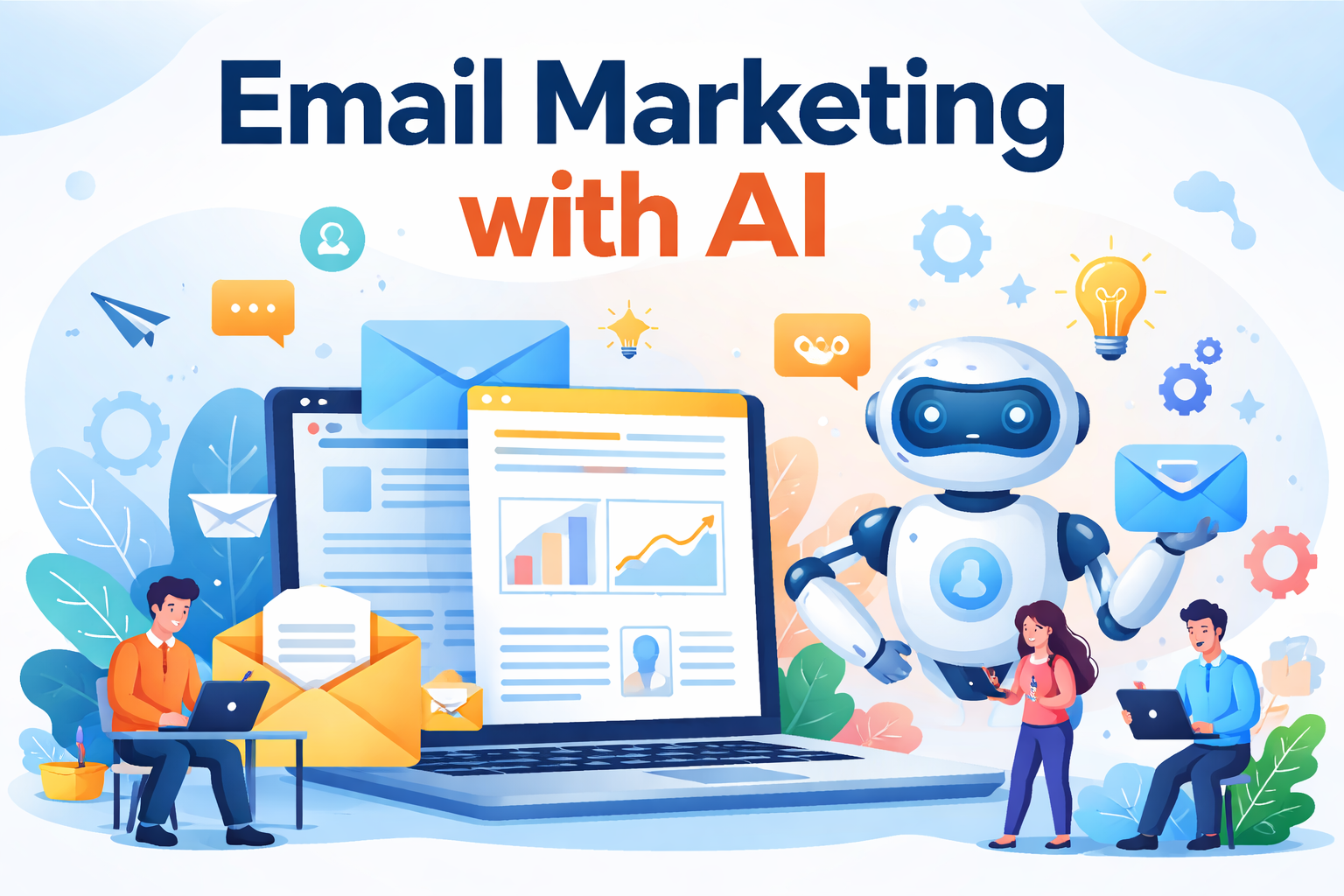
Email marketing still delivers one of the highest ROI among all digital channels. However, the landscape has changed significantly. Today, users receive dozens of emails every day, and most of them get ignored or deleted without a second glance. Generic campaigns no longer capture attention, and basic segmentation alone is not enough to drive meaningful engagement or conversions.
This is where Email Marketing with AI creates a powerful competitive advantage. Instead of relying on guesswork, artificial intelligence uses real-time data, behavioral insights, and predictive analytics to optimize every part of your email strategy. It helps you understand not only what your audience has done in the past, but also what they are likely to do next.
From generating high-performing subject lines to delivering hyper-personalized content, AI transforms how brands communicate with their audience. It allows marketers to send the right message at the right time, tailored to each individual user’s preferences and behavior.
As competition increases, businesses that adopt AI-driven email strategies can improve engagement, boost conversions, and scale their campaigns more efficiently than ever before.
What Is Email Marketing with AI? (Quick Answer)
Email marketing with AI is the use of artificial intelligence technologies—such as machine learning, natural language processing, and predictive analytics—to automate, personalize, and optimize email campaigns using real-time user data. Instead of relying on manual decisions and assumptions, AI analyzes large volumes of data to identify patterns, predict user behavior, and improve campaign performance.
At its core, AI helps marketers send the right message to the right person at the right time—without constant manual effort. It can automatically segment audiences, generate personalized content, and determine the best time to deliver emails based on user engagement patterns.
For example, AI can recommend products to returning customers, trigger welcome emails for new subscribers, and re-engage inactive users with targeted offers. This level of precision allows businesses to move beyond generic campaigns and create highly relevant, one-to-one communication at scale.
As a result, AI-driven email marketing improves open rates, click-through rates, and conversions while saving time and resources. It turns email marketing from a basic outreach tool into a smart, data-driven growth engine.
Why AI Is Transforming Email Marketing
Artificial intelligence is transforming email marketing because it replaces guesswork with data-driven precision. Traditional campaigns rely on static lists and broad assumptions, which often fail to match user intent. AI changes this by enabling dynamic targeting that adapts to user behavior in real time.
With AI, marketers can analyze how users interact with emails, websites, and products. This allows them to deliver highly relevant messages that feel personalized rather than generic. As a result, engagement rates improve and users are more likely to take action.
AI helps you:
- Personalize emails at scale without increasing workload
- Automate repetitive tasks like segmentation and scheduling
- Predict customer actions based on behavior and trends
- Improve conversions through smarter targeting
Another major advantage is efficiency. Tasks that once required hours of manual effort can now be handled automatically using automated email marketing software. This allows marketers to focus more on strategy and creativity instead of routine execution.
As competition increases, businesses that adopt AI-driven email marketing gain a clear edge by delivering faster, smarter, and more relevant campaigns.
Benefits of AI in Email Marketing
Artificial intelligence improves both efficiency and performance in email marketing. Instead of relying on manual processes and assumptions, AI uses data-driven insights to optimize every stage of your campaigns. This results in faster execution, better targeting, and higher overall returns.
One of the biggest advantages is personalization at scale. AI can tailor emails based on user behavior, preferences, and past interactions, which leads to higher engagement and conversions. At the same time, automation reduces repetitive tasks such as segmentation, scheduling, and testing, allowing marketers to focus on strategy.
AI also introduces predictive analytics, which helps identify high-intent users and target them more effectively. Send-time optimization ensures emails reach users when they are most likely to open them, increasing visibility and engagement. In addition, AI-powered content generation speeds up campaign creation without sacrificing quality.
Key Benefits Overview
| Benefit | Impact on Performance |
| Personalization | Higher engagement & conversions |
| Automation | Saves time and manual effort |
| Predictive Analytics | More accurate targeting |
| Send-Time Optimization | Increased open rates |
| Smart Content Generation | Faster campaign execution |
Businesses using AI-driven marketing automation consistently outperform traditional campaigns by combining speed, precision, and scalability.
Email Marketing Statistics (Trusted Data)
Data-backed insights play a crucial role in building trust and improving SEO performance. They also help marketers make informed decisions instead of relying on assumptions. The growth of AI in email marketing is strongly supported by reliable industry research.
According to HubSpot, segmented email campaigns can generate up to 30% higher open rates and 50% more click-through rates compared to non-segmented campaigns. This highlights the importance of targeting and personalization in modern email strategies.
Research from Statista shows that the number of global email users is expected to reach 4.6 billion by 2027, confirming that email remains one of the most widely used communication channels worldwide. Despite the rise of social media, email continues to deliver consistent engagement and ROI.
In addition, Salesforce reports that 84% of customers expect personalized experiences when interacting with brands. This clearly indicates a shift in user expectations toward more relevant and tailored communication.
These statistics make one thing clear: businesses that adopt AI-driven marketing automation and personalization strategies are better positioned to improve engagement, increase conversions, and stay competitive in a rapidly evolving digital landscape.
How AI Works in Email Marketing
AI in email marketing works by collecting, processing, and analyzing large amounts of user data to make smarter decisions. It gathers information from multiple touchpoints, including website visits, email interactions, and purchase behavior. This data forms the foundation for all AI-driven actions.
Once collected, machine learning algorithms analyze this data to identify patterns and trends. They determine which users are more likely to open emails, what type of content drives engagement, and which segments generate the highest conversions. This allows marketers to move beyond assumptions and rely on real insights.
AI systems then:
- Identify behavior patterns
- Predict future user actions
- Automatically segment audiences
Based on these insights, AI can personalize content and trigger campaigns in real time. For example, if a user browses a product but does not purchase, the system can automatically send a follow-up email with a relevant offer.
This process enables customer journey automation, where emails are triggered based on user behavior rather than fixed schedules. Over time, AI continues to learn and improve, making campaigns more accurate, efficient, and results-driven.
AI vs Traditional Email Marketing
Understanding the difference between traditional and AI-powered email marketing highlights why more businesses are shifting toward automation and data-driven strategies. Traditional email marketing relies heavily on manual processes, fixed schedules, and broad audience segments. While it can still deliver results, it often lacks precision and scalability.
AI-based email marketing, on the other hand, uses real-time data and machine learning to optimize every aspect of a campaign. It automatically analyzes user behavior, adapts messaging, and improves performance over time. This allows marketers to deliver more relevant and timely content without increasing manual effort.
Comparison Overview
| Feature | Traditional | AI-Based |
| Segmentation | Manual | Automated (behavior-based) |
| Personalization | Basic | Advanced & dynamic |
| Timing | Fixed schedules | Optimized per user |
| Testing | Manual A/B testing | Continuous AI optimization |
| Scalability | Limited | Highly scalable |
With AI, campaigns become more efficient, targeted, and adaptable. Instead of relying on assumptions, marketers can use real insights to drive decisions and improve outcomes.
AI clearly outperforms traditional methods by combining automation, personalization, and predictive intelligence.
Real-World Case Study: AI in Action
To understand the real impact of AI in email marketing, consider a practical example from an ecommerce business. A mid-sized brand implemented AI-driven campaigns using predictive segmentation, personalized content, and automated workflows. Their primary goal was to improve engagement and increase revenue from existing email subscribers.
Within just 90 days, the results were significant and measurable:
- Open rates increased by 22%
- Click-through rates (CTR) improved by 31%
- Email-driven revenue grew by 18%
These improvements did not come from increasing email volume. Instead, the brand focused on delivering more relevant content to the right users at the right time. AI analyzed customer behavior, identified high-intent segments, and triggered personalized emails based on user actions.
For example, returning customers received product recommendations, while inactive users received targeted re-engagement offers. This approach reduced wasted impressions and improved overall campaign efficiency.
These results align with research from McKinsey, which shows that personalization can significantly boost marketing performance and customer engagement.
The key takeaway: AI doesn’t just automate campaigns—it enhances targeting, improves decision-making, and drives measurable business growth.
Key Use Cases of AI in Email Marketing
Artificial intelligence is not limited to one function in email marketing. It supports multiple use cases that improve efficiency, personalization, and overall campaign performance. By leveraging AI, businesses can create smarter, more targeted campaigns that adapt to user behavior in real time.
One of the most powerful use cases is personalized campaigns. AI analyzes user data such as browsing history, purchase behavior, and engagement patterns to deliver content tailored to each subscriber. This increases relevance and boosts conversions.
Another important use case is predictive segmentation. Instead of grouping users manually, AI identifies patterns and automatically segments audiences based on behavior and intent. This ensures that the right message reaches the right audience.
Send-time optimization is also a key advantage. AI determines when each user is most likely to open emails and schedules delivery accordingly, improving open rates and engagement.
Finally, automated workflows enable seamless communication across the customer journey. Emails are triggered based on user actions, such as sign-ups, purchases, or inactivity.
These use cases make AI a core component of modern, scalable, and high-performing email marketing strategies.
AI Email Personalization Strategies
Personalization is no longer optional—it’s a core expectation. Modern users expect emails that feel relevant, timely, and tailored to their needs. This is where AI email personalization delivers a significant advantage over traditional methods.
AI analyzes multiple data points, including:
- Browsing history
- Purchase behavior
- Email engagement patterns
By combining these insights, AI creates highly targeted email experiences for each subscriber. Instead of sending the same message to everyone, you can deliver unique content based on individual preferences and actions.
Common personalization strategies include:
- Product recommendations based on past purchases
- Welcome sequences tailored to new subscribers
- Re-engagement campaigns for inactive users
For example, an ecommerce store can automatically suggest products similar to what a user recently viewed, increasing the chances of conversion. At the same time, inactive users can receive targeted offers designed to bring them back.
The key is to balance personalization with user privacy. Use data responsibly and avoid making emails feel intrusive.
When executed correctly, personalized emails consistently outperform generic campaigns in open rates, click-through rates, and overall revenue.
AI Email Subject Line Optimization
Your subject line determines whether your email gets opened or ignored. Even the most valuable content won’t matter if users never click. This makes subject line optimization one of the most critical parts of email marketing.
An AI email subject line generator removes guesswork by analyzing large datasets and past campaign performance. It evaluates factors such as:
- Word choice and phrasing
- Emotional triggers and tone
- Length and readability
- Historical open-rate performance
Based on this analysis, AI can suggest multiple subject line variations and predict which one is most likely to perform well. This allows marketers to make data-driven decisions instead of relying on assumptions.
To get the best results, follow these proven practices:
- Keep subject lines short and easy to read
- Create curiosity or urgency to encourage clicks
- Avoid spam-trigger words that can affect deliverability
For example, instead of a generic subject like “New Products Available,” AI might suggest a more engaging version like “You’ll Love These Picks—Just for You.”
AI doesn’t replace creativity—it enhances it. When combined with human insight, it significantly improves open rates and overall campaign performance.
How to Set Up AI Email Marketing (Step-by-Step)
- Choose tools (HubSpot, Klaviyo, ActiveCampaign)
- Collect clean data
- Segment users
- Build workflows
- Enable AI optimization
- Track and improve
Best AI Email Marketing Tools in 2026
| Tool | Best For | Key AI Features | Pricing |
| HubSpot | All-in-one | Predictive analytics | High |
| Mailchimp | Beginners | AI suggestions | Medium |
| Klaviyo | Ecommerce | Predictive segmentation | Medium |
| ActiveCampaign | Automation | Behavior tracking | Medium |
| Brevo | Budget | Send-time optimization | Low |
AI Email Marketing for Ecommerce
AI helps ecommerce brands:
- Recover abandoned carts
- Recommend products
- Increase retention
- Boost lifetime value
Using ChatGPT for Email Marketing
Use ChatGPT email marketing prompts to:
- Generate subject lines
- Write email copy
- Create campaigns
Common Mistakes to Avoid
- Over-automation
- Poor data quality
- Skipping testing
- Over-personalization
- Tool overload
Best Practices for AI-Driven Marketing Automation
- Use clean data
- Combine AI with human creativity
- Test regularly
- Track performance
Future Trends in AI Email Marketing
- Hyper-personalization
- Predictive journeys
- Real-time content
- CRM integration
- Interactive emails
Start Using AI in Email Marketing
If you’re still relying on manual campaigns, you’re already behind.
Start small:
- Choose one AI tool
- Automate one workflow
- Test and scale
The sooner you adopt AI, the faster you gain a competitive edge.
Conclusion
Email marketing has evolved into a data-driven, AI-powered channel. Businesses can now automate processes, improve targeting, and increase conversions using artificial intelligence in email marketing.
The key is balance—use AI for efficiency and human creativity for connection.
Start small, optimize consistently, and scale over time.
FAQs
1. What is email marketing with AI?
AI-powered automation and personalization of email campaigns.
2. How does AI improve performance?
By optimizing targeting, timing, and content.
3. What is AI email personalization?
Tailoring emails based on user behavior.
4. What are the Best tools?
HubSpot, Mailchimp, Klaviyo.
5. Can AI write emails?
Yes, tools like ChatGPT can generate content.
6. How does machine learning help?
It predicts behavior and improves targeting.
7. What is customer journey automation?
Automated emails triggered by user actions.
8. Does AI increase open rates?
Yes, through better timing and subject lines.
9. Is it beginner-friendly?
Yes, most tools are easy to use.
10. Is it expensive?
Flexible pricing options exist.

Honestly the easiest platform I have used for quick logins and straight to the action. Everything loads fast on my phone and I never get stuck on silly verification steps. 662bdtlogin