
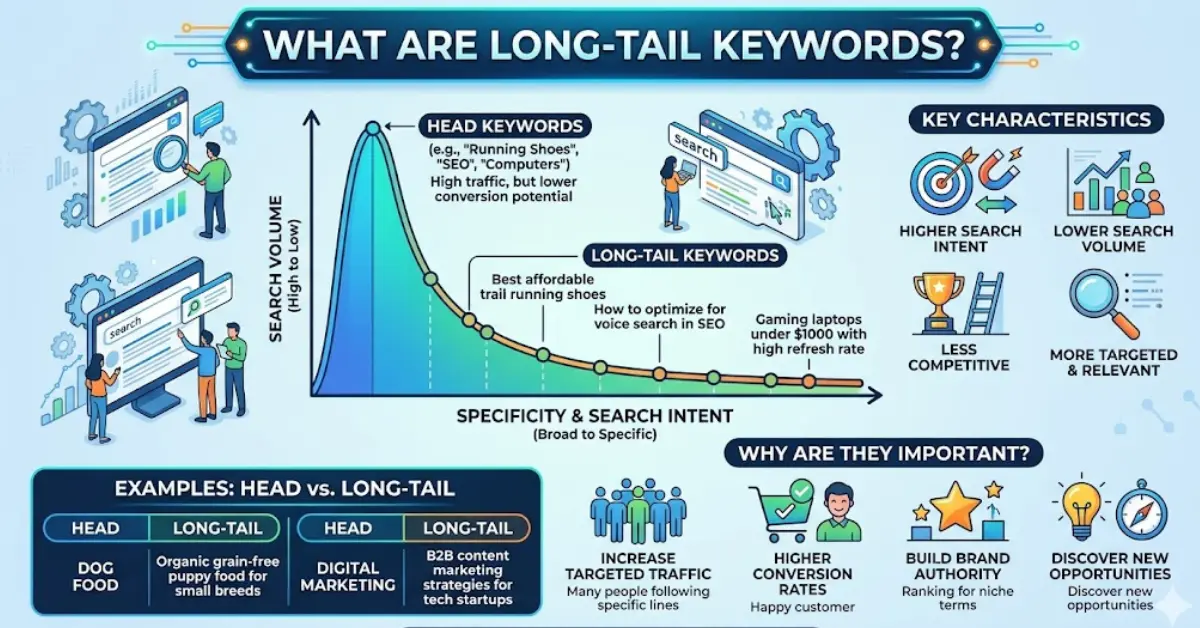
Long tail keywords are specific search phrases that usually contain three or more words. Unlike broad SEO keywords such as “shoes” or “digital marketing,” long tail search queries are more detailed and closely connected to what users actually want to find online. For example, instead of searching for “running shoes,” a user may search for “best running shoes for flat feet.” These searches reveal stronger intent and often lead to higher engagement and conversions.
In modern search engine optimization, long tail keywords play a major role because search behavior has become more conversational and intent driven. Users now search with detailed questions, product comparisons, and location based phrases. As a result, businesses that focus on precise keyword targeting can attract visitors who are more likely to take action, whether that means making a purchase, filling out a form, or subscribing to a service.
Another important advantage is lower competition. Broad keywords are usually dominated by large websites with strong authority, making them difficult to rank for. In contrast, low competition keywords offer smaller websites and growing brands a better opportunity to appear in search results and gain qualified traffic.
While short tail keywords generate high search volume, they are often vague and highly competitive. Long tail keywords may attract fewer searches individually, but they typically deliver better relevance, stronger user intent, and improved conversion potential.
In this guide, you will learn how long tail keywords work, why they matter for SEO strategy, how to find them, and how to use them effectively to improve organic visibility and targeted traffic.
What Are Long Tail Keywords in SEO?
Long tail keywords in SEO are highly specific keyword phrases that users enter into search engines when they are looking for detailed information, products, or solutions. These keywords usually contain three or more words and are designed around a clear search intent. Unlike broad terms that attract a wide audience, long tail keywords focus on a narrower topic, making them more targeted and relevant.
For example, a broad keyword like “shoes” can mean many different things. A user searching for that term could be looking for sports shoes, formal shoes, shoe brands, or even shoe repair services. However, a specific search query such as “best running shoes for flat feet” clearly shows what the user wants. This level of detail helps search engines understand intent more accurately and deliver more relevant results.
Long tail keywords generally have lower search volume compared to short tail keywords, but they often attract more qualified traffic. People using targeted keywords are usually further along in the buying journey or actively searching for a solution. Because of this, long tail searches tend to produce higher click through rates and better conversion potential.
The structure of long tail keywords commonly includes modifiers such as:
- Product features
• Price range
• Location
• Problem based searches
• Brand names
• User preferences
For instance:
- “best gaming laptop under $1000”
• “organic skincare products for sensitive skin”
• “digital marketing agency for startups”
• “affordable wedding photography in Hyderabad”
These niche keywords are easier to rank for because they face less competition than broad SEO keywords. They also align closely with user intent, which is now one of the most important ranking factors in modern search engine optimization.
Businesses across industries use long tail keyword phrases to attract highly targeted audiences. An ecommerce store may target product specific searches, while a SaaS company may optimize for solution based queries. Similarly, local businesses often use location focused long tail searches to capture nearby customers.
By targeting specific search queries instead of broad generic terms, websites can improve relevance, increase organic visibility, and connect with users who are more likely to engage or convert.
Why Are Long Tail Keywords Important for SEO?
Long tail keywords are an essential part of a successful SEO strategy because they help websites attract targeted visitors with clear search intent. As search engines continue to prioritize relevance and user experience, businesses that focus on highly specific keyword targeting often achieve stronger rankings, better engagement, and improved conversion performance.
Unlike broad keywords that are extremely competitive, long tail searches allow websites to connect with users who are actively looking for precise information, products, or services. This makes them valuable for improving organic traffic quality rather than simply increasing traffic volume.
Lower Competition
One of the biggest advantages of long tail keywords is lower keyword difficulty. Broad SEO keywords such as “insurance” or “fitness equipment” are usually dominated by large brands with strong domain authority and extensive backlink profiles. Competing against these websites can be extremely challenging, especially for newer businesses or smaller websites.
Long tail keyword phrases create easier ranking opportunities because they focus on narrower topics with reduced competition. For example, ranking for “laptop” may be difficult, but ranking for “best gaming laptop under $1000 for students” is far more achievable.
This approach helps newer websites gain visibility faster in search engine results. Instead of competing for massive search volume immediately, businesses can build authority gradually by targeting niche keywords that align with user needs.
Higher Conversion Rates
Long tail keywords often generate higher conversion rates because users searching with detailed phrases usually have stronger intent. These visitors already know what they are looking for, which means they are more likely to take action after landing on a page.
For example, someone searching for “running shoes” may simply be browsing. However, a user searching for “buy lightweight running shoes for marathon training” is much closer to making a purchase decision.
This level of purchase readiness improves conversion optimization by attracting visitors who are already deep into the decision making process. Whether the goal is product sales, lead generation, subscriptions, or inquiries, targeted keywords typically bring more qualified traffic.
Better Search Intent Matching
Modern search engine optimization relies heavily on understanding search behavior and matching content to user intent. Long tail keywords help businesses create highly relevant content that directly answers what users are searching for.
These keywords support different types of search intent, including:
Informational Intent
Users searching for knowledge or answers, such as “how to improve website speed for SEO.”
Transactional Intent
Users ready to make a purchase or complete an action, such as “buy wireless earbuds online.”
Navigational Intent
Users looking for a specific website, brand, or service page, such as “Ahrefs keyword research tool pricing.”
By targeting intent driven searches, websites can improve engagement signals and increase the likelihood of ranking for relevant queries.
Voice Search Optimization
The growth of voice assistants and mobile search has made long tail keywords even more important. People using voice search typically speak in natural language instead of typing short phrases. This creates more conversational searches and question based queries.
For example, instead of typing “best pizza NYC,” users may ask, “Where can I find the best pizza in New York near Times Square?”
Long tail keywords align naturally with these spoken search patterns. Optimizing for conversational queries helps businesses capture voice search traffic and adapt to changing search behavior trends.
As search engines become more advanced in understanding context and semantics, long tail keywords continue to play a major role in improving relevance, visibility, and user focused SEO performance.
Short Tail vs Long Tail Keywords
Understanding the difference between short tail and long tail keywords is essential for building an effective SEO strategy. Both keyword types serve different purposes in search engine optimization, and using them together can help websites improve visibility, attract targeted traffic, and strengthen topical authority.
Short tail keywords are broad keywords that usually contain one or two words. These generic search terms often have very high search volume but also face intense keyword competition. Long tail keywords, on the other hand, are more specific keywords that focus on detailed user intent and niche searches.
According to Google Search Central, creating content that matches user intent and search relevance is one of the most important aspects of SEO. This is why long tail keyword targeting has become increasingly valuable for businesses aiming to attract qualified visitors.
Key Differences
|
Factor |
Short Tail Keywords | Long Tail Keywords |
|
Search Volume |
High | Lower individually |
|
Competition |
Very high | Lower competition |
|
Conversion Rate |
Lower due to broad intent |
Higher due to targeted intent |
| User Intent | Often unclear or broad |
More specific and intent driven |
| Ranking Difficulty | Difficult for newer websites |
Easier to rank for |
| CPC Potential | Expensive in paid campaigns |
Often more cost efficient |
For example:
- Short tail keyword: “laptop”
• Long tail keyword: “best gaming laptop under $1000”
The first search is broad and could relate to many different needs, while the second clearly defines what the user wants. This helps search engines deliver more relevant results and improves the likelihood of conversion.
Research from Ahrefs highlights that long tail keywords often account for a large percentage of total search traffic because users frequently search using detailed phrases and conversational queries.
Which One Should You Target?
The best approach is not choosing one over the other, but building a balanced keyword strategy that includes both broad keywords and specific keywords.
Short tail keywords help websites build overall visibility and brand awareness. They are useful for cornerstone content, category pages, and high level topics. However, relying only on broad search terms can make ranking difficult, especially for growing websites.
Long tail keywords are more effective for targeting niche audiences, matching search intent, and driving conversions. They also help websites establish topical authority by covering detailed subtopics within a broader subject area.
For example, a technology website targeting the broad keyword “SEO tools” can strengthen authority by also creating content around long tail searches such as:
- “best SEO tools for small businesses”
• “free keyword research tools for beginners”
• “SEO audit tools for ecommerce websites”
This layered approach improves content depth and helps search engines better understand the website’s expertise within a topic cluster.
Examples of Long Tail Keywords
Long tail keywords can be used across nearly every industry and content type. These keyword examples are designed to target highly specific user needs, making them valuable for attracting qualified traffic and improving conversion rates. Instead of focusing only on broad search terms, businesses often use niche search phrases to connect with audiences searching for exact products, services, or solutions.
According to Semrush Keyword Research Guide, targeted search terms with clear user intent often produce stronger engagement and better SEO performance because they closely match what users are actively searching for.
E Commerce Examples
E commerce websites frequently use long tail keywords to target buyers who are close to making a purchase decision.
Examples:
- “best running shoes for flat feet”
• “wireless gaming mouse under $50”
• “organic skincare products for dry skin”
• “buy stainless steel water bottle online”
These searches are highly product specific and usually indicate strong transactional intent.
Local SEO Examples
Local businesses use location based long tail keywords to attract nearby customers searching for services in a specific area.
Examples:
- “best dental clinic in Hyderabad”
• “24 hour pharmacy near Times Square”
• “affordable wedding photographer in Visakhapatnam”
• “digital marketing agency for startups in Bangalore”
These targeted search terms improve local visibility and help businesses appear in relevant local search results.
Google recommends using location relevant and intent focused content to improve local search visibility through Google Business Profile Help.
Blog SEO Examples
Blogs often target informational long tail keywords to answer detailed questions and build topical authority.
Examples:
- “how to improve website speed for SEO”
• “best content marketing strategies for small businesses”
• “how to start investing for beginners”
• “tips for studying online effectively”
These keyword examples help publishers attract organic traffic from users seeking educational content and practical solutions.
B2B SEO Examples
B2B companies commonly target niche search phrases focused on software solutions, professional services, and industry challenges.
Healthcare
• “HIPAA compliant telemedicine software for clinics”
• “patient management system for small hospitals”
SaaS
• “best CRM software for remote sales teams”
• “project management tools for startup companies”
Finance
• “small business accounting software with payroll”
• “investment planning services for retirees”
Travel
• “family friendly resorts in Bali with private pool”
• “budget travel tips for Europe in summer”
Education
• “online coding courses for beginners with certificate”
• “best universities for data science programs”
These examples show how long tail keywords can target very specific audiences and user needs. By focusing on detailed search intent instead of generic traffic, businesses can improve relevance, engagement, and conversion potential across different industries.
How to Find Long Tail Keywords
Finding long tail keywords is one of the most effective ways to improve SEO performance and attract highly targeted traffic. These keywords reveal what users are actually searching for, making it easier to create content that matches search intent and ranks for low competition phrases.
The best long tail keyword opportunities often come directly from real user search behavior. By analyzing search queries, autocomplete suggestions, forums, and competitor content, businesses can uncover valuable phrases that broader keyword strategies may overlook.
According to Google Search Central SEO Starter Guide, understanding how people search and creating content that answers those needs is a core part of modern search engine optimization.
Use Google Autocomplete
Google Autocomplete is one of the simplest and most effective free methods for discovering long tail keywords. When users begin typing into Google Search, the platform automatically displays suggested search queries based on popular user behavior.
For example, typing:
“best SEO tools for…”
may generate suggestions such as:
- “best SEO tools for beginners”
• “best SEO tools for small businesses”
• “best SEO tools for ecommerce websites”
These autocomplete suggestions provide insight into what users commonly search for and help identify relevant keyword opportunities.
Another valuable section is the “Related Searches” area at the bottom of Google search results pages. These recommendations often reveal additional low competition phrases and semantically related topics that can strengthen content relevance.
Google’s search suggestions are especially useful because they reflect real search demand and evolving search behavior trends.
Analyze People Also Ask
The “People Also Ask” section in Google search results is another powerful source for long tail keywords. This feature highlights question based keywords that users frequently search around a topic.
For example, searching for “content marketing” may produce questions such as:
- “What is content marketing in SEO?”
• “Why is content marketing important?”
• “How do beginners start content marketing?”
These questions reveal informational intent and help content creators understand what users genuinely want to learn.
Using People Also Ask data can improve:
- Blog topic ideation
• FAQ content creation
• Featured snippet optimization
• Voice search relevance
• Semantic SEO coverage
Since voice searches are often conversational, question based search queries are becoming increasingly important for organic visibility.
Use Keyword Research Tools
Professional keyword research tools help marketers discover search volume data, keyword difficulty scores, competition levels, and related search opportunities.
Popular SEO tools include:
These platforms allow users to analyze:
- Monthly search volume
• Keyword competition
• Cost per click data
• SERP rankings
• Related keyword ideas
• Search intent patterns
For example, a broad keyword like “email marketing” may generate targeted long tail phrases such as:
- “best email marketing software for ecommerce”
• “email marketing tips for small businesses”
• “free email marketing tools for startups”
Research from Ahrefs Blog Research Study shows that long tail keywords make up a significant portion of overall search traffic, making them valuable for sustainable SEO growth.
Use Forums and Communities
Forums and online communities are excellent sources for discovering authentic search queries and user pain points. People often discuss problems, ask questions, and share recommendations using natural language that closely mirrors how they search online.
Useful platforms include:
For example, discussions in marketing communities may reveal searches such as:
- “best SEO tools for local businesses”
• “how to improve ecommerce conversion rates”
• “content strategy for SaaS startups”
These conversations help identify low competition phrases that may not appear immediately in traditional keyword databases.
Community platforms are particularly valuable for uncovering conversational and intent driven search behavior.
Analyze Competitor Keywords
Competitor analysis is another highly effective method for finding long tail keyword opportunities. By reviewing competitor content and rankings, businesses can identify keywords already generating traffic within their niche.
SEO tools such as Ahrefs and Semrush allow marketers to perform content gap analysis, which compares keyword rankings between websites and highlights missed opportunities.
This process helps uncover:
- Underserved search topics
• Ranking gaps
• High intent keyword phrases
• Emerging search trends
• SERP opportunities with weaker competition
For example, if competitors rank for detailed guides related to “technical SEO audit checklist,” creating more comprehensive and updated content around that topic may improve search visibility.
Analyzing competitor strategies also helps businesses understand which content formats and keyword structures perform best within their industry.
By combining autocomplete insights, SEO tools, community research, and competitor analysis, businesses can build a stronger long tail keyword strategy that supports sustainable organic growth and better audience targeting.
How to Use Long Tail Keywords Effectively
Finding long tail keywords is only the first step. To achieve strong SEO results, businesses must use these keywords strategically within their content and overall website structure. Proper implementation improves relevance, strengthens topical authority, and helps search engines better understand the context of a page.
According to Google Search Central Content Guidelines, content should focus on providing value to users rather than manipulating rankings through excessive keyword usage. This makes natural optimization and intent focused writing essential for modern SEO.
Optimize Headings
Headings play a major role in on page SEO because they help both users and search engines understand the structure of content. Including long tail keywords in headings improves topical relevance and increases the likelihood of ranking for targeted search terms.
For example, instead of a generic heading like:
“SEO Tips”
a more optimized heading could be:
“How to Improve Local SEO for Small Businesses”
Using keyword focused headings also enhances readability and helps search engines identify important sections within the content.
Use Keywords Naturally
Long tail keywords should be integrated naturally throughout the content rather than forced into every paragraph. Search engines have become highly advanced in understanding semantic search and contextual relevance, making unnatural keyword repetition unnecessary.
Instead of repeating the exact phrase multiple times, use semantic variations and related terms. For example, content targeting “best email marketing software for startups” can also include phrases such as:
- Email automation tools
• Marketing platforms for small businesses
• Startup email campaigns
• Email marketing solutions
This approach improves content optimization while maintaining readability and user experience.
Research from Semrush SEO Writing Assistant Guide highlights that semantically related keywords help search engines better interpret content relevance and topic depth.
Create Topic Clusters
Topic clusters are an effective way to organize content around a central subject while targeting multiple long tail keywords. This strategy strengthens topical authority and improves internal content relationships.
For example, a pillar page about “digital marketing” can connect to supporting articles such as:
- “best SEO strategies for ecommerce websites”
• “how to improve PPC campaign performance”
• “content marketing tips for startups”
• “social media marketing trends for small businesses”
This structure helps search engines recognize subject expertise and increases the chances of ranking for broader and more specific search queries.
Improve Internal Linking
Internal linking helps distribute authority across a website and guides users toward related content. Linking pages using descriptive anchor text improves crawlability and reinforces keyword relevance.
For example, an article about local SEO can internally link to related pages covering:
- Google Business Profile optimization
• Local keyword research
• Technical SEO audits
• Citation building strategies
Strong internal linking also improves user engagement by encouraging visitors to explore additional content.
Match Search Intent
One of the most important aspects of content optimization is aligning pages with user intent. Long tail keywords often reveal exactly what users want, whether they are searching for information, products, comparisons, or solutions.
For example:
- Informational intent: “how to start affiliate marketing”
• Transactional intent: “buy wireless earbuds online”
• Commercial intent: “best project management software for agencies”
Matching content format and messaging to the correct intent improves engagement and ranking potential.
Best Practices for Long Tail Keyword Optimization
To maximize SEO performance:
- Avoid keyword stuffing and repetitive phrasing
• Use semantic variations naturally throughout content
• Optimize sections for featured snippets using concise answers
• Include FAQ sections targeting question based searches
• Focus on readability and user experience
• Build content clusters to strengthen topical authority
By combining strategic keyword placement with intent driven content creation, businesses can improve organic visibility, attract qualified traffic, and create content that performs well in both traditional and AI powered search results.
Common Mistakes to Avoid With Long Tail Keywords
Long tail keywords can significantly improve SEO performance when used correctly, but many websites fail to achieve results because of poor keyword strategy and weak content optimization. Avoiding common SEO mistakes is essential for maintaining content quality, improving rankings, and attracting relevant organic traffic.
According to Google Search Central Helpful Content System, search engines prioritize useful, people first content that demonstrates expertise and relevance. Simply adding long tail keywords without providing real value is unlikely to produce sustainable rankings.
One of the most common mistakes is targeting zero intent keywords. Some search phrases may appear unique or easy to rank for, but they offer little value because users searching for them have no meaningful engagement or conversion intent. Focusing on irrelevant or unclear keyword opportunities can waste time and resources without generating useful traffic.
Ignoring search intent is another major issue. Long tail keywords often reveal exactly what users expect to find, and failing to align content with that expectation can lead to poor engagement and ranking issues. For example, a user searching for “best SEO tools for beginners” expects comparisons, recommendations, and beginner friendly explanations. Delivering a sales focused landing page instead of informative content creates a mismatch that reduces relevance.
Over optimization is also a frequent problem in SEO. Some websites repeatedly force the same keyword phrase into headings, paragraphs, and anchor text in an attempt to improve rankings. This practice, commonly known as keyword stuffing, negatively affects readability and can make content appear unnatural.
Research from Moz Beginner’s Guide to SEO emphasizes that modern SEO relies more on topical relevance and semantic understanding rather than excessive exact match keyword repetition.
Another mistake is choosing keywords with no traffic potential. Not every long tail keyword is worth targeting. Some searches may have extremely low demand or lack business relevance. Using keyword research tools to evaluate search volume, competition, and intent helps identify worthwhile opportunities.
Creating thin content is equally damaging. Many websites publish short pages with minimal information simply to target additional keyword phrases. However, low value pages rarely perform well because search engines prioritize comprehensive and useful content.
To avoid these problems:
- Focus on user intent instead of only rankings
• Avoid keyword stuffing and unnatural repetition
• Prioritize quality over keyword quantity
• Create detailed, valuable content around each topic
• Choose keywords with realistic traffic and conversion potential
A strong long tail keyword strategy should improve user experience, strengthen topical authority, and provide genuinely helpful information rather than simply targeting search phrases for rankings alone.
Long Tail Keywords and AI Search Optimization
Long tail keywords have become increasingly important in the era of AI SEO because modern search engines now rely heavily on natural language processing, semantic understanding, and intent based ranking systems. Search is no longer focused only on matching exact keywords. Instead, AI driven algorithms analyze context, user behavior, and topical relevance to deliver more accurate and conversational search experiences.
According to Google Search Central on AI Powered Search Experiences, search systems are designed to better understand meaning, intent, and relationships between words rather than relying solely on direct keyword matching.
One major reason long tail keywords perform well in AI search environments is their alignment with conversational search behavior. Users now search using complete questions and detailed phrases instead of short fragmented terms. For example, rather than searching for “best laptop,” users may ask:
- “What is the best gaming laptop under $1000 for students?”
• “Which SEO tools are best for small businesses?”
These conversational queries closely resemble natural human language, making long tail keywords highly compatible with AI search engines and voice assistants such as Google Assistant, Amazon Alexa, and Apple Siri.
Generative search experiences are also changing how content appears in search results. AI powered systems increasingly summarize information from multiple trusted sources to provide direct answers. Websites with strong topical depth and semantically connected content are more likely to be referenced in these AI generated responses.
This is where entity based SEO becomes important. Search engines now evaluate relationships between topics, entities, and user intent to understand expertise and contextual authority. Instead of focusing only on isolated keywords, websites should build comprehensive topic coverage using related concepts, semantic variations, and supporting content clusters.
Research from Google Natural Language Processing Documentation explains how AI systems analyze entities, sentiment, syntax, and contextual meaning to interpret content more effectively.
To optimize for AI driven search environments, businesses should:
- Use natural and conversational language
• Target question based long tail keywords
• Build in depth topical authority
• Optimize for semantic relevance instead of exact match repetition
• Match content closely to user intent
• Include FAQs and structured information
As AI search engines continue evolving, long tail keywords will remain essential for improving visibility, supporting conversational search, and aligning content with modern search intent optimization strategies.
Best Long Tail Keyword Tools
Using the right keyword research tools can make it much easier to discover long tail keyword opportunities, analyze competition, and understand user search behavior. Modern SEO platforms provide valuable insights into search volume, keyword difficulty, related queries, and search intent, helping businesses create more targeted content strategies.
According to Google Keyword Planner Help Center, keyword research data helps marketers identify relevant search terms and better understand how users search for products, services, and information online.
Here are some of the best tools for finding long tail keywords and improving SEO performance.
Ahrefs
Ahrefs is widely used for advanced keyword research and competitor analysis.
Key Features
• Keyword difficulty analysis
• SERP tracking
• Competitor keyword research
• Content gap analysis
• Related keyword suggestions
Pros
• Extensive keyword database
• Strong backlink and competitor insights
• Accurate SEO metrics
Best Use Cases
Ideal for agencies, SEO professionals, and businesses focused on competitive keyword opportunities and content strategy development.
Semrush
Semrush offers a comprehensive suite of SEO and digital marketing tools.
Key Features
• Keyword Magic Tool
• Search intent analysis
• PPC and SEO data
• Topic research
• Organic ranking analysis
Pros
• Excellent keyword filtering options
• Strong competitive analysis features
• Useful for both SEO and paid campaigns
Best Use Cases
Suitable for businesses managing large scale SEO campaigns, content marketing, and multi channel digital strategies.
Google Keyword Planner
Google Keyword Planner is a free keyword research tool provided by Google Ads.
Key Features
• Search volume estimates
• Keyword forecasting
• Related keyword suggestions
• CPC data insights
Pros
• Direct data from Google
• Free to access
• Useful for beginner SEO research
Best Use Cases
Best for identifying foundational keyword ideas and understanding search demand trends.
AnswerThePublic
AnswerThePublic focuses on question based and conversational search queries.
Key Features
• Question keyword visualization
• Search intent insights
• Autocomplete based suggestions
• Topic clustering ideas
Pros
• Excellent for content ideation
• Useful for voice search optimization
• Helps identify informational queries
Best Use Cases
Ideal for bloggers, content marketers, and websites targeting featured snippets and FAQ based SEO.
Moz
Moz Keyword Explorer provides beginner friendly keyword research and SEO insights.
Key Features
• Keyword difficulty scoring
• Organic CTR estimates
• SERP analysis
• Keyword suggestions
Pros
• User friendly interface
• Helpful educational resources
• Reliable keyword opportunity analysis
Best Use Cases
Well suited for small businesses, beginner SEO users, and websites building foundational SEO strategies.
Using a combination of these tools can help businesses uncover valuable long tail keyword opportunities, improve content targeting, and build stronger topical authority in competitive search environments.
Frequently Asked Questions
1. What are long tail keywords with examples?
Long tail keywords are detailed search phrases like “best gaming laptop under $1000” that target specific user intent and lower competition.
2. Why are long tail keywords important for SEO?
Long tail keywords improve search intent targeting, attract qualified traffic, and help websites rank more easily for niche searches.
3. Do long tail keywords have less competition?
Yes, long tail keywords usually face lower competition because they target narrower and more specific search queries.
4. How do I find long tail keywords for my website?
Use Google Autocomplete, People Also Ask, Ahrefs, Semrush, Reddit, and Quora to discover long tail keyword opportunities.
5. Are long tail keywords better for conversions?
Yes, long tail keywords often drive higher conversions because users searching detailed phrases usually have stronger purchase intent.
6. How many words should a long tail keyword contain?
Most long tail keywords contain three or more words, but specificity and user intent matter more than exact word count.
Final Thoughts
Understanding what are long tail keywords is essential for building a modern and sustainable SEO strategy. As search engines continue evolving through AI search optimization, semantic SEO, and conversational search technologies, long tail keywords have become increasingly valuable for improving relevance and connecting with users more effectively.
Unlike broad keywords, long tail keywords in SEO focus on specific search intent, making them highly effective for attracting qualified traffic and improving conversions. They also help websites compete for low competition keywords while building stronger topical authority within their industry.
A balanced keyword strategy should combine both broad and specific search terms. Short tail keywords help increase visibility, while long tail keyword examples support deeper topic coverage and intent driven optimization.
By learning how to find long tail keywords and using them strategically across content, businesses can improve organic rankings, strengthen semantic relevance, and create long term traffic growth opportunities.
For continued SEO improvement, businesses should also focus on content quality, internal linking, structured data implementation, and search intent optimization to remain competitive in both traditional and AI powered search environments.





https://shorturl.fm/BMPTD