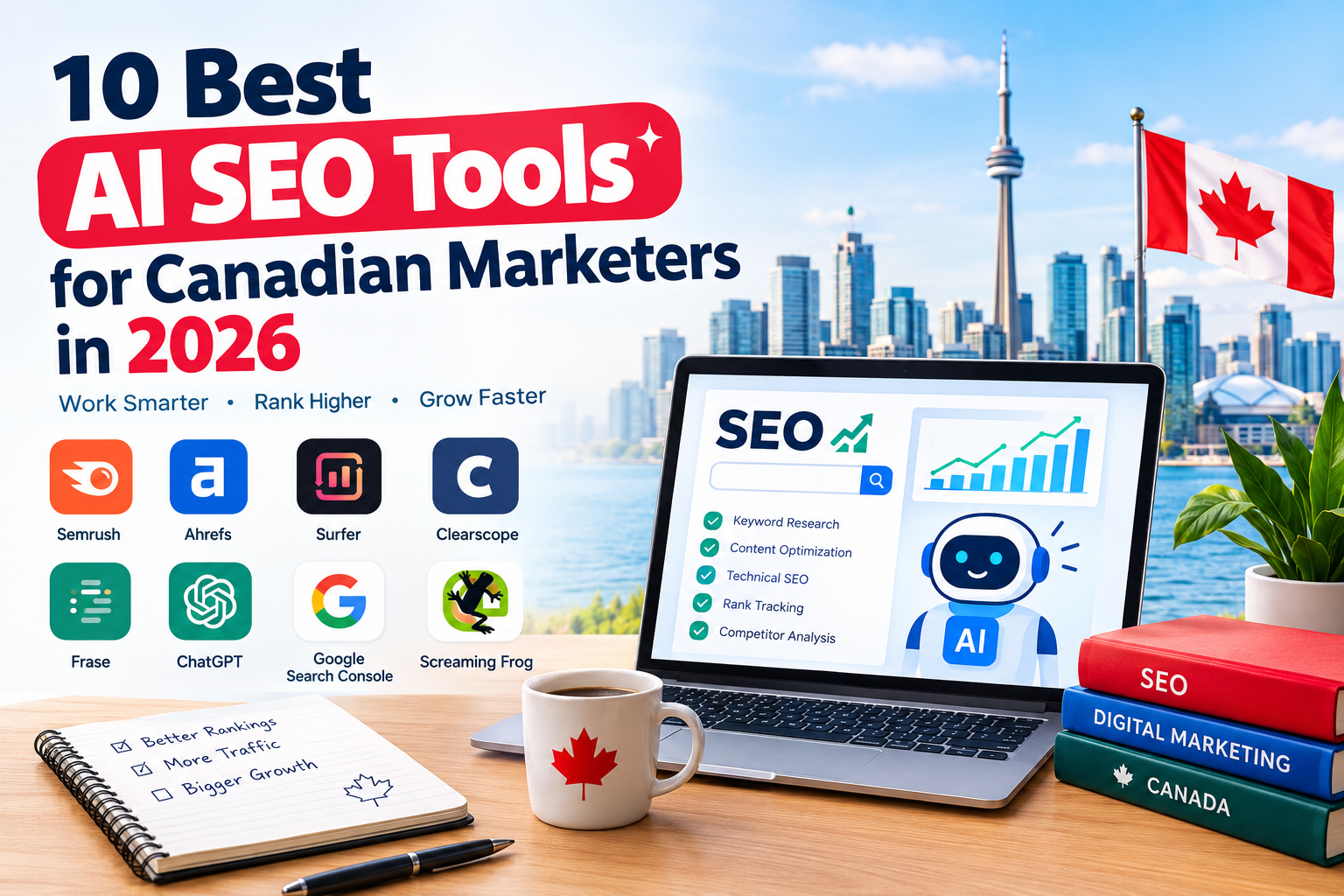
AI SEO Tools Canadian Marketers Should Use in 2026
AI SEO tools for Canadian marketers Search engine optimization is changing faster than ever. A few years ago, SEO mainly meant researching keywords, publishing blog posts, building backlinks, and monitoring Google rankings. In 2026, artificial intelligence is helping marketers perform many of these tasks faster and more efficiently.
For Canadian businesses, this shift creates a major opportunity. Whether you are a small business owner in Toronto, a startup in Vancouver, an e-commerce brand in Calgary, or a marketing agency serving customers across Canada, the right AI tools can help you compete more effectively in search.
That is why AI SEO tools for Canadian marketers are becoming an important part of modern digital marketing strategies.
AI can help you discover keywords, understand search intent, analyze competitors, create content briefs, optimize existing pages, identify technical SEO problems, and monitor your search performance. However, AI should support your SEO strategy—not replace human experience and judgment.
In this guide, we’ll explore the best AI SEO tools for Canadian marketers in 2026, how they work, what they are best for, and how Canadian businesses can use them to build a smarter SEO strategy.
What Are AI SEO Tools?
AI SEO tools are platforms that use artificial intelligence, machine learning, natural-language processing, or AI-powered automation to help marketers improve their website’s visibility in search engines.
Traditional SEO tools usually provide data such as:
- Keyword search volume
- Keyword difficulty
- Backlinks
- Rankings
- Website errors
- Competitor data
- Organic traffic estimates
AI-powered tools can go further by helping marketers understand this information and turn it into practical recommendations.
For example, instead of simply discovering the keyword SEO agency Toronto an AI SEO tool may help you identify:
- The likely search intent
- Related keywords
- Questions users ask
- Relevant subtopics
- Competitor content gaps
- Content opportunities
- Potential page structures
This makes AI particularly useful for marketers who want to save time while maintaining an organized SEO workflow.
Why Canadian Marketers Should Use AI SEO Tools in 2026
Canada has a competitive online market. Businesses are competing for visibility at local, provincial, national, and sometimes international levels.
AI can help marketers manage this competition more efficiently.
1. SEO competition is increasing
Canadian businesses compete with local companies, large national brands, international websites, marketplaces, and publishers.
For example, a Toronto-based digital marketing agency may compete for keywords such as:
- Digital marketing agency Toronto
- SEO agency Toronto
- Google Ads agency Toronto
- SEO services Toronto
AI-powered research can help identify realistic opportunities instead of blindly targeting the most competitive keywords.
2. AI can speed up keyword research
Keyword research can take hours when performed manually.
AI can help organize large keyword lists into meaningful groups based on:
- Topic
- Search intent
- Location
- Funnel stage
- Business relevance
This allows marketers to spend more time developing strategy and less time sorting spreadsheets.
3. Content creation is becoming more efficient
AI can help with:
- Content outlines
- Topic ideas
- Research questions
- FAQs
- Content briefs
- Meta title ideas
- Meta descriptions
- Content updates
However, the best results come from combining AI assistance with human expertise.
4. Local search is important
Canadian businesses often depend on local customers.
A company may want to rank in:
- Toronto
- Vancouver
- Montreal
- Calgary
- Ottawa
- Edmonton
- Winnipeg
- Mississauga
AI SEO tools can help marketers research local topics and identify opportunities relevant to their target locations.
5. Search behavior is evolving
Search engines and AI-powered search experiences are becoming increasingly capable of understanding context and intent.
This means marketers should focus on creating useful, trustworthy, comprehensive content instead of simply repeating keywords.
Best AI SEO Tools for Canadian Marketers
There is no single SEO tool that is perfect for every business.
Your ideal tool depends on your budget, website size, SEO experience, and goals.
Here are several tools worth considering.
1. Semrush
Semrush is a comprehensive digital marketing and SEO platform.
It provides tools for:
- Keyword research
- Competitor analysis
- Site audits
- Backlink research
- Rank tracking
- Content optimization
- Keyword gap analysis
- Organic research
How Canadian marketers can use Semrush
Imagine you operate an SEO agency in Vancouver.
You could research competing websites and discover:
- Which keywords they rank for
- Which pages receive organic visibility
- Which topics they cover
- Which keywords you are missing
- Potential content gaps
You can then use this information to create a better content strategy.
Best for
Semrush is particularly useful for:
- SEO agencies
- Marketing teams
- Growing businesses
- Experienced SEO professionals
2. Ahrefs
Ahrefs is another widely used SEO platform, especially popular for backlink research and competitor analysis.
It can help marketers with:
- Keyword research
- Backlink analysis
- Competitor research
- Rank tracking
- Site auditing
- Content research
- Keyword gap analysis
Example
Suppose you operate an online store targeting customers across Canada.
You can analyze competing websites to discover:
- Their strongest pages
- Keywords generating visibility
- Websites linking to them
- Content opportunities
- Topics that deserve more coverage
Rather than copying competitors, use this information to create something more useful and original.
Best for
Ahrefs is a strong choice for:
- SEO professionals
- Content marketers
- Agencies
- Link-building teams
- Competitive research
3. Surfer
Surfer focuses heavily on content optimization.
It can help writers and marketers understand how top-ranking content covers a particular topic.
For example, if you’re creating an article about SEO for Canadian small businesses, you may need to discuss:
- Keyword research
- Local SEO
- Google Business Profile
- Reviews
- Website performance
- Mobile optimization
- Content marketing
- Local search
A content optimization tool can help identify related concepts and areas worth covering.
Best for
Surfer can be useful for:
- Bloggers
- Content marketers
- SEO writers
- Content teams
4. Clearscope
Clearscope is another content optimization platform designed to help marketers create comprehensive content.
Instead of concentrating only on exact keyword repetition, it helps writers understand the broader topics and concepts associated with a search query.
Example
Suppose you’re targeting: SEO for Canadian businesses
A comprehensive article could cover:
- Technical SEO
- Local SEO
- Keyword research
- Content marketing
- Internal linking
- Backlinks
- Search intent
- Mobile SEO
- Analytics
This provides readers with a more complete resource.
Best for
Clearscope can be useful for:
- Professional content teams
- Publishers
- Agencies
- Businesses producing large amounts of content
5. Frase
Frase combines content research, SEO analysis, and AI-assisted content workflows.
It can help marketers:
- Research search results
- Create content briefs
- Find questions
- Organize article structures
- Generate content ideas
- Optimize existing articles
Example
If you’re writing about Google Ads for Canadian businesses, Frase can help identify questions and related subjects that could make your article more useful.
Best for
Frase is suitable for:
- Bloggers
- Freelance writers
- Content marketers
- Small marketing teams
6. ChatGPT
ChatGPT can work as an AI assistant throughout your SEO workflow.
It can help with:
- Keyword clustering
- Search-intent analysis
- Content outlines
- Topic research
- FAQs
- Meta descriptions
- SEO title ideas
- Internal-link suggestions
- Content refresh ideas
- Content briefs
How to use ChatGPT for SEO
Suppose your target keyword is: SEO services Calgary.
Don’t immediately ask AI to write a complete article.
Instead, ask it to help you analyze:
- Search intent
- Related keywords
- Important subtopics
- Frequently asked questions
- Local considerations
- Competitor content gaps
- Possible content structure
Then add your own expertise and original information.
Best for
ChatGPT can be useful for:
- Beginners
- Bloggers
- Freelancers
- SEO professionals
- Marketing agencies
- Business owners
7. Google Search Console
Google Search Console is one of the most important free SEO tools available to website owners.
Although it isn’t primarily an AI content tool, it provides valuable first-party information about how your website performs in Google Search.
You can monitor:
- Clicks
- Impressions
- CTR
- Search queries
- Average position
- Indexing
- Search-related website issues
Why Search Console matters
Many SEO platforms provide estimates.
Search Console helps you understand how your own website is actually performing in Google Search.
For example, suppose one of your articles receives thousands of impressions but very few clicks.
You may have an opportunity to improve:
- The title
- Meta description
- Search intent
- Content quality
- Page structure
8. Screaming Frog SEO Spider
AI doesn’t eliminate the need for technical SEO.
Screaming Frog can crawl websites and help identify technical issues such as:
- Broken links
- Missing title tags
- Missing meta descriptions
- Duplicate content
- Redirect problems
- Canonical issues
- Crawl-related problems
Example
Imagine a Canadian e-commerce website has thousands of product URLs.
Manually checking every page would be extremely time-consuming.
A crawler can identify technical problems across the site and help SEO teams prioritize fixes.
Best for
Screaming Frog is especially useful for:
- Technical SEO
- E-commerce websites
- Large websites
- SEO agencies
How to Choose the Right AI SEO Tool
You don’t need to subscribe to every SEO platform.
In fact, using too many tools can increase your costs without improving your results.
Instead, choose tools according to your goals.
For SEO beginners
A simple setup could include:
- Google Search Console
- Google Analytics
- ChatGPT
- One keyword research tool
For bloggers
Consider:
- ChatGPT
- Surfer
- Frase
- Google Search Console
For agencies
A more advanced setup could include:
- Semrush or Ahrefs
- Screaming Frog
- ChatGPT
- Google Search Console
- A content optimization platform
For e-commerce businesses
Prioritize tools that support:
- Keyword research
- Competitor analysis
- Technical SEO
- Product-page optimization
- Content optimization
- Rank tracking
How to Use AI SEO Tools Without Sacrificing Content Quality
AI can make SEO faster, but using it incorrectly can produce weak content.
The goal should not be: How much content can AI generate?
Instead, ask: How can AI help me create more useful content?
Step 1: Understand your audience
Before choosing keywords, understand your customers.
Consider:
- Location
- Industry
- Customer problems
- Search behavior
- Buying intent
- Competition
For a Canadian business, location can be especially important.
2: Research keywords
Use your SEO tools to identify relevant keywords.
Don’t automatically target the keyword with the highest search volume.
Consider: Relevance + intent + competition + business value
A lower-volume keyword that attracts highly relevant customers may be more valuable than a high-volume keyword that generates little business.
3: Analyze the competition
Review pages ranking for your target query.
Look for:
- Topics they cover
- Questions they answer
- Content gaps
- Weak explanations
- Missing examples
- Opportunities for original information
4: Build a content brief
Use AI to organize your research into:
- H1
- H2 headings
- H3 headings
- Related keywords
- Questions
- Examples
- FAQs
5: Add human expertise
This is critical.
Improve AI-assisted content with:
- Personal experience
- Original examples
- Case studies
- Expert opinions
- Unique data
- Screenshots
- Practical recommendations
6: Optimize the page
Before publishing, check:
- SEO title
- Meta description
- URL
- Headings
- Focus keyword
- Internal links
- External references
- Images
- ALT text
- Readability
- Mobile experience
7: Measure results
SEO doesn’t end when you publish.
Monitor:
- Impressions
- Clicks
- CTR
- Rankings
- Organic traffic
- Conversions
Use the data to update and improve your content.
AI SEO Strategies for Canadian Businesses
Canadian marketers should consider both local and broader search strategies.
Local SEO
A Toronto business may target:
- SEO agency Toronto
- Digital marketing Toronto
- Local SEO Toronto
- SEO consultant Toronto
A Calgary business may target:
- SEO agency Calgary
- Local SEO Calgary
- Digital marketing Calgary
- SEO consultant Calgary
But don’t create dozens of nearly identical pages just by replacing the city name.
Each local page should provide genuinely useful information relevant to that location.
Canadian-focused content
Where relevant, create content that addresses Canadian users specifically.
Examples include:
- Canadian pricing
- Canadian regulations
- Canadian businesses
- Canadian consumer behavior
- Canadian cities
- Province-specific information
- Canadian market trends
This can make your content more useful than a generic article written primarily for another market.
English and French SEO
Canada has both English- and French-speaking audiences.
Businesses targeting specific Canadian markets should consider whether French SEO is relevant to their customers.
If you create French-language content, don’t rely on a basic automatic translation alone.
Make sure the content feels natural and reflects the search behavior and terminology of the target audience.
AI SEO vs Traditional SEO
AI SEO doesn’t mean traditional SEO is disappearing.
Instead, AI is becoming another layer within the SEO workflow.
Traditional SEO includes:
- Keyword research
- Technical SEO
- Website architecture
- Internal linking
- Content optimization
- Link building
- Search intent
- Performance tracking
AI can make many of these activities faster.
A useful way to think about it is: Traditional SEO = Strategy + Fundamentals
AI SEO = Strategy + Fundamentals + Automation + Intelligence
The strongest marketers combine both approaches.
Common AI SEO Mistakes to Avoid
1. Publishing unedited AI content
AI-generated content can contain inaccuracies, repetition, or generic statements.
Always review and improve it before publishing.
2. Focusing only on keyword density
Search engines don’t need you to repeat the same keyword dozens of times.
Use natural language and related terms.
3. Ignoring technical SEO
Even excellent content can struggle if your website has serious technical problems.
Regularly check crawling, indexing, redirects, broken links, and page performance.
4. Copying competitors
Competitor research should help you identify opportunities—not reproduce someone else’s content.
Ask: What can I add that the current results don’t provide?
5. Buying too many tools
You don’t need ten subscriptions to build a good SEO strategy.
Start with a small toolkit and expand when your requirements grow.
A Simple AI SEO Workflow for Beginners
If you’re new to AI SEO, follow this simple process:
1. Discover
Find valuable keywords and topics.
2. Analyze
Understand search intent and study competing pages.
3. Plan
Create a content brief and article structure.
4. Create
Write useful content using AI assistance where appropriate.
5. Improve
Add human expertise, original examples, accurate information, and useful resources.
6. Optimize
Improve titles, headings, links, images, metadata, and overall readability.
7. Measure
Track performance and update the content based on real search data.
This workflow can work for bloggers, freelancers, local businesses, agencies, and e-commerce companies.
Frequently Asked Questions
What are the best AI SEO tools for Canadian marketers?
The best tool depends on your goals. Semrush and Ahrefs are strong options for SEO research and competitor analysis, Surfer and Clearscope focus heavily on content optimization, Screaming Frog is useful for technical SEO, and ChatGPT can support many SEO workflows.
Can AI SEO tools replace SEO professionals?
No. AI can automate repetitive tasks and help with research, but SEO professionals still provide strategy, critical thinking, business understanding, quality control, and decision-making.
Is AI-generated content good for SEO?
AI can assist with content creation, but unedited AI content may not provide enough value. Content should be accurate, original, useful, and created to satisfy the needs of the audience.
Should Canadian businesses use local SEO?
Yes. Businesses serving specific Canadian cities or regions should consider local SEO when their customers search for location-based products or services.
Can ChatGPT help with keyword research?
Yes. ChatGPT can help organize keyword lists, group keywords by search intent, generate related topic ideas, create content briefs, and identify questions. However, actual keyword data should be validated using reliable SEO and search-data platforms.
How many AI SEO tools should a beginner use?
Start small. A beginner can build a useful workflow with Google Search Console, an SEO research platform, and an AI assistant. Add specialized tools only when there is a clear need.
Final Thoughts
SEO in 2026 is becoming more intelligent, but the fundamental goal remains the same: help people find useful answers and make better decisions.
The best AI SEO tools for Canadian marketers can help you work faster, discover new opportunities, understand competitors, improve content, and monitor your search performance.
But technology alone isn’t enough.
Successful SEO combines AI with:
- Human expertise
- Helpful content
- Search intent
- Technical SEO
- Local relevance
- Original insights
- Consistent measurement
- Continuous improvement
If you’re just starting, don’t try to master every tool at once. Choose one platform that fits your needs, connect your website to Google Search Console, use AI to support research and planning, and build a consistent SEO workflow.