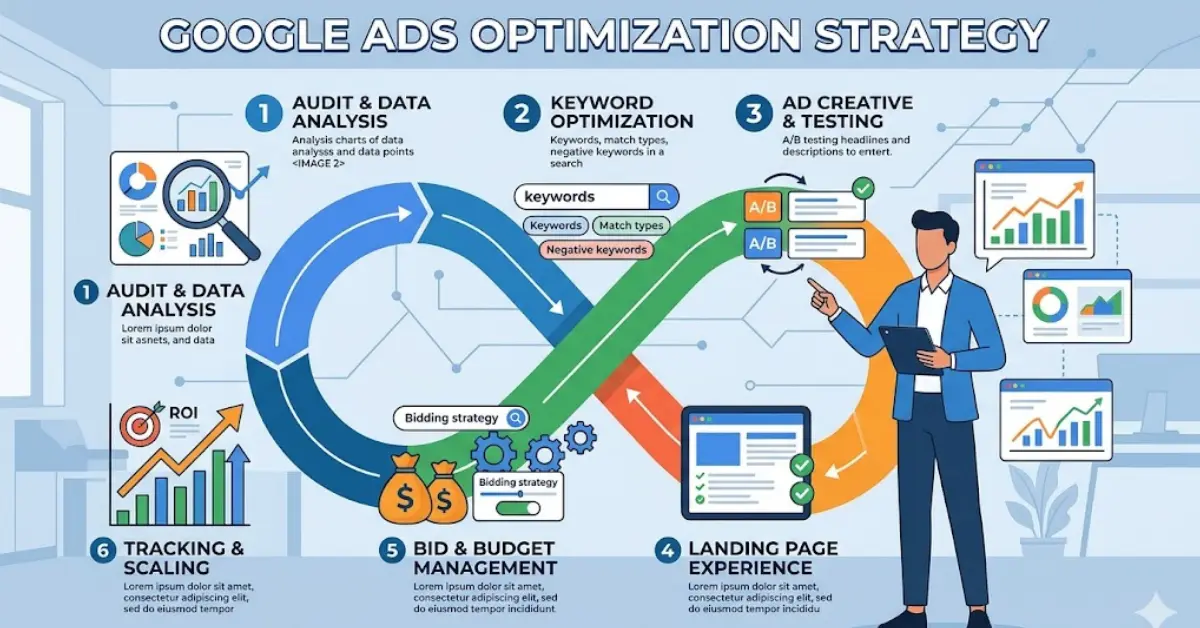
Running ads is easy—but consistently generating profitable results from Google Ads requires a structured, data-driven approach. A well-defined Google Ads optimization strategy helps eliminate wasted spend, improve conversion rates, and maximize return on ad spend (ROAS).
Successful optimization starts with aligning campaigns to user intent. This means selecting high-intent keywords, refining match types, and continuously filtering out irrelevant traffic using negative keywords. Ad copy must be compelling, relevant, and tailored to search queries, ensuring higher click-through rates (CTR) and better Quality Scores.
Equally important is landing page experience. Even the best ads will fail if users encounter slow, irrelevant, or poorly designed pages. Ensure your landing pages are fast, mobile-friendly, and conversion-focused with clear messaging and strong calls-to-action.
Ongoing performance analysis is critical. Regularly review key metrics such as CTR, cost-per-click (CPC), conversion rate, and cost per acquisition (CPA). Use A/B testing to optimize ad creatives, bidding strategies, and audience targeting.
Finally, leverage automation and smart bidding strategies where appropriate, but always monitor performance closely. Google rewards relevance, consistency, and user satisfaction—so continuous optimization is not optional, but essential for long-term success.
What Is Google Ads Optimization Strategy?
A Google Ads optimization strategy is the structured, ongoing process of improving campaign performance by refining every critical element—keywords, ad copy, bidding, audience targeting, and landing pages. Instead of relying on guesswork, optimization uses real performance data to make informed decisions that increase efficiency and profitability.
Google evaluates ads using four key factors: bid amount, expected click-through rate (CTR), ad relevance, and landing page experience. These elements combine to form Ad Rank, which determines both your ad position and the cost you pay per click.
Why This Matters in Practice
In real-world campaigns, budget alone does not guarantee success. Even if competitors are bidding higher, you can outrank them by improving relevance and user experience. For example, tightly grouped keywords, highly relevant ad copy, and fast, conversion-focused landing pages can significantly boost your CTR and Quality Score.
This means you can achieve better positions at a lower cost, improving both cost-per-click (CPC) and return on ad spend (ROAS). Ultimately, optimization is about making your campaigns more efficient, not just spending more—allowing you to scale sustainably while maintaining profitability.
Why Google Ads Optimization Matters
Many advertisers make the mistake of focusing only on driving more traffic. However, traffic alone does not guarantee results—what truly matters is how efficiently that traffic converts into customers.
The Real Performance Equation
- Traffic × Conversion Rate = Results
- Cost ÷ Conversions = Profitability
This means your success is not just about how many clicks you get, but how well those clicks turn into meaningful actions such as purchases, sign-ups, or leads.
Real-World Insight
In practical campaign scenarios, improving your conversion rate often delivers better outcomes than increasing your budget. For instance, increasing your conversion rate from 3% to 5% can significantly boost total conversions without any additional ad spend.
This is where optimization becomes critical. By refining targeting, improving ad relevance, and enhancing landing page experience, you increase efficiency across the entire funnel. Instead of paying more for traffic, you generate more value from the traffic you already have.
Ultimately, Google Ads optimization is about maximizing output while controlling costs—helping you achieve higher ROI and ROAS without unnecessary budget expansion.
Core Components of Google Ads Optimization Strategy
1. Google Ads Campaign Optimization
Campaign structure is the foundation of Google Ads success. A poorly structured account leads to wasted budget, unclear reporting, and limited scalability, while a well-organized structure improves targeting, relevance, and overall performance.
Advanced Best Practices
- Separate campaigns by goal (leads vs sales)
Different goals require different bidding strategies, messaging, and KPIs. Separating them ensures accurate tracking and better optimization. - Segment by audience intent (cold vs remarketing)
Cold audiences need awareness-driven messaging, while remarketing audiences respond better to high-conversion, action-focused ads. Mixing both reduces efficiency. - Use tightly themed ad groups (5–15 keywords max)
Smaller, focused ad groups improve ad relevance and Quality Score. This allows you to create highly specific ad copy that matches user search intent. - Align campaign structure with landing pages
Each ad group should point to a highly relevant landing page. Message match between keyword → ad → landing page directly impacts conversion rate and ad performance.
Practical Insight
A clean structure makes optimization easier. You can quickly identify what’s working, scale high-performing segments, and pause underperforming ones—leading to better control over CPC, conversions, and ROAS.
Expanded Example
|
Structure Type |
Performance Impact | Reason |
|
One campaign for all services |
Low CTR | Mixed intent |
| Segmented campaigns | Higher CTR |
Better relevance |
| Intent-based segmentation | Higher conversions |
Precise targeting |
Real-World Example
A SaaS company split campaigns into “awareness” and “conversion-focused.”
Result: Better budget allocation and improved lead quality.
2. Keyword Strategy and Long-Tail Keywords
Keywords are the backbone of any Google Ads campaign—they determine who sees your ads and how relevant your traffic is. A weak keyword strategy results in irrelevant clicks, higher costs, and poor conversion rates.
Advanced Keyword Approach
- Start with broad match for discovery
Broad match helps uncover new search queries and hidden opportunities you may not initially target. - Refine using search term reports
Regularly analyze actual user queries to identify high-performing terms and eliminate irrelevant traffic. - Move high-performing terms to exact match
Once proven, shift top-performing keywords into exact match to gain better control over cost and relevance. - Continuously expand long-tail keywords
Build a keyword list that captures specific user intent, not just high-volume generic terms.
Why Long-Tail Keywords Work
Long-tail keywords are highly specific search phrases that indicate strong intent. Unlike broad keywords, they attract users who are closer to taking action.
For example:
“google ads optimization strategy for local business” or
“how to improve google ads quality score fast”
These users are not browsing—they are searching with a clear objective. This typically leads to higher conversion rates, lower CPC, and better ROI, making long-tail keywords essential for scalable and profitable campaigns.
Expanded Comparison
|
Keyword Type |
Ideal Use | Risk Level |
|
Broad Match |
Discover new queries | High |
| Phrase Match | Scale safely |
Medium |
| Exact Match | Maximize conversions |
Low |
3. Negative Keywords Strategy
A refined negative keywords strategy ensures your ads show only to relevant users.
Strategic Approach
- Analyze search terms weekly
- Identify irrelevant intent patterns
- Build shared negative keyword lists
Expanded Example
|
Irrelevant Intent |
Negative Keyword | Benefit |
|
Free users |
“free” | Saves budget |
| Job seekers | “jobs” |
Better targeting |
| DIY learners | “tutorial” |
Higher quality leads |
Real Insight
Many campaigns waste budget on irrelevant clicks. Adding negative keywords often delivers faster improvements than increasing bids.
4. Ad Copy Optimization for Higher CTR
Your ad must compete for attention in seconds.
Advanced Copywriting Techniques
- Use problem + solution format
- Highlight unique value proposition (UVP)
- Add urgency or credibility (when appropriate)
- Include keyword naturally in headline
Expanded Example
|
Basic Ad |
Optimized Ad |
| “PPC Services Available” |
“Boost ROI by 40% with Proven Google Ads Strategy” |
Practical Tip
Test multiple variations continuously. Even small CTR improvements improve Quality Score and reduce CPC.
5. Google Ads Quality Score Improvement
Google Ads Quality Score improvement is one of the most cost-effective optimizations.
Deeper Breakdown
|
Factor |
Optimization Method |
|
CTR |
Improve headlines and relevance |
| Ad Relevance |
Match keywords with ad copy |
| Landing Page |
Improve speed and content alignment |
Advanced Insight
Quality Score impacts:
- Cost per click
- Ad position
- Impression share
Improving Quality Score from 5 to 8 can significantly reduce costs without changing your bid.
Google Ads Conversion Optimization
Clicks are only the starting point—conversions are what generate actual revenue. Without a strong conversion optimization strategy, even high-traffic campaigns will fail to deliver meaningful ROI.
Conversion Optimization Framework
- Match landing page with ad intent
Ensure a seamless message match between keyword → ad → landing page. If users don’t immediately find what they expect, they will bounce, wasting your ad spend. - Reduce friction (forms, navigation)
Simplify the user journey. Use shorter forms, minimize unnecessary fields, and remove distractions like excessive links or cluttered design. The easier it is to convert, the higher your conversion rate. - Build trust (reviews, testimonials)
Trust signals play a critical role in decision-making. Include customer reviews, case studies, ratings, and guarantees to reduce hesitation and improve credibility. - Optimize for mobile
A large portion of traffic comes from mobile devices. Ensure fast load times, responsive design, and easy-to-click CTAs to avoid losing potential conversions.
Practical Insight
Small improvements in conversion rate can significantly impact profitability. By optimizing user experience and reducing friction, you turn existing traffic into more conversions—improving CPA, ROAS, and overall campaign efficiency without increasing spend.
Expanded Example
|
Element |
Before | After |
|
CTA |
“Submit” | “Get Free Strategy Call” |
| Form Length | 8 fields |
3 fields |
| Page Speed | Slow |
Optimized |
Real Insight
In many campaigns, improving landing page clarity increases conversions more than changing ads.
7. Maximise Return on Ad Spend (ROAS)
To maximise return on ad spend, focus on efficiency and scalability.
Advanced Strategy
- Identify high-performing segments
- Allocate budget based on performance
- Pause underperforming keywords
Expanded Table
|
Campaign |
Spend | Revenue | ROAS | Action |
|
A |
$1000 | $2000 | 2x | Optimize |
| B | $1000 | $4000 | 4x |
Scale |
| C | $1000 | $800 | 0.8x |
Pause |
Practical Insight
Scaling profitable campaigns is more effective than fixing poor ones.
8. Performance Marketing Optimization
Performance marketing optimization depends on accurate data and continuous analysis.
Key Metrics Explained
|
Metric |
Why It Matters |
|
CTR |
Indicates ad relevance |
|
Conversion Rate |
Measures effectiveness |
| CPA |
Determines cost efficiency |
| ROAS |
Shows profitability |
Use Google Analytics to understand user behavior beyond clicks.
9. Smart Bidding Strategies
Smart bidding uses machine learning to optimize bids.
When to Use Each Strategy
|
Strategy |
Best For |
|
Target CPA |
Lead generation |
| Target ROAS |
E-commerce |
| Maximize Conversions |
Scaling campaigns |
Practical Insight
Smart bidding performs best when you have enough conversion data. Without data, manual control may work better
10. Audience Targeting Optimization
Audience targeting increases precision and efficiency.
Advanced Targeting Layers
- Remarketing audiences
- In-market segments
- Custom intent audiences
Real-World Insight
Users who already visited your site are more likely to convert. Remarketing helps capture these users effectively.
11. Device and Location Optimization
Not all traffic performs equally.
Expanded Device Insights
|
Device |
Behavior |
|
Mobile |
Quick browsing |
| Desktop |
Detailed decision-making |
Location Optimization
- Increase bids for high-performing regions
- Reduce spend in low-performing areas
12. A/B Testing for Continuous Improvement
Testing removes guesswork and improves performance.
Testing Framework
- Test one variable at a time
- Run tests long enough for data
- Implement winning variations
Example
Changing headline wording can significantly impact CTR and conversions.
13. Landing Page Optimization for Better Results
Landing pages directly impact conversion success.
Advanced Best Practices
- Match headline with ad
- Use clear value proposition
- Add trust signals (reviews, badges)
- Optimize for speed and mobile
Real Insight
Even small changes in layout or messaging can improve user engagement.
14. Conversion Tracking and Analytics Setup
Without tracking, optimization becomes guesswork.
What to Track
- Leads
- Purchases
- Calls
Tools to Use
- Google Ads tracking
- Google Analytics
Practical Insight
Accurate tracking enables better decision-making and smarter optimization.
15. Continuous Optimization Strategy
Google Ads success requires ongoing effort.
Weekly Optimization Tasks
- Review search terms
- Adjust bids
- Test new ads
- Analyze performance metrics
Long-Term Approach
Consistency builds results. Campaigns improve over time with continuous refinement.
Google Ads Optimization Checklist
- Use long tail keywords for high intent traffic
- Implement a strong negative keywords strategy
- Improve Quality Score consistently
- Optimize landing pages for conversions
- Track data accurately
- Test campaigns regularly
Frequently Asked Questions (FAQs)
What is the best Google Ads optimization strategy?
It focuses on keyword targeting, ad relevance, landing page optimization, and continuous testing.
How can I improve Google Ads Quality Score?
Improve CTR, ad relevance, and landing page experience.
Why are long tail keywords important?
They attract high-intent users and improve conversion rates.
How does negative keyword strategy help?
It filters irrelevant traffic and improves campaign efficiency.