Introduction: Why GEO vs SEO Matters in 2026
Search is changing quickly.
For years, businesses and bloggers focused mainly on traditional Search Engine Optimization (SEO) to appear on Google and other search engines. Marketers researched keywords, optimized website pages, built backlinks, improved technical SEO, and created useful content.
Today, people are also asking questions directly to AI-powered tools and search experiences. Instead of clicking through several websites, a user may ask an AI system a detailed question and receive a summarized answer.
This change has created a new marketing concept called Generative Engine Optimization (GEO).
So, what is the difference between Generative Engine Optimization (GEO) vs SEO?
In simple terms, SEO focuses on improving a website’s visibility in traditional search results, while GEO focuses on making information more useful and discoverable within AI-generated answers and generative search experiences.
However, GEO does not necessarily mean that SEO is no longer important. In many cases, the two strategies can work together.
In this guide, we’ll explain Generative Engine Optimization (GEO) vs SEO, their differences, similarities, strategies, examples, and how businesses can prepare for the changing search landscape.
What Is SEO?
Search Engine Optimization (SEO) is the process of improving a website and its content so that search engines can understand, discover, and potentially rank its pages for relevant searches.
Traditional SEO involves several areas.
1. On-Page SEO
On-page SEO focuses on elements directly on your website.
Examples include:
- Page titles
- Headings
- Meta descriptions
- Keywords
- Internal links
- Image optimization
- Content structure
- Search intent
- Readability
For example, if you publish an article targeting the keyword digital marketing trends 2026, you might use that topic naturally in the title, introduction, headings, and relevant sections.
2. Technical SEO
Technical SEO focuses on the technical foundation of a website.
Important areas include:
- Website speed
- Mobile usability
- HTTPS
- XML sitemaps
- Crawlability
- Indexability
- Canonical URLs
- Structured data
- Website architecture
Technical SEO helps search engines access and understand your website.
3. Off-Page SEO
Off-page SEO includes activities that happen outside your website.
A major example is earning backlinks from relevant websites.
Other activities can include:
- Digital PR
- Brand mentions
- Business citations
- Industry publications
- Relevant partnerships
4. Local SEO
Local SEO helps businesses appear for location-based searches.
For example: Digital marketing agency in London
(or)SEO company near Toronto
Google Business Profile optimization, reviews, local citations, and location-specific content can all contribute to local SEO.
What Is Generative Engine Optimization (GEO)?
Generative Engine Optimization (GEO) refers to strategies designed to make content more useful, understandable, and potentially more likely to be surfaced or referenced in AI-generated search experiences.
Instead of thinking only about: How can I rank this page?
GEO encourages marketers to also consider: How can I create information that AI systems can understand, trust, and use when answering a user’s question?
Generative search experiences can synthesize information from multiple sources to provide a direct response.
This makes content quality, clarity, context, authority, and factual support increasingly important.
How GEO Works
A simplified GEO process looks like this: User asks a question → AI system retrieves or uses relevant information → information is analyzed → AI generates a response → useful sources may be referenced or surfaced
For example, a user could ask: What is the difference between SEO and GEO?
A traditional search experience may show a list of relevant pages.
A generative search experience may instead provide a synthesized explanation based on information gathered from multiple sources.
This creates another opportunity for publishers and businesses to make their content clear, authoritative, and easy to interpret.
Generative Engine Optimization (GEO) vs SEO: Key Difference
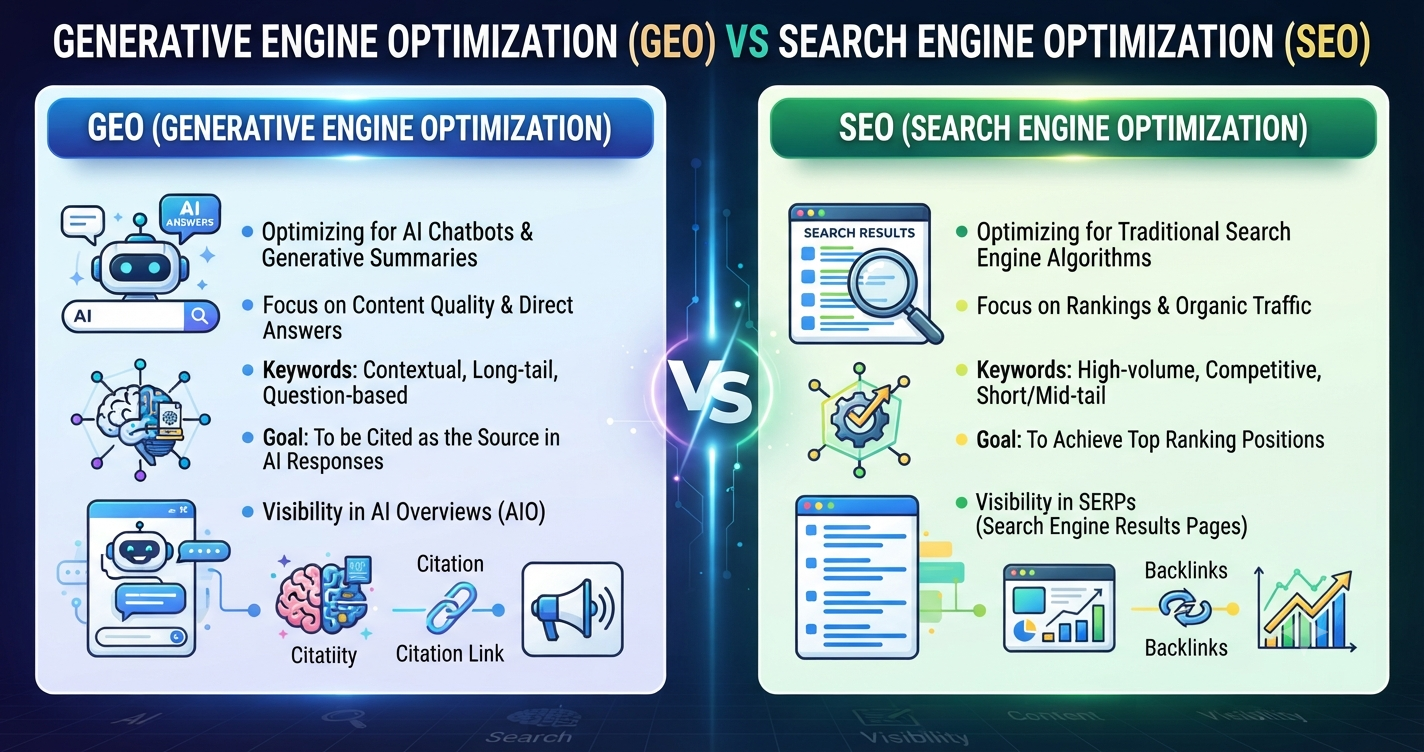
The biggest difference between Generative Engine Optimization (GEO) vs SEO is the search experience they are designed to address.
| SEO | GEO |
|---|---|
| Focuses primarily on traditional search visibility | Focuses on visibility within generative search experiences |
| Targets search engine rankings and organic visibility | Targets being understood and potentially referenced in AI-generated responses |
| Keyword research is important | User questions and contextual relevance are especially important |
| Backlinks can be an important signal | Clear, authoritative information and supporting evidence are important |
| Optimizes webpages for search engines and users | Optimizes information for AI-assisted discovery and synthesis |
| SERP visibility is a major objective | AI answer visibility or citation can be an objective |
| Traditional search remains central | Generative AI search experiences are increasingly relevant |
These approaches should not necessarily be treated as competitors.
For many websites, SEO and GEO can be complementary strategies.
GEO vs SEO: How Keyword Strategy Is Different
Keywords remain important for SEO.
However, GEO encourages marketers to think beyond individual keywords.
Traditional SEO Keyword Approach
Suppose your target keyword is: local SEO Canada
You might create content around:
- Local SEO Canada
- Local SEO services
- Google Maps SEO
- Local search ranking
- Local SEO strategy
GEO Content Approach
With GEO, you may also build content around the questions users naturally ask:
- What is local SEO in Canada?
- How does Google Maps ranking work?
- How long does local SEO take?
- How can a small business improve local visibility?
- What are common local SEO mistakes?
This creates a broader topical context. The goal isn’t to stuff every possible phrase into an article. Instead, the content should answer the user’s underlying questions naturally.
Does GEO Replace SEO?
No. GEO should not be viewed as a simple replacement for SEO.
Traditional search engines continue to play an important role in how people discover information, products, services, and businesses.
At the same time, AI-powered search and answer experiences are changing how people interact with information.
A practical strategy is therefore: SEO + helpful content + strong authority + GEO awareness
For example, a business can:
- Optimize its website technically.
- Research relevant search topics.
- Create useful content.
- Improve internal linking.
- Earn relevant mentions and backlinks.
- Clearly explain products and services.
- Answer important customer questions.
- Support factual claims with trustworthy information.
- Structure content clearly.
- Monitor how search behavior changes.
Why GEO Is Becoming Important
The way people search is becoming more conversational.
Instead of typing: best SEO tools
a user may ask: Which SEO tools are useful for a beginner running a small business, and what should I use each tool for?
This type of query contains more context.
AI systems are designed to handle natural-language questions and synthesize information.
As a result, businesses need to think about more than keyword placement.
They should also consider:
- Search intent
- Context
- Entity relationships
- Topical coverage
- Factual accuracy
- Content quality
- Author expertise
- Brand credibility
- Clear explanations
- Original insights
How to Optimize Content for GEO
There is no single guaranteed formula for appearing in AI-generated answers. However, several practical content principles can make information easier for both people and search systems to understand.
1. Answer Questions Directly
Start important sections with clear answers.
For example: What is GEO?
GEO is a content optimization approach focused on improving the visibility and usefulness of information in generative AI and AI-powered search experiences.
Then provide additional explanation.
This structure makes your content easier to scan.
2. Use Clear Headings
Organize your article with descriptive H2 and H3 headings.
For example:
- What Is GEO?
- What Is SEO?
- GEO vs SEO Differences
- How GEO Works
- How to Optimize Content for GEO
- GEO and SEO Strategy
- Common GEO Mistakes
3. Build Topical Authority
Instead of publishing one article about a subject and stopping there, create related content.
For example, a website focusing on AI SEO could publish:
Pillar Page
Generative Engine Optimization (GEO) vs SEO
Supporting Articles
- What Is Generative Engine Optimization?
- How AI Search Works
- GEO Optimization Techniques
- SEO vs AEO vs GEO
- AI Search Optimization Guide
- How to Create Content for AI Search
- Traditional SEO vs AI Search
4. Provide Original Information
Generic information is easy to reproduce.
Original research, examples, case studies, comparisons, observations, and first-hand experience can make content more useful.
For example, instead of writing only: AI is changing search.
you could analyze how search results for several queries have changed over time and explain what marketers should watch.
5. Support Important Claims
Trust matters.
When discussing statistics, research, industry changes, regulations, product capabilities, or technical information, use reliable sources where appropriate.
Good sources may include:
- Official documentation
- Government websites
- Research organizations
- Academic publications
- Established industry organizations
- Original company announcements
Avoid presenting unsupported claims as facts.
How to Combine GEO and SEO
A strong modern content strategy can combine both approaches.
1: Research Search Intent
Find out what your audience actually wants to know.
2: Identify Primary and Secondary Keywords
Choose one main topic and related phrases.
3: Build Comprehensive Content
Answer the main question and important related questions.
4: Improve Technical SEO
Make sure search engines can crawl and index the page.
5: Use Structured Content
Use headings, lists, tables, definitions, examples, and concise explanations.
6: Add Internal Links
Connect the article to related pages on your website.
7: Strengthen Authority
Earn relevant backlinks, mentions, and citations where appropriate.
8: Keep Information Updated
AI search and traditional search both operate in an environment where information changes.
Update outdated facts and examples when necessary.
Example: GEO vs SEO for a Digital Marketing Blog
Imagine you have a digital marketing website and want to publish an article about Google Ads vs Meta Ads.
SEO approach
You could optimize for:
- Google Ads vs Meta Ads
- Google Ads vs Facebook Ads
- Google Ads comparison
- Meta Ads comparison
You might create a detailed comparison page with optimized headings and internal links.
GEO approach
You could also answer questions such as:
- What is the difference between Google Ads and Meta Ads?
- When should a small business use Google Ads?
- When is Meta Ads useful?
- Which platform is suitable for brand awareness?
- How does audience targeting differ?
- How should businesses measure performance?
Now the content provides both keyword relevance and broader contextual information.
Common GEO Mistakes to Avoid
GEO is still an evolving area, so avoid treating every new AI-search tactic as a guaranteed ranking technique.
1. Keyword Stuffing
Repeating the same keyword excessively can make content difficult to read.
Use natural language instead.
2. Writing Only for AI
Your primary audience is still people.
Content should be useful and understandable to human readers.
3. Publishing Generic AI Content
Simply generating large amounts of generic text does not automatically create valuable content.
Add expertise, examples, original insights, and useful information.
4. Ignoring Traditional SEO
Don’t abandon:
- Technical SEO
- Internal linking
- Search intent
- Page experience
- Crawling and indexing
- Relevant backlinks
- Helpful content
GEO works alongside these areas rather than making them automatically irrelevant.
5. Making Unsupported Claims
Don’t claim that a specific GEO technique guarantees AI citations or visibility.
AI systems and search experiences can change, and visibility depends on many factors.
GEO, SEO, AEO and AI Search: What’s the Difference?
These terms are related but aren’t identical.
SEO
Search Engine Optimization focuses broadly on improving organic search visibility.
AEO
Answer Engine Optimization focuses on making content suitable for direct answers to user questions.
GEO
Generative Engine Optimization focuses on optimizing information for generative AI and AI-powered search experiences.
AI Search Optimization
This is a broader term that can describe strategies for improving visibility and discoverability within AI-powered search systems.
These concepts can overlap significantly.
Future of Generative Engine Optimization (GEO) vs SEO
The future of search is likely to involve multiple ways of discovering information.
Users may continue using:
- Traditional search engines
- AI assistants
- AI-powered search
- Social platforms
- Video platforms
- Voice interfaces
- Online communities
- Specialized search tools
Because of this, marketers should avoid building their entire strategy around one traffic source.
A diversified strategy can include: SEO + GEO + content marketing + social media + email marketing + brand building
This gives businesses multiple ways to reach their audiences.
GEO and SEO Checklist for 2026
Before publishing an article, use this checklist:
SEO Checklist
- Choose a clear primary keyword
- Research search intent
- Write a useful title
- Create a strong introduction
- Use descriptive H2 and H3 headings
- Optimize the URL
- Write a useful meta description
- Add internal links
- Optimize images
- Check mobile usability
- Ensure the page can be crawled and indexed
GEO-Friendly Content Checklist
- Answer important questions directly
- Use clear definitions
- Provide useful examples
- Cover the topic comprehensively
- Add original insights where possible
- Support important factual claims
- Keep information accurate and updated
- Use logical content structure
- Avoid unnecessary repetition
- Write for humans first
Frequently Asked Questions About GEO vs SEO
What is the difference between GEO and SEO?
SEO primarily focuses on improving organic visibility in traditional search engines. GEO focuses on making content useful and understandable for generative AI and AI-powered search experiences.
Is GEO better than SEO?
GEO and SEO serve related but different purposes. Instead of treating one as universally better, businesses can use SEO as the foundation while adapting content for emerging AI search experiences.
Does GEO replace traditional SEO?
No. Traditional SEO remains important for crawling, indexing, organic visibility, website structure, and search discovery. GEO adds another layer of consideration for generative search.
How do I start GEO optimization?
Start by creating clear, accurate, useful content that directly answers user questions. Organize information logically, build topical authority, use trustworthy sources, and maintain strong SEO fundamentals.
Can small businesses use GEO?
Yes. Small businesses can focus on answering customer questions, publishing useful expertise, creating location-specific content where relevant, and building a trustworthy online presence.
Does AI-generated content automatically rank in AI search?
No. Simply using AI to create content does not guarantee search visibility or AI citations. Content still needs to provide value, accuracy, relevance, and a useful experience.
What keywords should I use for GEO?
Use a combination of your primary topic, related terms, conversational questions, and long-tail searches. Focus on satisfying search intent rather than repeating keywords unnaturally.
Is GEO only for large companies?
No. GEO concepts can be applied by bloggers, startups, local businesses, ecommerce websites, agencies, and larger organizations.
Conclusion: GEO and SEO Are Both Important for the Future of Search
The difference between Generative Engine Optimization (GEO) vs SEO comes down to how people discover and consume information. SEO focuses on improving visibility in traditional search results, while GEO focuses on making content useful and understandable for AI-powered and generative search experiences.
However, GEO does not mean that SEO is disappearing. Instead, marketers should think beyond rankings and create content that is accurate, helpful, well-structured, trustworthy, and genuinely valuable to users.
A strong 2026 strategy can combine:
- SEO for traditional organic search visibility
- GEO for emerging AI search experiences
- High-quality content for building trust and authority
- Internal linking for stronger topical relevance
- Original insights and examples for added value
- Continuous optimization as search behavior evolves
Whether you’re a blogger, small business owner, marketer, or SEO professional, understanding Generative Engine Optimization (GEO) vs SEO can help you prepare for the changing search landscape.