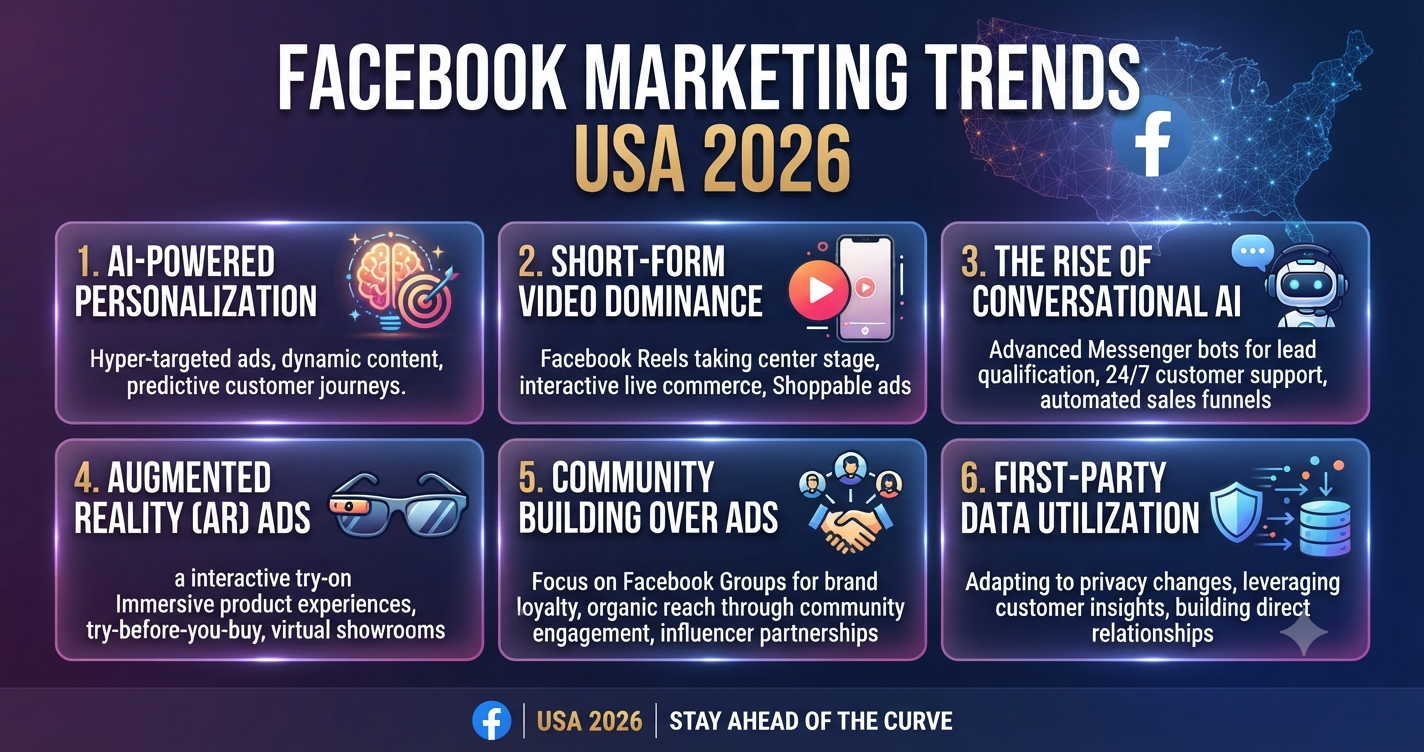
What Are the Facebook Marketing Trends USA 2026?
Facebook marketing trends are the changing strategies, technologies, content formats, and user behaviors that influence how businesses market themselves on Facebook.
In 2026, several important trends are shaping Facebook marketing in the USA:
- AI-powered advertising
- Short-form video and Reels
- Personalized content
- Social commerce
- Facebook Messenger marketing
- User-generated content
- Creator and influencer collaborations
- Facebook SEO and social search
- Retargeting and personalized advertising
- Data-driven marketing
Businesses do not necessarily need to use every trend. Instead, they should identify the trends that match their audience, industry, goals, and budget.
1. AI-Powered Facebook Advertising
One of the biggest Facebook Marketing Trends USA 2026 is the growing role of artificial intelligence in advertising.
AI is increasingly being used to help advertisers create campaigns, identify audiences, optimize advertisements, generate creative variations, and analyze campaign performance.
Instead of manually testing every possible combination of audience, creative, and placement, marketers can use AI-powered tools to automate parts of the process.
How Businesses Can Use AI
Businesses can use AI to:
- Generate advertising copy ideas
- Create different creative variations
- Analyze campaign performance
- Identify potential customer segments
- Improve ad personalization
- Test different headlines
- Create content ideas
- Automate repetitive marketing tasks
Example
Imagine a US-based fitness business promoting a new online workout program.
Instead of creating one advertisement, the marketer could test different messages such as:
- Weight-loss-focused messaging
- Beginner fitness messaging
- Home-workout messaging
- Time-saving workout messaging
The business can then analyze which messages generate better engagement and conversions.
AI does not eliminate the need for marketers. Instead, it can help marketers spend more time on strategy, creativity, and customer understanding.
2. Facebook Reels and Short-Form Video
Short-form video continues to be an important content format for social media marketing.
Facebook Reels can help businesses present products, explain services, answer questions, share tips, and create entertaining content.
For many businesses, video provides an opportunity to communicate an idea faster than a long text post.
Facebook Reels Ideas for Businesses
Businesses can create Reels around:
- Product demonstrations
- Behind-the-scenes content
- Customer testimonials
- Quick tutorials
- Frequently asked questions
- Before-and-after examples
- Industry tips
- Product comparisons
- Company stories
- Limited-time offers
For example, a local restaurant in New York could create a short Reel showing how one of its popular dishes is prepared.
A digital marketing agency could create a 30-second video explaining one simple SEO technique.
The key is to make the content useful, easy to understand, and relevant to the target audience.
3. Video Marketing Becomes More Important
Video is not only useful for Reels. Businesses can use different video formats across their Facebook marketing strategy.
Longer videos can be useful for educational content, interviews, product demonstrations, webinars, and detailed explanations.
A Simple Facebook Video Strategy
Try creating three types of videos:
Educational videos:
Teach your audience something useful.
Entertainment videos:
Create content that is interesting, relatable, or enjoyable.
Conversion-focused videos:
Show how your product or service solves a specific problem.
For example: How to reduce your Google Ads costs
could attract people interested in digital marketing.
A follow-up video could explain your service or product and encourage interested viewers to learn more.
This creates a simple content journey from attention → education → consideration → conversion.
4. Social Commerce and Product Discovery
Another important Facebook marketing trend is the continued connection between social media and ecommerce.
Consumers increasingly discover products through social platforms.
Instead of searching for a product only through traditional search engines, users may discover products through:
- Videos
- Reels
- Facebook posts
- Recommendations
- Creator content
- Advertisements
- Business pages
- Social communities
This means ecommerce businesses should think about Facebook as both a marketing channel and a product-discovery platform.
How Ecommerce Businesses Can Use Facebook
An online store can:
- Showcase products through video
- Share customer reviews
- Publish product demonstrations
- Run targeted advertising
- Retarget website visitors
- Answer product questions
- Promote seasonal offers
- Encourage user-generated content
The goal is to make the buying journey simple and trustworthy.
5. Facebook Messenger Marketing
Messaging is becoming increasingly useful for businesses.
Customers often have questions before purchasing a product or service. Facebook Messenger can provide a convenient way for businesses to communicate with potential customers.
For example, a customer might ask: Do you deliver to California?
or:What is the price of this product?
A fast response can help reduce uncertainty.
Messenger Marketing Ideas
Businesses can use Messenger for:
- Customer support
- Product questions
- Lead generation
- Appointment inquiries
- Order-related communication
- Promotions
- Frequently asked questions
However, businesses should avoid sending excessive promotional messages. Useful and relevant communication is more likely to create a positive customer experience.
6. User-Generated Content Builds Trust
People often want to see how real customers use a product before making a purchase.
That is why user-generated content (UGC) is an important part of Facebook marketing.
UGC can include:
- Customer reviews
- Customer photos
- Product videos
- Testimonials
- Unboxing videos
- Customer stories
- Social media mentions
Example
Suppose an American skincare brand sells a moisturizer.
Instead of only publishing professional product photos, the company could encourage customers to share their experiences using the product.
The company can then feature selected customer content on its Facebook page or advertising campaigns, subject to appropriate permissions.
This provides potential customers with real-world examples.
7. Creator and Influencer Collaborations
Creator marketing remains another useful strategy for businesses trying to reach specific audiences.
Instead of selecting an influencer only because they have a large following, businesses should consider:
- Audience relevance
- Engagement
- Content quality
- Location
- Industry
- Audience demographics
- Brand compatibility
A smaller creator with an audience interested in a specific niche may be more relevant to a business than a large creator whose audience is unrelated.
Example
A fitness equipment company could collaborate with a fitness creator whose audience is interested in home workouts.
A technology company could collaborate with creators who regularly review technology products. The important factor is audience relevance, not simply follower count.
8. Facebook SEO and Social Search
Search behavior is changing. People increasingly use social platforms to discover information, businesses, products, creators, and recommendations.
That means businesses should think about how their Facebook content can be discovered. This is where Facebook SEO becomes important.
Facebook SEO Basics
Businesses should optimize:
- Facebook Page name
- About section
- Page description
- Post captions
- Video titles
- Relevant keywords
- Hashtags where appropriate
- Business information
- Location information
For example, instead of writing a vague post such as: Check out our latest service!
a local business could write: Affordable Digital Marketing Services for Small Businesses in Texas The second example provides more context about the business and its service. However, keywords should be used naturally. Repeating the same keyword excessively can make content difficult to read.
9. Personalized Facebook Marketing
Consumers see a huge amount of content every day.
Generic marketing messages can easily get ignored.
Personalization allows businesses to create messages that are more relevant to different audience groups.
For example, an ecommerce business could create different campaigns for:
- New visitors
- Existing customers
- Previous purchasers
- Cart abandoners
- Highly engaged users
Example of Audience Segmentation
Imagine an online clothing store.
A person who has never visited the website may see an introductory advertisement.
Someone who viewed a product could see content related to that product.
A previous customer could receive a campaign promoting related products.
This approach can make marketing communication more relevant.
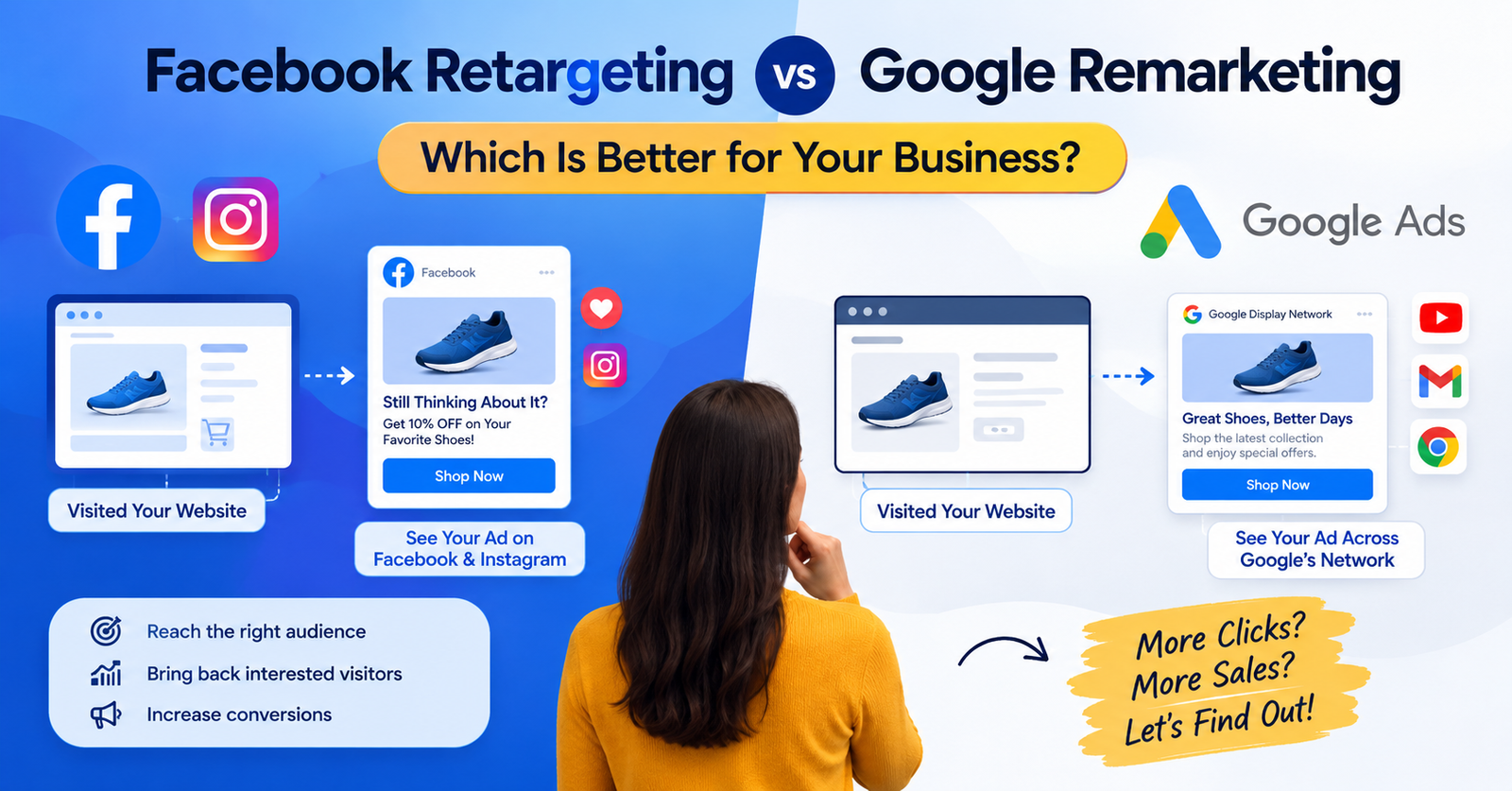
10. Retargeting Becomes an Important Strategy
Retargeting allows businesses to reconnect with people who have previously interacted with their brand.
For example, someone may:
- Visit your website.
- Look at a product.
- Leave without purchasing.
- Later see an advertisement from your business.
This type of marketing can help businesses stay connected with potential customers.
Facebook Retargeting Examples
Businesses can create campaigns for people who:
- Visited a website
- Viewed a product
- Added an item to their cart
- Watched a video
- Engaged with a Facebook Page
- Interacted with previous advertisements
Retargeting should be handled carefully. Showing the same advertisement too frequently can lead to ad fatigue.
11. Community Building on Facebook
Facebook is not only an advertising platform.
It can also be used to build communities.
Businesses can create or participate in relevant communities where customers discuss:
- Products
- Services
- Problems
- Industry trends
- Questions
- Recommendations
For example, a local business could create a community focused on a specific interest or customer need.
The goal should not be to constantly promote products.
Instead, businesses can:
- Answer questions
- Share useful information
- Start discussions
- Ask for feedback
- Provide helpful resources
- Build relationships
Community-focused marketing can help businesses develop stronger connections with their audiences.
12. Data-Driven Facebook Marketing
Successful marketing requires measurement.
Businesses should track important metrics rather than simply counting likes.
Useful Facebook marketing metrics can include:
- Reach
- Impressions
- Engagement
- Video views
- Link clicks
- Click-through rate
- Leads
- Conversions
- Cost per result
- Return on ad spend
Example
Suppose Campaign A receives 10,000 impressions and generates 100 website visits.
Campaign B receives 8,000 impressions but generates 200 website visits.
Looking only at impressions would not tell the complete story.
Marketers need to examine several metrics together to understand campaign performance.
How to Create a Facebook Marketing Strategy in 2026
Understanding trends is useful, but businesses also need a practical strategy.
Creating a Facebook marketing strategy in 2026 is about more than publishing posts and hoping people engage with them. Businesses need to understand their audience, set clear objectives, create useful content, choose suitable advertising options, and measure results.
The good news is that you do not need to be an expert to get started. A simple, structured approach can help small businesses, marketers, creators, and ecommerce brands build a practical Facebook strategy.
Here is a step-by-step process for creating a Facebook marketing strategy in 2026
Follow these steps.
1: Define Your Goal
Start with a specific objective.
Your goal could be:
- Brand awareness
- Website traffic
- Lead generation
- Sales
- App downloads
- Engagement
- Customer retention
A clear goal makes it easier to select appropriate content and advertising strategies.
2: Understand Your Audience
Identify:
- Age group
- Location
- Interests
- Problems
- Buying behavior
- Preferred content formats
- Customer needs
For businesses targeting the USA, remember that audiences can differ significantly between states, cities, industries, and demographic groups.
3: Create Valuable Content
Create content that answers questions or solves problems.
A simple content mix could include:
- 40% educational content
- 30% entertaining or engaging content
- 20% community-focused content
- 10% promotional content
These percentages are not a universal rule. Businesses should test different content mixes and use their own performance data.
4: Experiment With Video
Start with simple videos.
You do not need expensive equipment.
A smartphone, good lighting, clear audio, and a useful topic can be enough to begin.
Test:
- Short tutorials
- Reels
- Product demonstrations
- Customer stories
- FAQ videos
- Behind-the-scenes videos
5: Test Your Advertising
Do not assume that one advertisement will work for everyone.
Test different:
- Headlines
- Images
- Videos
- Calls to action
- Audience groups
- Offers
- Landing pages
Then compare the results using relevant performance metrics.
6: Monitor Results
Review your data regularly.
Ask:
- Which content gets the most engagement?
- Which videos generate clicks?
- Which campaigns generate leads?
- Which audiences respond?
- Which ads have high costs?
- Which landing pages convert?
Use these insights to improve future campaigns.
Common Facebook Marketing Mistakes to Avoid in 2026
Following trends is not enough. Businesses should also avoid common mistakes.
Following the latest Facebook Marketing Trends USA 2026 can help businesses discover new opportunities, but using the wrong strategy can waste time and advertising budget. Many businesses make simple mistakes such as posting without a clear goal, focusing only on likes, ignoring video, or failing to understand their audience.
If you are using Facebook for marketing in 2026, avoiding these common mistakes can help you create a more consistent and measurable strategy
1. Posting Without a Strategy
Posting randomly can make it difficult to build a consistent audience.
Create a basic content calendar.
2. Focusing Only on Likes
Likes can be useful, but they are not the only measure of marketing success.
Look at business outcomes such as traffic, leads, sales, and conversions.
3. Ignoring Video
If your audience responds well to video, avoiding it can limit your content opportunities.
4. Overusing Promotional Content
Constant sales messages can make a page feel like an advertisement.
Balance promotional posts with useful content.
5. Ignoring Customer Questions
Slow responses can create a poor customer experience.
Monitor messages and comments regularly.
6. Copying Competitors
Competitor research can provide ideas, but copying their content will not create a unique brand.
Find your own voice and value proposition.
Facebook Marketing Trends USA 2026 for Small Businesses
Small businesses may not have large advertising budgets, but they can still use Facebook effectively.
For small businesses in the United States, Facebook can be a useful platform for building brand awareness, connecting with customers, generating leads, and promoting products or services. However, simply creating a Facebook Page and posting occasionally is no longer enough.
The Facebook Marketing Trends USA 2026 for Small Businesses landscape is increasingly focused on useful content, short-form video, AI-assisted advertising, customer conversations, personalization, and measurable results.
Small businesses do not need a huge marketing budget to experiment with these strategies. A consistent content plan, a clear target audience, and regular performance analysis can provide a practical starting point.
A simple strategy could include:
- Create a professional Facebook Page.
- Clearly explain your products or services.
- Publish useful content consistently.
- Create short videos.
- Encourage customer reviews.
- Respond to comments and messages.
- Build a local community.
- Test small advertising campaigns.
- Track website traffic and leads.
- Improve your strategy based on results.
For example, a local bakery could post short videos showing new products, customer favorites, behind-the-scenes preparation, and special weekend offers.
A local service business could publish educational posts answering common customer questions.
Frequently Asked Questions
Is Facebook still useful for marketing in 2026?
Facebook remains a major social platform and can be useful for businesses depending on their target audience, industry, location, and marketing objectives. Businesses should evaluate their own audience and campaign performance rather than assuming every platform will work equally well.
What is the biggest Facebook marketing trend in 2026?
AI-powered advertising, short-form video, personalization, social commerce, messaging, and creator content are among the important areas businesses are exploring in 2026.
Are Facebook Reels good for business marketing?
Reels can be useful for businesses that can communicate their products, services, expertise, or stories effectively through short-form video.
How can small businesses use Facebook marketing?
Small businesses can use Facebook to publish educational content, showcase products, communicate with customers, build communities, generate leads, and run targeted advertising campaigns.
Should businesses use Facebook Ads in 2026?
Facebook Ads may be useful when they align with a business’s objectives and target audience. Businesses should start with a clear goal, appropriate budget, tracking, and testing process.
What is Facebook SEO?
Facebook SEO refers to optimizing Facebook Pages and content so that users can more easily discover relevant businesses, products, services, and information through search and recommendations.
Final Thoughts on Facebook Marketing Trends USA 2026
The Facebook marketing environment continues to evolve. In 2026, businesses are increasingly focusing on AI-powered advertising, short-form video, personalization, social commerce, messaging, user-generated content, creators, retargeting, and data-driven marketing.
The most important lesson is that businesses should not follow every trend simply because it is popular.
Instead, identify where your customers spend their time, understand what type of content they respond to, test different strategies, and measure meaningful business results.
If you are building a Facebook marketing strategy for the USA in 2026, start small. Choose two or three relevant trends, create useful content, test your campaigns, and improve your approach using real performance data.