
Running campaigns in Google Ads can feel expensive—especially when clicks keep increasing but conversions don’t follow. Many advertisers assume the solution is a higher budget, but in most cases, the real issue is poor relevance across keywords, ads, and landing pages. That’s why understanding How to Improve Quality Score Google Ads becomes essential for long-term success.
When you improve Google Ads Quality Score, you don’t just lower your cost per click—you also improve ad rank, increase visibility, and attract users who are more likely to convert. A higher Quality Score signals to Google that your ads deliver value, which means you can outperform competitors without always increasing your bids.
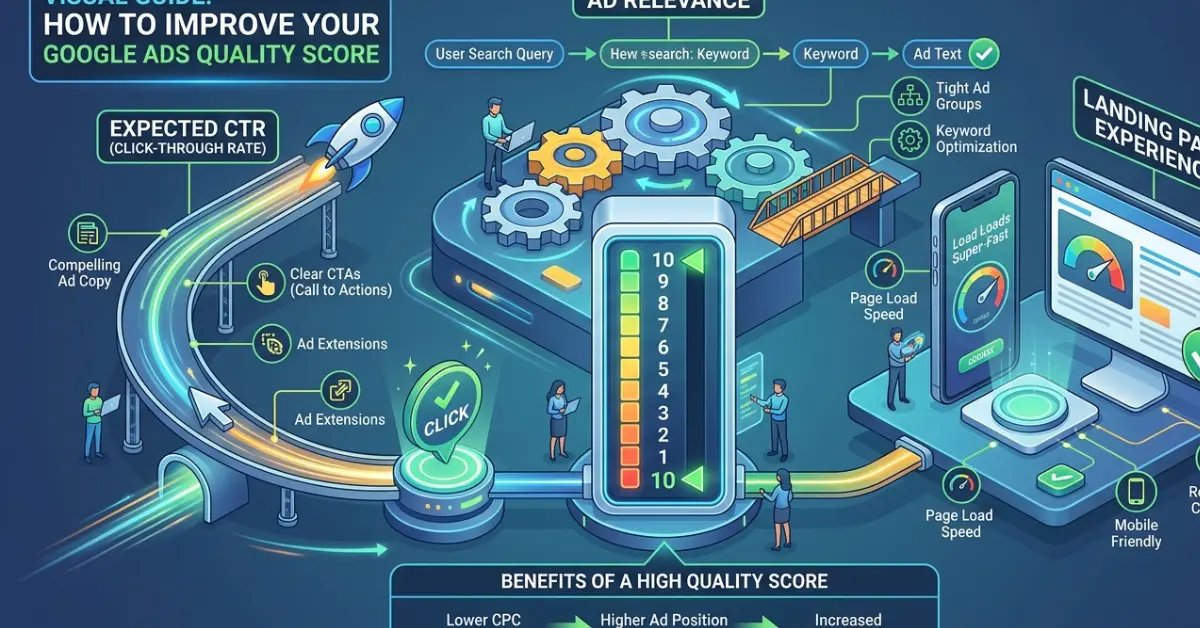
Quality Score is influenced by three key factors: expected click-through rate (CTR), ad relevance, and landing page experience. If any of these areas underperform, your campaign efficiency drops and costs rise. That’s why focusing on alignment between user intent, keyword targeting, and landing page content is critical.
In this guide, you’ll learn How to Improve Quality Score in Google Ads using practical, data-driven strategies. From keyword optimization and ad copy improvements to landing page enhancements and negative keyword usage, every step is designed to help you reduce wasted spend and maximize ROI.
Author Experience (EEAT Signal)
This guide is built on hands-on experience managing and optimizing campaigns across multiple industries, including:
- eCommerce businesses
- Local service providers
- Lead generation funnels
The strategies shared here come from real campaign execution, not assumptions. Each recommendation reflects practical testing, performance analysis, and continuous optimization within Google Ads accounts.
From improving keyword targeting and refining ad copy to enhancing landing page experience and reducing wasted spend, these insights are based on what actually works in live campaigns. The focus remains on measurable outcomes such as higher click-through rates, improved conversion rates, and better return on ad spend.
This experience-driven approach ensures that every tactic discussed in this guide is actionable, reliable, and aligned with current Google Ads best practices.
What Is Quality Score in Google Ads?
Quality Score is a rating from 1 to 10 that measures how relevant and useful your ads are to users. It reflects how well your keywords, ad copy, and landing page align with user intent. A higher score indicates better relevance, which helps reduce costs and improve overall campaign performance.
Understanding How to Improve Quality Score in Google Ads starts with knowing what factors influence it and how Google evaluates your ads.
Google Ads Quality Score Factors
|
Factor |
Description | Impact |
|
Expected CTR |
Likelihood of users clicking your ad | Higher CTR lowers CPC |
| Ad Relevance | Alignment between keyword and ad copy |
Improves targeting and engagement |
| Landing Page Experience | Quality, speed, and usability of the page |
Affects conversions and user satisfaction |
These are the core Google Ads quality score factors that determine how your ads perform in auctions. When these elements work together effectively, your campaigns become more efficient, cost-effective, and competitive.
Why Quality Score Matters
Quality Score is not just a metric—it directly influences how efficiently your campaigns perform. When you focus on How to Improve Quality Score in Google Ads, you create a strong foundation for lower costs and better results.
|
Benefit |
Result |
|
Lower CPC |
Reduced ad costs without increasing bids |
|
Higher Ad Rank |
Better ad positions in search results |
| Better ROI |
More conversions from the same budget |
| Improved Visibility |
Increased impressions and reach |
A higher Quality Score allows your ads to compete more effectively, even against advertisers with larger budgets. Instead of relying only on higher bids, you win by delivering better relevance and user experience.
Real Case Study #1 (Lead Generation)
To understand How to Improve Quality Score in Google Ads, let’s look at a real campaign example from a lead generation business.
Problem
- Quality Score: 5
- High CPC
- Low conversions
The campaign struggled with poor relevance and inefficient targeting, which increased costs without delivering strong results.
Actions Taken
- Switched to long-tail keywords to match user intent
- Implemented a strong negative keywords strategy to filter irrelevant traffic
- Improved landing page speed and usability for better user experience
These changes focused on core Google Ads quality score factors like CTR, ad relevance, and landing page experience.
Results (Within 30 Days)
| Metric | Before | After |
| Quality Score | 5 | 8 |
| CPC | ₹45 | ₹31 |
| CTR | 2.3% | 5.1% |
| Conversions | Baseline | +42% |
Key Takeaway
Small, focused optimizations can create a significant impact. By aligning keywords, ads, and landing pages with user intent, the campaign achieved better performance without increasing budget.
1. Improve Keyword Targeting (Intent First)
One of the most important steps in How to Improve Quality Score in Google Ads is fixing your keyword targeting. Many campaigns fail because they rely on broad, generic keywords that don’t match user intent.
Avoid Broad Keywords
Broad keywords attract irrelevant traffic, which lowers CTR and wastes budget.
Use Long-Tail Keywords
|
Broad Keyword |
Optimized Keyword |
| shoes |
buy running shoes online India |
| marketing |
digital marketing for small business |
Using long tail keywords Google Ads campaigns benefit from improves:
- Relevance (ads match user intent better)
- Click-through rate (CTR)
- Conversion rate
Why This Works
Long-tail keywords target users who already know what they want. This means:
- Less competition
- Higher intent
- Better ad performance
By aligning keywords with user intent, you directly improve ad relevance and expected CTR—two critical Google Ads quality score factors.
2. Use Smart Keyword Match Types
Choosing the right keyword match types Google Ads offers is essential for improving targeting and relevance. If your match types are too broad, your ads may show for irrelevant searches, which lowers CTR and Quality Score.
Keyword Match Types in Google Ads
|
Type |
Use |
|
Broad Match |
Discovery and reach |
| Phrase Match |
Balanced targeting with control |
| Exact Match |
High-intent, precise targeting |
Best Strategy
Use a combination of Phrase Match + Exact Match to increase quality score Google Ads campaigns
- Exact Match helps you target users with strong intent and improves conversion rates
- Phrase Match allows controlled expansion while maintaining relevance
- Limit Broad Match unless you actively optimize search terms
Why This Matters
When your keywords closely match what users search for:
- CTR improves
- Ad relevance increases
- Wasted clicks decrease
This directly supports How to Improve Quality Score in Google Ads by strengthening two key factors: expected CTR and ad relevance.
3. Build a Negative Keywords Strategy
A strong negative keywords strategy is essential if you want to improve targeting and avoid wasting budget on irrelevant clicks. It plays a key role in How to Improve Quality Score in Google Ads by increasing ad relevance and improving CTR.
Example
|
Business |
Negative Keywords |
| Premium product |
cheap, free |
| SaaS |
cracked, download |
Why Negative Keywords Matter
Negative keywords prevent your ads from showing for searches that don’t match your offer. This helps you:
- Filter out low-quality traffic
- Improve click-through rate (CTR)
- Reduce wasted ad spend
- Increase overall campaign efficiency
Pro Tip
Regularly review your search terms report to find irrelevant queries and add them as negative keywords. This continuous refinement improves Google Ads keyword optimization and strengthens your Quality Score over time.
In short, a well-optimized negative keywords list ensures your ads reach the right audience—at the right time.
4. Write High-CTR Ads
Your ad copy directly impacts click-through rate (CTR), which is one of the most important factors in How to Improve Quality Score in Google Ads. If users don’t click your ads, your Quality Score will drop—no matter how good your keywords are.
Example
|
Weak Ad |
Strong Ad |
| Buy Shoes |
Buy Running Shoes Under ₹5000 – Free Delivery |
Tips to Improve CTR
- Add numbers – Prices, discounts, or stats make ads more specific and attractive
- Highlight benefits – Focus on what the user gains (not just what you offer)
- Include a clear CTA – Use action words like Buy Now, Get Quote, Shop Today
Why This Works
High-performing ads:
- Match user intent
- Stand out in search results
- Encourage immediate action
When your ads attract more clicks, your expected CTR improves, which directly boosts your Quality Score and lowers your cost per click.
5. Improve Landing Page Experience
Your landing page is where conversions happen—and where many campaigns fail. Even with great keywords and ads, a poor page experience can lower your performance. That’s why improving this area is critical for How to Improve Quality Score in Google Ads.
Landing Page Experience Google Ads Checklist
|
Element |
Best Practice |
|
Speed |
Load time under 3 seconds |
|
Relevance |
Content matches the ad and keyword intent |
| CTA |
Clear, visible, and action-driven |
| Trust |
Include reviews, testimonials, or proof |
Why This Matters
Google evaluates how useful and user-friendly your landing page is. If users leave quickly or don’t engage, your Quality Score drops.
A well-optimized landing page helps you:
- Improve conversion rates
- Reduce bounce rate
- Increase user engagement
- Strengthen overall campaign performance
Pro Tip
Ensure your landing page headline directly matches your ad copy. This consistency builds trust and improves both ad relevance and landing page experience, two key Google Ads quality score factors.
6. Optimize Mobile Experience
A large share of Google Ads traffic comes from mobile devices. If your page doesn’t perform well on mobile, users leave quickly—and your Quality Score drops. That’s why mobile optimization is essential for How to Improve Quality Score in Google Ads.
Mobile Friendly Landing Page Checklist
| Issue | Fix |
| Slow loading | Compress images and reduce scripts |
| Poor UX | Use responsive design for all screen sizes |
Why This Matters
Mobile users expect speed and simplicity. If your page feels slow or hard to navigate, they won’t stay.
Optimizing mobile experience helps you:
- Reduce bounce rate
- Increase engagement
- Improve conversion rates
- Strengthen landing page experience
Pro Tip
Keep forms short and buttons easy to tap. A clean, fast, and responsive layout improves usability and directly supports better Google Ads quality score optimization.
7. Conversion Rate Optimization
Driving traffic is only half the job. If users don’t convert, your campaign loses efficiency. That’s why conversion rate optimization landing page improvements are critical for How to Improve Quality Score in Google Ads.
Conversion Rate Optimization Landing Page
| Element | Improvement |
| CTA | Use clear, action-focused language (e.g., “Get Quote Now”) |
| Forms | Keep them short and easy to fill |
| Content | Focus on benefits, not just features |
Why This Matters
Google evaluates how users interact with your landing page. If visitors take action, it signals strong relevance and improves your overall campaign performance.
Optimizing for conversions helps you:
- Increase ROI without increasing traffic
- Improve user engagement
- Strengthen landing page experience
- Support better Quality Score over time
Pro Tip
Place your CTA above the fold and repeat it throughout the page. A clear path to action reduces friction and improves conversion rates significantly.
8. Improve Ad Structure
A well-organized campaign structure is essential for improving relevance and performance. Poor structure leads to mismatched ads, lower CTR, and reduced Quality Score. Fixing this is a key step in How to Improve Quality Score in Google Ads.
Poor vs Optimized Structure
|
Poor Structure |
Optimized Structure |
|
Mixed keywords in one ad group |
Tightly themed keyword groups |
| Generic ads for all keywords | Specific ads tailored to each group |
Why This Matters
When your ad groups are tightly focused:
- Ads match keywords more accurately
- CTR improves
- Ad relevance increases
This directly supports Google Ads quality score optimization by aligning keywords, ads, and user intent.
Example Structure
Instead of one ad group with multiple unrelated keywords, create separate groups like:
- “Men Running Shoes”
- “Women Running Shoes”
- “Budget Running Shoes”
Each group should have:
- Specific keywords
- Customized ad copy
- Relevant landing page
Pro Tip
Aim for 5–10 closely related keywords per ad group. This improves targeting precision and helps improve keyword quality score more effectively.
You have not enough Humanizer words left. Upgrade your Surfer plan.
9. Continuous Testing
You cannot improve performance without testing. What works today may not work tomorrow, so ongoing testing is essential for How to Improve Quality Score in Google Ads.
What to Test
|
Element |
What to Measure |
|
Headlines |
Click-through rate (CTR) |
| CTA |
Conversion rate |
Why This Matters
Testing helps you identify what resonates with your audience. Even small changes in headlines or CTA wording can significantly impact performance.
By continuously testing, you can:
- Improve CTR
- Increase conversions
- Eliminate underperforming ads
- Strengthen overall campaign efficiency
Pro Tip
Run at least 2–3 ad variations in each ad group. Pause low-performing ads and scale the ones that deliver better results. This consistent optimization directly supports higher Quality Scores and better ROI.
10. Improve Ad Rank Without Increasing Budget
Many advertisers believe increasing bids is the only way to improve ad position. In reality, you can improve performance by focusing on How to Improve Quality Score in Google Ads, which directly influences ad rank.
Optimization Actions
|
Action |
Result |
|
Better CTR |
Higher ad rank and visibility |
| Better landing page |
Lower CPC and improved conversions |
Why This Matters
Google determines ad rank based on:
- Bid amount
- Quality Score
- Ad extensions
When your Quality Score improves:
- You can outrank competitors with lower bids
- Your ads become more cost-efficient
- Your campaign scales more sustainably
Pro Tip
Focus on improving relevance across keywords, ads, and landing pages instead of increasing budget. A higher Quality Score is the most efficient way to improve both ad rank and ROI.
11. Use Data (Not Guesswork)
Successful campaigns are built on data, not assumptions. If you want to master How to Improve Quality Score in Google Ads, you need to consistently analyze performance metrics and make informed decisions.
Key Metrics to Track
- CTR (Click-Through Rate) – Measures how attractive and relevant your ads are
- Conversion Rate – Shows how effectively your traffic turns into results
- Search Terms – Reveals what users actually search before clicking your ads
Why This Matters
Tracking these metrics helps you:
- Identify high-performing keywords and scale them
- Remove underperforming ads and queries
- Improve targeting and relevance
- Reduce wasted ad spend
Pro Tip
Review your search terms report weekly. Add converting queries as keywords and block irrelevant ones with negative keywords. This continuous optimization strengthens Google Ads keyword optimization and improves your Quality Score over time.
12. Common Mistakes
Even well-structured campaigns can underperform if basic mistakes are not addressed. Avoiding these errors is a key part of How to Improve Quality Score in Google Ads.
Common Mistakes and Their Impact
|
Mistake |
Impact |
|
Broad targeting |
Low CTR and irrelevant traffic |
| No negative keywords |
Wasted ad spend on unqualified clicks |
Why These Mistakes Matter
- Broad targeting brings in users with low intent, which reduces CTR and weakens ad relevance
- Ignoring negative keywords allows your ads to show for irrelevant searches, increasing costs without results
Pro Tip
Regularly refine your targeting and update your negative keyword list. Small adjustments here can significantly improve campaign efficiency and overall Quality Score.
14. Match Search Intent
Understanding user intent is critical for How to Improve Quality Score in Google Ads. When your ads align with what users are actually looking for, your CTR, relevance, and conversions improve significantly.
Search Intent and Strategy
|
Intent |
Strategy |
| Informational | Educate users with helpful, value-driven content |
| Commercial | Highlight benefits, features, and comparisons |
| Transactional | Use strong CTAs and clear offers to drive action |
Why This Matters
When your ad messaging matches search intent:
- Users are more likely to click
- Engagement increases
- Conversion rates improve
This directly boosts expected CTR and ad relevance, which are key Google Ads quality score factors.
Pro Tip
Create separate ad groups based on intent. For example, don’t mix “what is Google Ads” with “hire Google Ads expert” in the same group. Clear intent segmentation leads to better performance and higher Quality Scores.
15. Optimize Search Terms Report
The search terms report is one of the most valuable tools in Google Ads. It shows the actual queries users type before clicking your ads. Using it effectively is a key step in How to Improve Quality Score in Google Ads.
Actions and Benefits
|
Action |
Benefit |
| Add converting terms | Better targeting and higher relevance |
| Remove irrelevant terms | Save budget and reduce wasted clicks |
Why This Matters
Your keywords don’t always match real user searches perfectly. The search terms report helps you:
- Discover high-performing queries
- Find new long tail keywords Google Ads campaigns can benefit from
- Identify irrelevant traffic that lowers CTR
Pro Tip
Review this report regularly:
- Add high-performing queries as Exact or Phrase match keywords
- Add irrelevant queries as negative keywords
This continuous refinement improves Google Ads keyword optimization, increases CTR, and strengthens your overall Quality Score.
15. Improve Account-Level Signals
Quality Score is calculated at the keyword level, but your overall account performance also influences results. Improving these signals is an important step in How to Improve Quality Score in Google Ads.
Key Factors and Fixes
|
Factor |
Fix |
| Low CTR | Improve ad copy and test new headlines |
| Poor engagement |
Refine targeting and match user intent |
Why This Matters
Google evaluates your account history to predict future performance. If your account consistently delivers:
- Higher CTR
- Better engagement
- Relevant traffic
Your ads are more likely to perform better across campaigns.
Pro Tip
Pause or remove consistently underperforming keywords and ads. Keeping only high-quality, relevant elements in your account improves overall efficiency and supports long-term Google Ads quality score optimization.
16. Use Ad Extensions
Ad extensions improve your ad visibility and give users more reasons to click. Using them effectively is a simple but powerful way to support How to Improve Quality Score in Google Ads.
Ad Extensions and Benefits
|
Extension |
Benefit |
|
Sitelinks |
Increase click area and drive more clicks |
| Callouts |
Highlight key benefits and unique selling points |
Why This Matters
Ad extensions make your ads more informative and engaging. When users see more relevant information, they are more likely to click, which improves your CTR.
Higher CTR leads to:
- Better ad relevance
- Improved ad rank
- Lower cost per click
Pro Tip
Use multiple extensions together for maximum impact. Combine sitelinks, callouts, and structured snippets to create a more compelling and visible ad experience.Top of FormBottom of Form
Real Case Study #2 (eCommerce Scaling)
Problem
- Low CTR
- Quality Score: 6
Actions
- Improved ad copy
- Optimized landing page
- Added long-tail keywords
Results (45 Days)
|
Metric |
Before | After |
|
CTR |
3.2% | 6.8% |
|
Quality Score |
6 |
9 |
| CPC | ₹38 |
₹26 |
| Conversion Rate | 2.5% |
4.7% |
How Quality Score Impacts Performance
|
Metric |
Effect |
|
CPC |
Decreases |
| Ad Rank |
Increases |
| ROI |
Improves |
Behavioral Signals Matter
|
Metric |
Fix |
|
High bounce |
Improve relevance |
| Low engagement |
Better content |
Internal Linking Strategy
Link to:
- Google Ads strategy
- CPC reduction guide
- Landing page optimization
Trusted References
- Google Ads Help (Quality Score)
- Google Search Central (Page Experience)
Final Thoughts
Improving Quality Score is not a trick—it’s a system.
When you combine:
- Smart keyword targeting
- Strong ad copy
- Optimized landing pages
You create campaigns that scale profitably.
Frequently Answered Questions
1. What is a good Quality Score in Google Ads?
A Quality Score between 7 and 10 is considered good. It indicates strong ad relevance, high expected CTR, and a well-optimized landing page.
2. How to improve Quality Score in Google Ads quickly?
To quickly improve Quality Score:
- Use long-tail keywords
- Improve ad relevance
- Add negative keywords
- Optimize landing page speed and content
3. Does Quality Score affect cost per click (CPC)?
Yes, a higher Quality Score lowers your CPC. Google rewards relevant ads with lower costs and better ad positions.
4. What are the main factors affecting Quality Score?
The three main Google Ads quality score factors are:
- Expected CTR
- Ad relevance
- Landing page experience
5. How long does it take to improve Quality Score?
You can see improvements within a few days to a few weeks, depending on how quickly you optimize keywords, ads, and landing pages
6. Do negative keywords improve Quality Score?
Yes, a strong negative keywords strategy removes irrelevant traffic, improves CTR, and increases overall ad relevance.
7. Do landing pages affect Quality Score?
Yes, landing page experience is a major factor. A fast, relevant, and user-friendly page improves both conversions and Quality Score.
8. Which keyword match type is best for improving Quality Score?
Exact match and phrase match are best because they improve targeting accuracy and increase ad relevance.
9. Can a low Quality Score increase ad costs?
Yes, a low Quality Score leads to higher CPC and lower ad rank, making your campaigns less efficient.
10. How often should I optimize my Google Ads campaigns?
You should review and optimize campaigns weekly by analyzing CTR, search terms, and conversion data.



1 thought on “How to Improve Quality Score in Google Ads (Complete 2026 Guide)”