
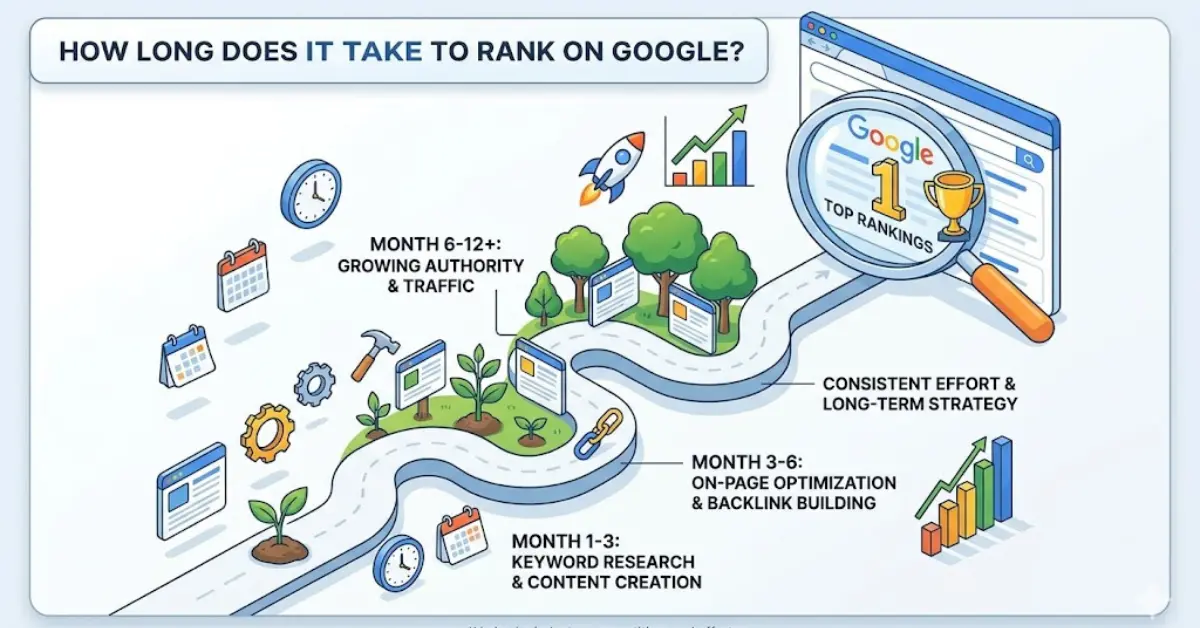
What Does “Ranking on Google” Really Mean
When people ask how long it takes to rank on Google, they usually mean appearing on the first page of Google search results for a specific keyword.
This involves:
- Getting your page indexed
- Building relevance for a keyword
- Gaining authority and trust
- Competing with existing pages
Ranking is not a single step. It is a process.
How Long Does It Take to Rank on Google
The honest answer: it typically takes 3 to 6 months to see initial results, and 6 to 12 months to achieve strong rankings.
This estimate comes from multiple industry studies and real world observations:
- Ahrefs found that only about 5.7 percent of new pages rank in the top 10 within one year
- Most high ranking pages are over two years old
- Competitive keywords often take longer than a year
Quick Breakdown
- 0 to 3 months: Indexing and early visibility
- 3 to 6 months: Gradual ranking improvements
- 6 to 12 months: Consistent traffic growth
- 12 months and beyond: Authority driven rankings
If someone promises results in a few weeks, they are either guessing or using risky tactics.
How Long Does SEO Take to Work for a New Website
A new website starts with zero authority. That makes the timeline longer.
Typical SEO Timeline for New Sites
Month 1 to 2
- Website gets indexed
- Minimal traffic
- Basic keyword visibility
Month 3 to 4
- Some long tail keywords start ranking
- Early organic traffic appears
Month 5 to 8
- Authority begins to build
- Rankings improve for mid level keywords
Month 9 to 12
- Stable traffic growth
- Potential first page rankings
According to Google Search Central, indexing alone can take days to weeks. Ranking takes longer because Google evaluates quality and trust over time.
How Long Does Google Take to Index and Rank
Indexing and ranking are two different stages.
Indexing Timeline
Google can index pages within:
- A few hours for high authority sites
- A few days to weeks for new sites
Ranking Timeline
Ranking depends on:
- Content quality
- Competition
- Backlinks
- User engagement
Even after indexing, ranking improvements may take months.
Why Does SEO Take So Long to Rank
SEO takes time because search engines prioritize trust and consistency.
Key Reasons
- Trust Building Takes Time
Google evaluates domain credibility. New domains need to prove reliability. - Content Evaluation Process
Google tests how users interact with your page. If users stay longer and engage, rankings improve. - Competition Levels
You compete with established websites that have years of authority. - Algorithm Complexity
Google uses hundreds of ranking signals. You cannot optimize everything overnight. - Backlink Acquisition
Quality links take time to earn. You cannot rush genuine authority.
In simple terms, SEO works like reputation in real life. You cannot build it instantly.
How Long Does It Take to Rank on Google First Page
Ranking on the first page depends heavily on keyword difficulty.
Low Competition Keywords
- 2 to 4 months
- Suitable for new websites
- Often long tail keywords
Medium Competition Keywords
- 4 to 8 months
- Requires solid content and some backlinks
High Competition Keywords
- 8 to 18 months or more
- Needs strong authority and consistent effort
If you target competitive keywords too early, you will likely see slow progress. A smarter strategy focuses on long tail queries first.
SEO Results Timeline for Small Businesses
Small businesses often work with limited budgets. That changes the timeline slightly.
Realistic SEO Timeline
Month 1 to 3
- Technical fixes
- Keyword research
- Content creation
Month 3 to 6
- Initial rankings
- Traffic begins
- Local SEO improvements
Month 6 to 12
- Noticeable traffic growth
- Lead generation starts
After 12 Months
- Strong ROI potential
- Consistent organic traffic
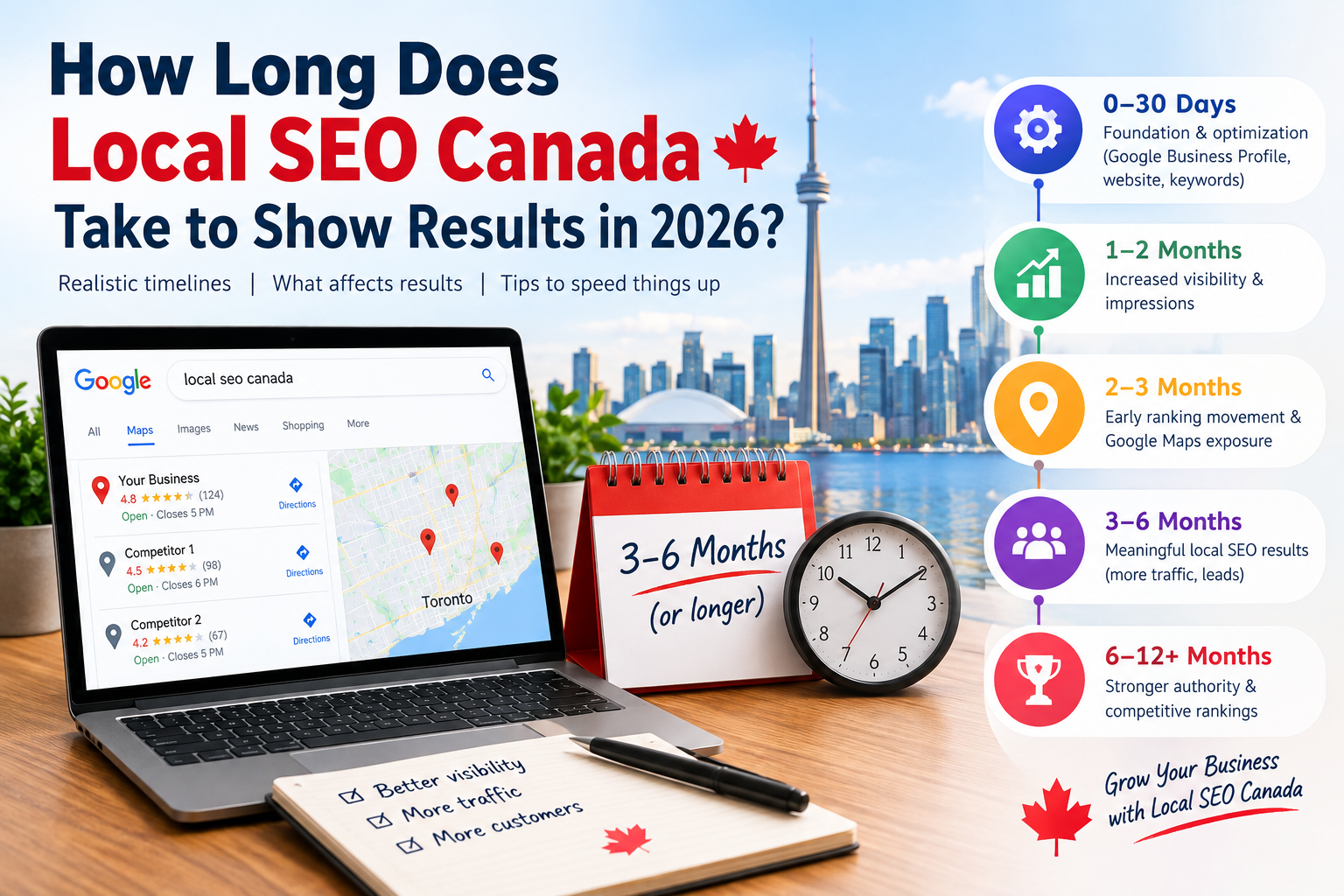
Local businesses can sometimes see faster results due to lower competition in local search.
How Long Does It Take to Rank Without Backlinks
You can rank without backlinks, but it is harder and slower.
What Happens Without Backlinks
- Rankings depend only on content relevance
- Growth remains limited
- Competitive keywords become nearly impossible
Timeline Without Backlinks
- Low competition keywords: 4 to 8 months
- Medium competition: 8 to 12 months or more
Backlinks act as trust signals. Without them, Google has fewer reasons to rank your page higher.
Understanding the SEO Timeline
SEO is not a straight line. It looks more like a curve.
Phase 1: Foundation
- Technical SEO
- Keyword research
- Content setup
Phase 2: Growth
- Content expansion
- Link building
- User engagement
Phase 3: Authority
- Consistent rankings
- Higher traffic
- Brand trust
Most people quit during Phase 1 because results seem slow. That is where patience becomes your competitive advantage.
Key Google Ranking Factors That Affect Timeline
Content Quality
Content quality is one of the most important ranking factors that directly affects how fast your page ranks on Google. High-quality content helps search engines understand your page better and increases user engagement signals.
Your content should be relevant to the target keyword and fully satisfy the user’s search intent. It should provide clear, useful, and actionable information rather than generic explanations. Well-performing pages usually cover a topic in depth and answer multiple related questions within the same article.
Content must also be easy to read and properly structured. Using headings like H2 and H3, short paragraphs, and simple language improves readability and keeps users engaged longer. Studies show that pages ranking in the top 10 often contain 1500 to 2500 words of well-structured content.
Google prioritizes user-focused content that demonstrates expertise, experience, authority, and trust. If your content is thin, outdated, or lacks value, it will take significantly longer to rank.
Keyword Competition
Keyword competition plays a major role in determining how quickly you can rank on Google. It reflects how many websites are already targeting the same keyword and how strong those competitors are.
High competition keywords are usually dominated by authoritative websites with strong backlink profiles and aged domains. Ranking for these keywords can take 8 to 12 months or more. On the other hand, low competition keywords, especially long-tail keywords, can rank within 2 to 4 months with proper optimization.
Choosing the right keywords is a critical strategy. Instead of targeting highly competitive terms immediately, it is more effective to start with low to medium difficulty keywords. This allows your website to gain initial traction, build authority, and gradually compete for more competitive keywords over time.
Using long-tail keywords also improves your chances of ranking faster because they are more specific and align better with user intent.
Domain Authority
Domain authority represents the overall trust and credibility of your website in the eyes of search engines. Websites with higher authority tend to rank faster because Google already trusts their content.
Older domains with a strong history of publishing quality content and earning backlinks usually perform better in search results. These websites get indexed faster and often rank new pages more quickly compared to newer sites.
For new websites, building domain authority takes time. It requires consistent content publishing, internal linking, and acquiring high-quality backlinks. In the early stages, even well-optimized content may take longer to rank because the domain has not yet established trust.
As your domain authority grows, your ranking speed improves, and you will start seeing faster results for new content.
Backlinks
Backlinks are one of the strongest ranking signals in Google’s algorithm. They act as votes of confidence from other websites, indicating that your content is valuable and trustworthy.
High-quality backlinks from relevant and authoritative websites can significantly accelerate your ranking timeline. In many cases, a single strong backlink from a high-authority site can have more impact than dozens of low-quality links.
Websites with a strong backlink profile tend to rank faster because Google sees them as more credible sources. Backlinks also help search engines discover your content more quickly, which improves indexing speed.
However, it is important to focus on quality over quantity. Spammy or irrelevant backlinks can harm your rankings and delay your progress. A consistent and natural link-building strategy is essential for long-term SEO success.
User Experience
User experience is a critical factor that influences how Google ranks your content. Search engines analyze how users interact with your page to determine its quality and relevance.
Important user behavior signals include click-through rate, time spent on the page, and bounce rate. If users click on your page and stay longer to read your content, it signals to Google that your content is valuable. This can lead to improved rankings over time.
A well-designed page with clear navigation, fast loading speed, and engaging content improves user experience. Using visuals, proper formatting, and easy-to-read text can also increase user engagement.
If users quickly leave your page or fail to find useful information, your rankings may drop. Improving user experience not only helps with rankings but also increases conversions and overall website performance.
Technical SEO
Technical SEO ensures that your website is properly optimized for search engine crawling and indexing. Even high-quality content may struggle to rank if your site has technical issues.
Key technical factors include page speed, mobile friendliness, site structure, and crawlability. Slow-loading pages can negatively impact both user experience and rankings. Google prioritizes websites that load quickly and perform well on mobile devices.
Broken links, duplicate content, and poor URL structures can also affect your rankings. Ensuring that your website is free from technical errors helps search engines understand and index your content more efficiently.
Core Web Vitals, which measure loading performance, interactivity, and visual stability, are also important ranking signals. Optimizing these factors can improve both ranking speed and overall visibility.
A technically sound website provides a strong foundation for all your SEO efforts and allows your content to perform at its full potential.
Organic Traffic Growth Timeline
Traffic does not grow instantly. It compounds over time.
Typical Growth Pattern
- First 3 months: Almost zero traffic
- 3 to 6 months: Slow increase
- 6 to 12 months: Noticeable growth
- After 12 months: Exponential potential
SEO works like investing. Early patience leads to long term gains.
Search Engine Ranking Reality Check
Let us be realistic.
- SEO is not instant
- There is no guaranteed timeline
- Results depend on strategy and execution
If your competitors invest heavily in SEO, your timeline increases.
Common Mistakes That Delay Rankings
Avoid these mistakes if you want faster results.
- Targeting High Competition Keywords Too Early
Start small. Build momentum first.
- Ignoring Content Quality
Thin content will not rank.
- Lack of Consistency
SEO needs regular updates and publishing.
- No Backlink Strategy
Ignoring links slows authority growth.
- Technical Issues
Even great content fails if your site has technical problems.
Practical Tips to Speed Up SEO Results
You cannot shortcut SEO, but you can optimize your process.
Focus on Long Tail Keywords
They rank faster and bring targeted traffic.
Publish High Quality Content Consistently
Consistency signals reliability to Google.
Improve Internal Linking
Helps distribute authority across pages.
Optimize for User Intent
Match what users actually search for.
Build Quality Backlinks
Focus on relevance over quantity.
A Simple Analogy to Understand SEO
Think of SEO like growing a tree.
- You plant the seed with content
- You water it with optimization
- You nurture it with backlinks
You will not see a tree the next day. But if you stay consistent, it will grow stronger over time.
Final Thoughts
So, how long does it take to rank on Google?
- New websites: 6 to 12 months for strong results
- Low competition keywords: 2 to 4 months
- Competitive keywords: 8 to 18 months or more
SEO rewards patience, strategy, and consistency. It is not about quick wins. It is about sustainable growth.
If you focus on real value, trusted data, and user intent, rankings will follow.
And yes, if you were hoping for overnight success, SEO politely says, “Not today.”
Frequently Asked Questions
1. How long does it take for SEO to show results?
SEO usually takes around 3 to 6 months to show initial improvements in rankings and traffic. For more competitive keywords and consistent growth, it can take 6 to 12 months depending on your website authority, content quality, and backlink profile.
2. Can you rank on Google in 30 days?
Ranking on Google in 30 days is possible, but only for low-competition keywords. For medium to high competition keywords, it generally takes several months of consistent SEO efforts to achieve strong rankings.
3. Why does SEO take so long to work?
SEO takes time because search engines need to evaluate multiple factors such as content quality, backlinks, user engagement, and domain trust. Google prioritizes reliable and authoritative websites, which cannot be built overnight.
4. How long does it take for a new website to rank on Google?
A new website typically takes 6 to 12 months to rank well on Google. Since new domains have little to no authority, they need time to build trust, publish quality content, and acquire backlinks.
5. Does backlink building speed up ranking on Google?
Yes, backlink building can significantly speed up rankings if the links are high-quality and relevant. Backlinks act as trust signals for Google and help improve your website’s authority faster.
6. How long does Google take to index a new page?
Google can index a new page within a few hours to a few weeks. The speed depends on factors like website authority, crawl frequency, and how well your site is optimized.
7. What factors affect how fast you rank on Google?
Several factors influence ranking speed, including keyword competition, content quality, domain authority, backlinks, and technical SEO. A well-optimized site with strong content and links tends to rank faster.
8. How long does it take to rank for competitive keywords?
Ranking for competitive keywords can take anywhere from 6 to 18 months or even longer. These keywords require strong domain authority, high-quality content, and a solid backlink strategy.
9. Can you rank on Google without backlinks?
It is possible to rank without backlinks, but only for low-competition keywords. Without backlinks, your growth will be slower and it will be difficult to compete for high-volume keywords.
10. What is the fastest way to rank on Google?
The fastest way to rank on Google is by targeting low-competition keywords, creating high-quality content, optimizing for user intent, improving internal linking, and building relevant backlinks consistently.



1 thought on “How Long Does It Take to Rank on Google? (SEO Timeline 2026 + Data)”