
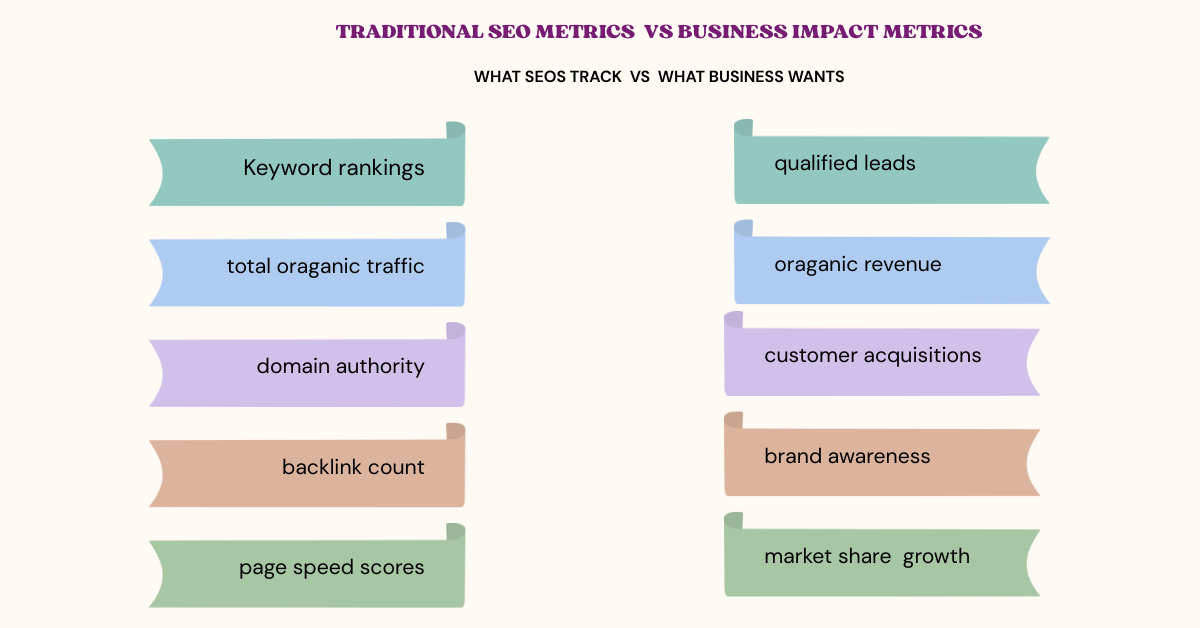
What SEOs Track vs What Business Wants: Bridging the Digital Marketing Gap
Introduction
Have you ever felt a disconnect between your SEO team and your business goals? You’re not alone. Many companies face this exact issue — the SEO team tracks metrics like organic traffic, keyword rankings, and backlinks, while business leaders focus on revenue, leads, and ROI.
This gap between what SEOs track vs what business wants is one of the biggest challenges in digital marketing today. It’s like two people speaking different languages — both want success but define it differently.
In this post, we’ll explore what SEOs track, what businesses actually want, and most importantly, how to align both worlds to create a win-win strategy. By the end, you’ll know how to measure SEO in a way that truly supports business growth.
What SEOs Track: The Metrics That Matter to Marketers
SEO professionals live and breathe metrics. Their job is to optimize websites to rank higher, get more visibility, and drive traffic. Here are the key metrics SEOs track to measure their success:
1. Organic Traffic
-
Definition: The number of visitors who come to your website through unpaid search results.
-
Why it matters: It shows how visible your website is on Google and how well your content is performing organically.
-
SEO focus: Increasing organic sessions through keyword optimization and content strategies.
2. Keyword Rankings
-
Definition: Where your website appears on search engines for specific keywords.
-
Why it matters: Higher rankings mean more clicks and visibility.
-
SEO focus: Tracking progress for target keywords and identifying opportunities for improvement.
3. Click-Through Rate (CTR)
-
Definition: The percentage of users who click on your site after seeing it in search results.
-
Why it matters: A high CTR shows your titles and meta descriptions are appealing.
-
SEO focus: Crafting engaging titles and snippets to attract clicks.
4. Bounce Rate & Dwell Time
-
Definition: Bounce rate measures how many people leave after viewing one page; dwell time measures how long they stay.
-
Why it matters: Low engagement can signal poor content or user experience.
-
SEO focus: Improving content quality, readability, and user experience.
5. Backlinks
-
Definition: Links from other websites to your own.
-
Why it matters: Google views backlinks as votes of credibility.
-
SEO focus: Earning high-quality backlinks through outreach and valuable content.
6. Core Web Vitals
-
Definition: Google’s metrics for page speed, interactivity, and visual stability.
-
Why it matters: They affect both user experience and ranking.
-
SEO focus: Enhancing site performance and technical health.
7. Domain Authority (DA)
-
Definition: A score (0–100) that predicts how well a website will rank.
-
Why it matters: A higher DA usually means better SEO potential.
-
SEO focus: Building authority through content and backlinks.
In short, SEOs focus on visibility, performance, and user experience metrics that improve rankings and traffic.
But while these metrics matter, they don’t always translate directly to business outcomes — and that’s where the disconnect begins.
What Businesses Want: The Metrics That Drive Growth
Business owners and executives often have a very different perspective. They care less about rankings and traffic — and more about tangible results that impact revenue.
Here’s what businesses actually want from SEO:
1. Leads and Conversions
-
Definition: The number of users who take a desired action (buy, sign up, contact, etc.).
-
Business focus: Quality leads that turn into paying customers.
-
Why it matters: It directly affects the bottom line.
2. Return on Investment (ROI)
-
Definition: The financial return compared to what was spent on SEO.
-
Business focus: Every dollar invested should generate measurable growth.
-
Why it matters: SEO is seen as a cost only when ROI is unclear.
3. Customer Lifetime Value (CLV)
-
Definition: The total revenue a business can expect from one customer.
-
Business focus: Acquiring long-term, loyal customers.
-
Why it matters: SEO should attract the right customers, not just any traffic.
4. Brand Visibility & Authority
-
Definition: How well-known and trusted a brand is in its market.
-
Business focus: Building a strong brand that stands out.
-
Why it matters: Authority leads to customer trust and higher conversion rates.
5. Competitive Advantage
-
Definition: Outranking competitors and capturing more market share.
-
Business focus: Staying ahead in search visibility and audience engagement.
-
Why it matters: SEO success should position the business as a leader in its niche.
Businesses want outcomes, not just outputs. They care about growth, profit, and sustainable success — things that SEO metrics alone don’t always What SEOs Track vs What business Wants reflect.
The Disconnect: Why SEO and Business Goals Often Clash
Despite good intentions, SEOs and business teams often misalign due to three main reasons:
1. Different Success Metrics
-
SEOs track traffic and rankings.
-
Businesses track revenue and sales.
Result? SEO might claim success while the business sees no growth.
2. Lack of Communication
SEOs may not fully understand the company’s goals, while decision-makers may not grasp how SEO works. This communication gap causes misaligned What SEOs Track vs What business Wants strategies.
3. Short-Term vs Long-Term Thinking
SEO is a long game, but businesses often want immediate results. This mismatch creates tension and unrealistic expectations.
Bridging the Gap: Aligning SEO Goals with Business Objectives
To succeed, SEO professionals must shift their mindset — from tracking technical KPIs to proving business impact. Here’s how to align what SEOs track vs what business wants:
1. Start with Business Goals
Before launching any SEO campaign, ask:
-
What are the company’s growth targets?
-
What products or services need visibility?
-
What customer actions drive revenue?
SEO strategy should be built around these answers.
2. Map SEO Metrics to Business KPIs
For example:
| SEO Metric | Business Metric | Connection |
|---|---|---|
| Organic traffic | Leads | More traffic = more lead opportunities |
| Keyword rankings | Sales | Higher visibility = more conversions |
| CTR | Revenue | Better engagement = more qualified visitors |
| Backlinks | Brand authority | More links = stronger brand trust |
This mapping helps stakeholders see how SEO drives results they care about.
3. Use Conversion Tracking
Implement tools like:
-
Google Analytics 4 (GA4) for user behavior and conversion paths
-
Google Tag Manager to track clicks, form fills, and downloads
-
CRM integration to connect SEO traffic with actual leads and sales
This data shows the real business value of SEO traffic.
4. Focus on Bottom-of-Funnel Keywords
While informational keywords bring traffic, transactional keywords bring buyers.
Example:
-
“How to optimize SEO” → informational
-
“Best SEO agency for eCommerce” → buyer intent
Target keywords that align with purchase intent.
5. Report What Matters
Instead of long reports full of metrics, focus on:
-
Conversions from organic traffic
-
Cost-per-lead (CPL) from SEO
-
SEO-driven revenue growth
Make it easy for business leaders to see ROI at a glance.
Real-World Example: When Alignment Creates Success
Imagine a SaaS company that was obsessed with ranking for “free project management tools.” Their SEO team celebrated top rankings and 50K monthly visitors.
But conversions were low — the traffic wasn’t converting because most visitors wanted free tools, not paid plans.
When the team aligned their strategy with the business goal (paid subscriptions), they shifted focus to keywords like “best project management software for What SEOs Track vs What business Wants startups.”
Result:
-
Traffic dropped by 20%,
-
But leads increased by 80%,
-
And monthly revenue doubled.
This is the perfect example of bridging the gap between what SEOs track vs what business wants.
Key Takeaways: How to Align SEO and Business Success
# Speak the same language: Translate SEO metrics into business impact.
# Focus on ROI: Always link SEO actions to measurable revenue outcomes.
# Set shared goals: Create KPIs that matter to both SEO teams and executives.
# Report strategically: Simplify data and highlight financial results.
# Prioritize user intent: Focus on attracting qualified leads, not just traffic.
Conclusion
The divide between what SEOs track vs what business wants doesn’t have to exist. When SEO professionals focus on metrics that matter to business leaders — like conversions, revenue, and ROI — they prove real value and strengthen What SEOs Track vs What business Wants trust.
SEO is not just about ranking higher on Google — it’s about driving meaningful business growth.
So, the next time you report SEO results, go beyond impressions and clicks. Show how your efforts contribute to the company’s success. What SEOs Track vs What business Wants When SEOs and businesses align, everyone wins.
Frequently Asked Questions (FAQ)
1. What does “What SEOs Track vs What Business Wants” mean?
It refers to the difference between what SEO professionals measure (like traffic, rankings, and backlinks) and what business leaders care about (like revenue, sales, and ROI). Bridging this gap ensures that SEO strategies directly support business growth.
2. Why do SEOs and businesses often have different goals?
SEOs focus on improving website performance and visibility, which are technical and marketing-based goals. Businesses, on the other hand, prioritize financial outcomes like leads and profits. The mismatch happens when SEO metrics don’t clearly connect to revenue-driven goals.
3. How can SEOs align their goals with business objectives?
SEOs can align with business goals by:
-
Understanding the company’s core objectives
-
Focusing on conversion-driven keywords
-
Tracking leads and ROI, not just traffic
-
Reporting business impact instead of technical stats
4. What SEO metrics are most important for businesses?
The most valuable SEO metrics for businesses include:
-
Organic conversions (leads or sales)
-
Cost per lead (CPL)
-
Return on investment (ROI)
-
Customer lifetime value (CLV)
-
Revenue generated from organic traffic
These metrics show how SEO contributes to real growth.
5. Should businesses only focus on revenue and ignore SEO metrics?
No. While revenue is the ultimate goal, SEO metrics like rankings, backlinks, and user engagement help achieve that goal. A balanced approach — tracking both SEO performance and business outcomes — gives a complete picture of success.
6. What tools can help measure SEO and business impact together?
You can use:
-
Google Analytics 4 (GA4): To track conversions and traffic sources
-
Google Tag Manager: For event tracking
-
CRM tools (like HubSpot or Salesforce): To link SEO leads with sales data
-
Google Search Console: To monitor search visibility and keyword performance
7. Can SEO really improve a company’s revenue?
Absolutely! When SEO is aligned with business goals, it can significantly increase qualified traffic, generate more leads, and boost sales. The key is targeting high-intent keywords and tracking conversions, not just clicks.
8. How long does it take to see business results from SEO?
Typically, SEO takes 3–6 months to show measurable impact, depending on your industry, competition, and strategy. However, aligning SEO with business goals can shorten that timeline by focusing on high-value actions early.
9. What happens if SEO goals don’t align with business goals?
If SEO and business goals aren’t aligned, you may see high traffic but low conversions. This leads to wasted resources and frustration for both marketers and decision-makers. Alignment ensures every SEO effort drives real business growth.
10. What’s the best way to present SEO results to business leaders?
Keep it simple and meaningful. Instead of showing dozens of metrics, focus on:
-
Leads generated from SEO
-
Conversion rate improvements
-
Organic revenue growth
-
ROI on SEO investment
This helps business leaders see the real value of SEO in financial terms.


Nice
Your point of view caught my eye and was very interesting. Thanks. I have a question for you.
I don’t think the title of your article matches the content lol. Just kidding, mainly because I had some doubts after reading the article. https://accounts.binance.com/ar-BH/register?ref=S5H7X3LP
Thanks for sharing. I read many of your blog posts, cool, your blog is very good.
Your article helped me a lot, is there any more related content? Thanks! https://accounts.binance.info/si-LK/register-person?ref=LBF8F65G
Your article helped me a lot, is there any more related content? Thanks!
Can you be more specific about the content of your article? After reading it, I still have some doubts. Hope you can help me.
Thanks for sharing. I read many of your blog posts, cool, your blog is very good. https://www.binance.com/register?ref=QCGZMHR6
Thanks for sharing. I read many of your blog posts, cool, your blog is very good.
I don’t think the title of your article matches the content lol. Just kidding, mainly because I had some doubts after reading the article.
Your article helped me a lot, is there any more related content? Thanks!
Your point of view caught my eye and was very interesting. Thanks. I have a question for you.
Your point of view caught my eye and was very interesting. Thanks. I have a question for you.
I don’t think the title of your article matches the content lol. Just kidding, mainly because I had some doubts after reading the article. https://accounts.binance.info/register/person?ref=JW3W4Y3A
Thank you for your sharing. I am worried that I lack creative ideas. It is your article that makes me full of hope. Thank you. But, I have a question, can you help me?
Your article helped me a lot, is there any more related content? Thanks! https://www.binance.bh/register?ref=GGYHGRE
Thank you for your sharing. I am worried that I lack creative ideas. It is your article that makes me full of hope. Thank you. But, I have a question, can you help me?
Thank you for your sharing. I am worried that I lack creative ideas. It is your article that makes me full of hope. Thank you. But, I have a question, can you help me?
Can you be more specific about the content of your article? After reading it, I still have some doubts. Hope you can help me. https://accounts.binance.bh/register/person?ref=IXBIAFVY
Thanks for sharing. I read many of your blog posts, cool, your blog is very good.
Thanks for sharing. I read many of your blog posts, cool, your blog is very good. https://accounts.binance.bh/register/person?ref=GGYHGRE
Thank you for your sharing. I am worried that I lack creative ideas. It is your article that makes me full of hope. Thank you. But, I have a question, can you help me?