
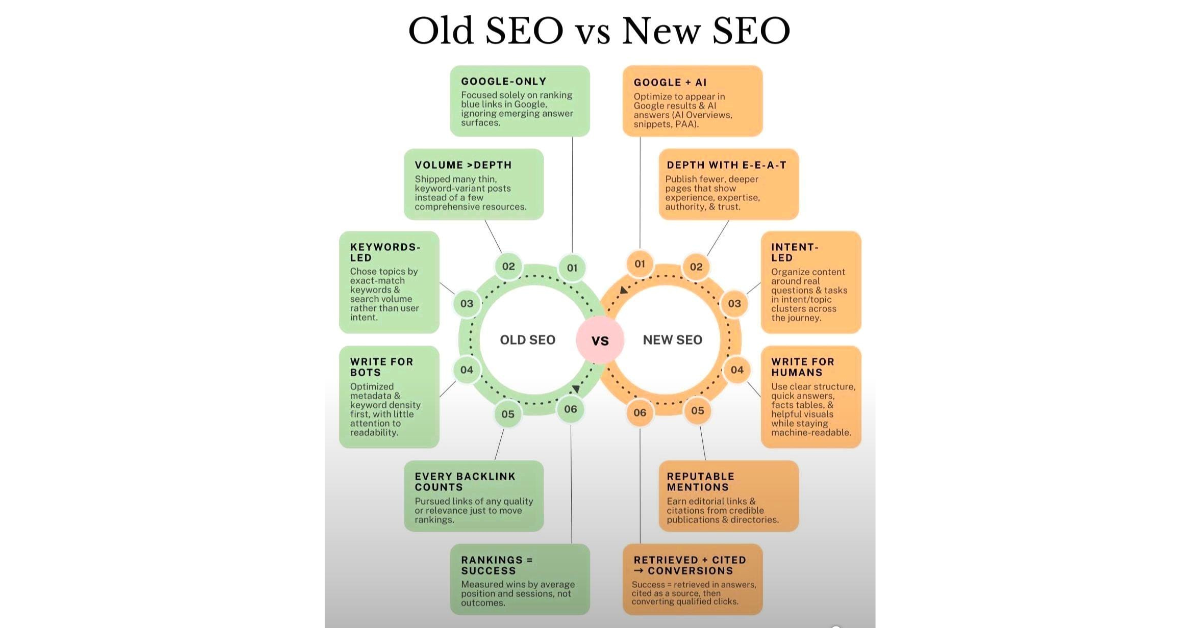
Introduction: From Keyword Stuffing to Smart Blogging
Remember the days when ranking on Google was as simple as cramming a few keywords into your blog post? Those were the old SEO days — when quantity mattered more than quality, and search engines weren’t as smart as they are now.
Fast forward to 2025, and everything about blogging has transformed. Today, Google’s algorithms are intelligent, readers are more selective, and SEO has evolved into a blend of art and science.
This post dives deep into old SEO vs new SEO blogging, showing you how blogging strategies have shifted, what practices to leave behind, and how to master modern SEO for sustainable growth.
Whether you’re a beginner or an experienced blogger, this guide will help you understand:
-
How SEO blogging used to work
-
What has changed in recent years
-
What strategies you must use in 2025 to stay ahead
Let’s explore how blogging has evolved from keyword-heavy content to meaningful, intent-based storytelling.
What Was Old SEO Blogging All About?
Back in the early days of blogging, SEO (Search Engine Optimization) was simplistic but also manipulative. Bloggers discovered that Google’s early algorithms relied heavily on keywords and backlinks, so they optimized their blogs accordingly.
1. Exact-Match Keywords Were Everything
In the old SEO era, keyword matching was the golden rule. Bloggers would repeat the same phrase over and over again — often in unnatural ways.
Example:
“If you want to learn old SEO vs new SEO blogging, this old SEO vs new SEO blogging guide will help you understand old SEO vs new SEO blogging…”
This repetition might sound ridiculous now, but it used to work.
2. Keyword Stuffing Was Common
The more times a keyword appeared, the higher your blog ranked — or so people believed. As a result, content often looked robotic and lacked genuine value for readers.
3. Focus on Quantity Over Quality
Old SEO blogging was all about publishing as many posts as possible, regardless of depth or usefulness. The idea was: more pages = more traffic.
4. Backlink Farming
Instead of earning backlinks naturally, bloggers would submit their links to directories, low-quality blogs, and link exchanges — often leading to spammy results.
5. Meta Keywords and Hidden Tags
Bloggers filled meta tags with dozens of keywords, even those unrelated to their post, just to attract random clicks.
The Evolution: From Old SEO to New SEO Blogging
So, what caused this massive shift?
The answer: Google got smarter.
With updates like Panda, Penguin, Hummingbird, RankBrain, and BERT, Google began prioritizing user intent, content quality, and authenticity over keyword density.
Today’s SEO blogging focuses on creating valuable, user-centric content that actually solves readers’ problems.
Let’s break down how new SEO blogging works in 2025.
New SEO Blogging: What Works Today
1. Focus on Search Intent
Modern SEO revolves around why someone is searching — not just what they type.
There are three primary types of intent:
-
Informational: The user wants to learn something (e.g., “what is SEO blogging”).
-
Transactional: The user wants to buy or subscribe.
-
Navigational: The user is looking for a specific website or brand.
Example:
Instead of targeting “SEO blogging tips,” focus on “how to start SEO blogging in 2025” — which matches informational intent and attracts the right audience.
2. Content Quality and E-E-A-T
E-E-A-T stands for Experience, Expertise, Authoritativeness, and Trustworthiness.
Google evaluates blogs based on these signals. That means your post should:
-
Demonstrate personal experience or industry knowledge.
-
Be well-researched and supported by credible sources.
-
Be clear, well-structured, and helpful to readers.
Pro Tip: Add examples, screenshots, and case studies to make your content more authentic and engaging.
3. Natural Keyword Placement
Unlike old SEO, where stuffing was common, new SEO blogging prioritizes natural, conversational use of keywords.
You can use:
-
Primary keyword: old SEO vs new SEO blogging
-
Related terms: “modern SEO blogging,” “SEO strategies 2025,” “SEO for blogs,” “content optimization.”
Google’s AI understands synonyms and context, so you don’t have to repeat the same phrase dozens of times.
4. Long-Form, Valuable Content
In 2025, comprehensive guides outperform short posts.
Readers (and Google) prefer blogs that dive deep into a topic, answering every related question.
For example, this 3000+ word guide on old SEO vs new SEO blogging performs better than a 600-word summary.
Why? Because it provides more context, authority, and depth.
5. Visuals and Readability
New SEO blogging isn’t just about text — it’s about experience.
Use:
-
Images, infographics, and charts to simplify complex ideas.
-
Short paragraphs (2–3 lines max).
-
Headings and bullet points to improve readability.
-
White space to keep readers comfortable on mobile screens.
6. Mobile and Voice Search Optimization
Most users now read blogs on their phones or ask smart assistants like Siri and Google Assistant.
Optimize your blog for:
-
Mobile responsiveness
-
Conversational keywords (“how do I start SEO blogging?”)
-
Fast loading speed
These factors improve your SEO and reduce bounce rates.
Old SEO vs New SEO Blogging: Key Differences
| Aspect | Old SEO Blogging | New SEO Blogging |
|---|---|---|
| Keyword Strategy | Exact-match, repetitive | Intent-based, natural use |
| Content Focus | Search engines | Real users |
| Length & Depth | Short and superficial | Long, detailed, helpful |
| Backlinks | Quantity over quality | Quality, relevant backlinks |
| User Experience | Ignored | Essential (UX, speed, mobile) |
| Meta Tags | Keyword stuffing | Optimized meta titles/descriptions |
| Voice Search | Not considered | Highly important |
| E-E-A-T Factors | Not required | Crucial for authority |
Examples of Old vs New SEO Blogging in Action
Old SEO Example:
“SEO blogging tips are important. SEO blogging tips help you rank higher. Use SEO blogging tips to write better SEO blogs.”
New SEO Example:
“If you’re new to blogging, SEO might feel confusing — but it’s simpler than it seems. By focusing on user intent, writing helpful content, and using natural keywords, you can attract readers who genuinely value your insights.”
Notice how the new version feels human, conversational, and valuable.
How to Transition from Old SEO to New SEO Blogging
Ready to modernize your blogging strategy? Follow these steps:
Step 1: Audit Your Old Content
Use tools like Ahrefs, SEMrush, or Google Search Console to identify outdated posts that still get traffic.
Update them with:
-
Fresh stats and data
-
Better formatting
-
Relevant internal links
-
Updated keywords
Step 2: Optimize for Intent
Rewrite content to match what users are actually looking for.
Ask yourself:
-
“Is this post solving a real problem?”
-
“Does it answer follow-up questions clearly?”
-
“Would I share this if I found it online?”
Step 3: Build Topic Clusters
New SEO blogging thrives on interlinked content.
Create pillar pages (comprehensive guides) and link to smaller supporting posts.
This improves authority and internal SEO structure.
Step 4: Embrace Multimedia
Add images, charts, and videos to improve engagement.
Google loves blogs that keep readers longer on the page.
Step 5: Improve User Experience
Check your site’s:
-
Loading speed
-
Mobile design
-
Navigation structure
Use Google’s Core Web Vitals to analyze and fix performance issues.
Step 6: Monitor & Update Regularly
SEO is not “set and forget.”
Revisit your content every few months to:
-
Add new insights
-
Replace outdated information
-
Check for broken links
-
Optimize meta titles and headings
SEO Blogging in 2025: What the Future Holds
The SEO landscape continues to evolve with AI integration, voice search, and content personalization.
Here’s what you can expect going forward:
-
AI-Powered SEO Tools: Platforms like SurferSEO, Frase, and ChatGPT (for research) will help you optimize faster.
-
Search Intent Becomes Deeper: Google’s AI will understand context and emotion.
-
Content Authenticity Matters: Real voices and human stories will outperform generic AI-written blogs.
-
Experience-Driven Ranking: Google will favor blogs that show first-hand expertise.
In short, blogging success will depend on trust, authority, and genuine connection — not keyword tricks.
Conclusion: The New Era of SEO Blogging
The shift from old SEO vs new SEO blogging marks a fundamental change — from chasing algorithms to serving people.
In the old SEO world, keywords ruled.
In the new SEO era, quality content, user intent, and experience reign supreme.
If you want your blog to thrive in 2025 and beyond:
# Write for humans first, search engines second.
# Focus on clarity, depth, and trust.
# Keep learning — SEO never stops evolving.



Thanks for sharing. I read many of your blog posts, cool, your blog is very good. https://www.binance.info/ar-BH/register?ref=S5H7X3LP
I don’t think the title of your article matches the content lol. Just kidding, mainly because I had some doubts after reading the article.
Thanks for sharing. I read many of your blog posts, cool, your blog is very good.
I don’t think the title of your article matches the content lol. Just kidding, mainly because I had some doubts after reading the article. https://accounts.binance.com/es/register-person?ref=RQUR4BEO
Thanks for sharing. I read many of your blog posts, cool, your blog is very good.
Clientemx, my go-to for online entertainment. Easy to register and start having fun with different games. See for yourself at clientemx